
The Teacher Portal: Who Checks the Machine, and What They Earn for It
Generated content is only as good as its review, and review only happens if someone is paid to do it. QuizByt pays teachers in credits, which convert to money. Here is exactly how the queue, the approvals and the payouts work.
The short version
- A teacher-written quiz publishes when two different teachers approve it. One rejection sends it back, because one person seeing a real problem should be enough to stop it.
- A monthly quiz an administrator assigns to a named teacher publishes on that teacher's single approval, since the administrator already chose who should check it.
- Approving earns one credit, paid immediately. Having your own quiz published earns three, paid at publication rather than at submission.
- Fifty credits is the minimum redemption, converted at a rate set per country, and paid out by an administrator.
Any serious claim about AI-generated educational content rests on a single question: who reads it before a child does? It is easy to answer with the word teachers and leave it there. The harder and more useful version is how the queue is built, how many people must agree, what stops a bad actor, and what the reviewer gets for the twenty minutes.
The queue
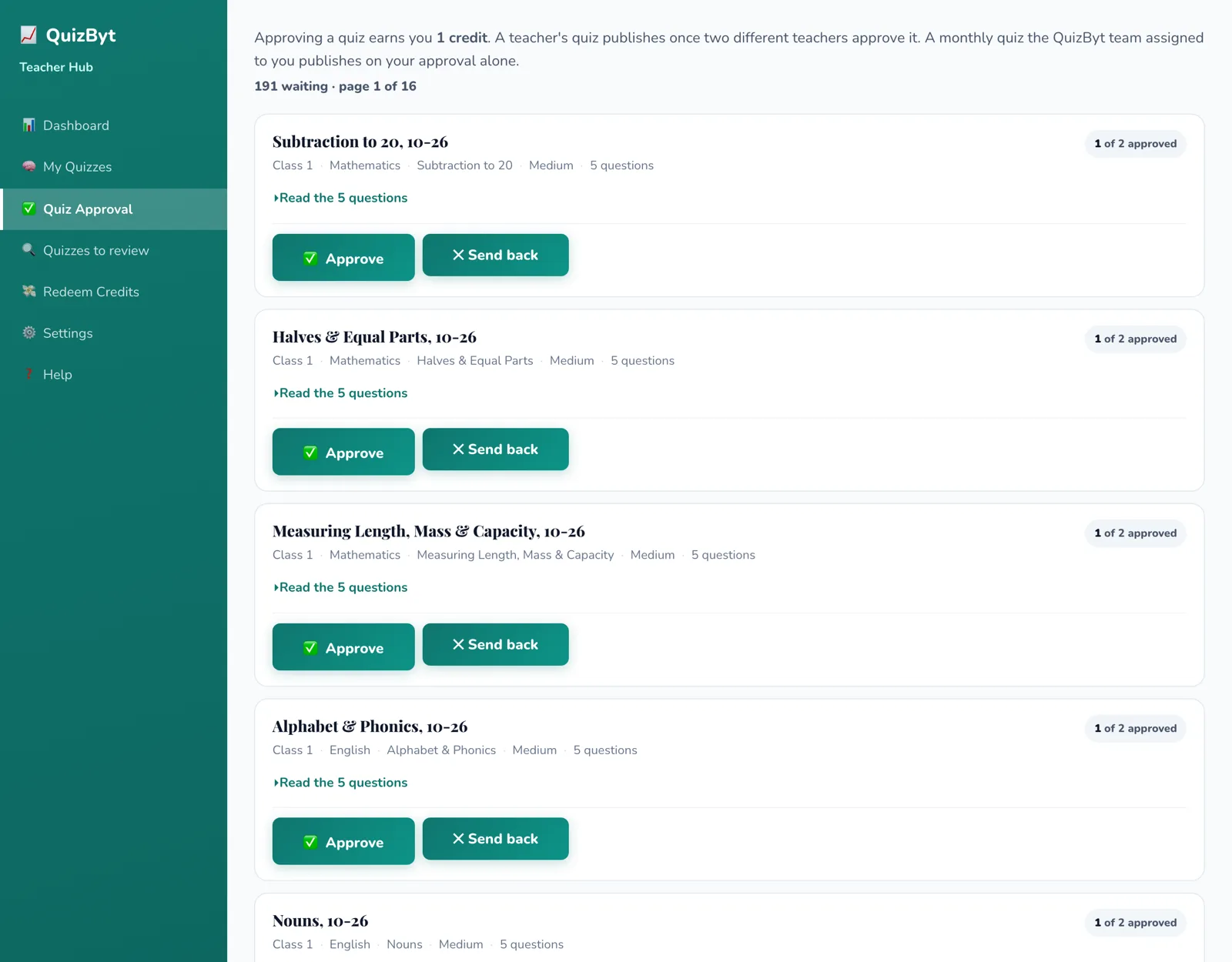
A teacher who turns on reviewing in their settings gets a queue of quizzes awaiting approval. Their own submissions are excluded. Anything they have already decided on is excluded, so the list is always work that is actually theirs to do.
Each item shows the whole quiz, not a summary: every question, every option, every marked answer, every fill-in answer, every ordering and every grouping. For picture questions the picture is drawn, because approving a question about base-ten blocks without seeing the blocks is not approving anything.
How many approvals
There are two paths, and they differ because the situations differ.
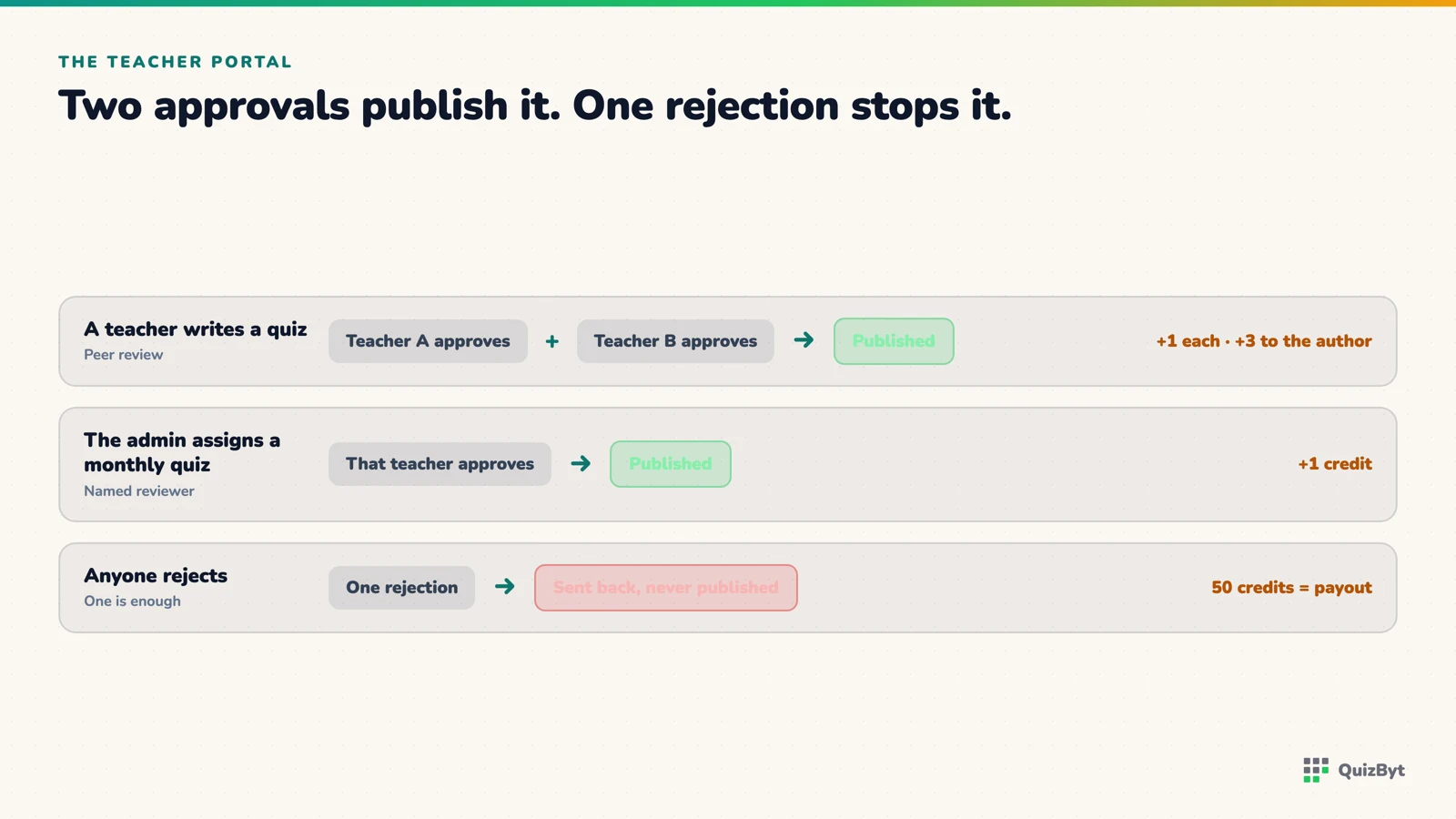
A quiz written by a teacher publishes when two different teachers approve it. Two is a considered number. One is a single point of failure for content going to thousands of children. Three slows the queue to the point where nothing moves and the review becomes a formality people click through.
A quiz an administrator assigns to a named teacher publishes on that teacher's single approval. The second opinion already happened: an administrator looked at the batch and chose who should check this part of it. Asking for another signature after that is ceremony. Assigned quizzes sort to the top of that teacher's queue and are marked as theirs.
In both paths, one rejection is enough to stop a quiz. Agreement should be hard and objection should be easy, because the costs are not symmetric.
What it pays
- Approving a quiz: one credit, paid at the moment you decide, regardless of whether your approval is the one that publishes it. The work is reading the quiz, and you did that either way.
- Having your own quiz published: three credits, paid when it reaches publication, not when you submit it. Submitting fifty weak quizzes earns nothing at all.
- Student engagement with your quiz: a further credit for each ten questions answered by students on their first attempt at it. Replays by the same student never count twice.
The timing of the writing reward is the part worth dwelling on. Pay at submission and you have built a machine for generating volume. Pay at publication and the reward is attached to the only thing anyone wants, which is content good enough to pass two colleagues.
Turning credits into money
From fifty credits a teacher can request a redemption. The conversion rate is set per country with a fallback for countries not listed, because fifty credits should mean something comparable in Lahore and in Dubai. Requesting holds the credits immediately, so the same balance cannot be claimed twice, and an administrator processes the payout. A rejected request returns the credits in full.
This is a manual payout model and we would rather describe it plainly than dress it up as something automated. The amounts are modest. The thing being bought is attention from a qualified person, and it is better to pay something real for that than to ask for professional judgement as a favour.
The queue that does not fit this model
Some content never reaches peer review. A keyword filter runs over every submitted question, and anything it flags goes to an administrator-only queue instead. Not rejected: routed. A Class 9 biology question can look alarming in a word list and be entirely correct in its chapter. That decision belongs to an administrator rather than to whichever volunteer is next in the queue.
Why this is the part we talk about most
The generation is the impressive-looking half and the easy half. Anyone can call an API. What is hard, and what decides whether a platform is trustworthy, is building the layer where qualified people look at the output, having enough of them, making it worth their time, and making sure nothing routes around them.
So when we say experts check the content, this is what that sentence is standing on: a queue, two approvals or one named one, a rejection that outranks an approval, a filter that escalates rather than blocks, and credits that convert to money. The mechanisms that keep unreviewed content out of a student's hands are described separately.
Questions parents ask
Who can review?
Any school teacher or independent teacher with a QuizByt account who turns reviewing on in their settings. A teacher who has been assigned quizzes by an administrator sees them whether or not they opted in.
Can I review my own quiz?
No. Your own submissions are excluded from your queue, and you cannot approve a quiz you wrote.
Why three credits for writing and one for approving?
Writing a quiz takes longer than reading one. The writing reward is paid when the quiz publishes rather than when it is submitted, so submitting weak content in volume earns nothing.
How do credits become money?
At fifty credits or more you can request a redemption. The rate depends on your country, with a fallback rate for countries not listed, and an administrator processes the payout. Requesting holds the credits straight away so a request cannot be made twice.
Responses
Sign in to join the conversation. Responses are open to people with a QuizByt account, which is how we keep this a place you would let your child read.
Loading responses…
Lessons that talk, quizzes that mark themselves, games that make kids think
QuizByt is matched to your child's class. Classes 1–10 and Cambridge O Level. Every subject opens with a free lesson, quiz and worksheet, no account needed.
 The Hours a School Gets BackCounted honestly, with the hours it adds as well as the hours it removes. Where a department of six actually saves time, where it does not, and the one place the saving is larger than anyone expects.Read the article →
 What the AI Is Not Allowed to DecideA list of decisions a language model never makes on QuizByt, and the mechanism that stops it in each case. Not policies and promises, but constraints in the code.Read the article →
 What the Monthly Report Actually Tells YouFour numbers and one recommendation. Here is how to read each of them, and which one is the early warning most parents miss.Read the article →