
The Hours a School Gets Back
Counted honestly, with the hours it adds as well as the hours it removes. Where a department of six actually saves time, where it does not, and the one place the saving is larger than anyone expects.

The short version
- The biggest saving is marking, because it goes to zero for anything the engine scores, and it was never a judgement task to begin with.
- Building practice material drops a lot but not to zero, since reviewing a draft takes real time and is the step that must not be rushed.
- Reporting changes shape rather than shrinking: the figures already exist, so the work becomes reading them instead of assembling them.
- The system adds work in the first fortnight, in setup and in learning what a weak generated question looks like.
Every education platform promises to save teachers time, and almost none of them say where, how much, or what they cost in return. So here is the count as we see it from the school portal, including the parts that go the other way.
Marking: this one is real
A quiz scores itself the moment a student finishes. Not later that evening, not on Thursday. The result is recorded against the topic, so a class result reads as "eleven of twenty-eight missed both questions on electric circuits" rather than as a column of percentages.
For a teacher setting weekly practice to four classes, this is the largest single block of time the system removes, and it is removed completely rather than reduced. It is also the block that was never teaching. Nobody became a teacher to tick boxes against an answer key.
The exception is written work uploaded as a file. Those are marked by hand, with a score out of a maximum the teacher sets. We have no interest in pretending a model can mark an essay to a standard a school should accept.
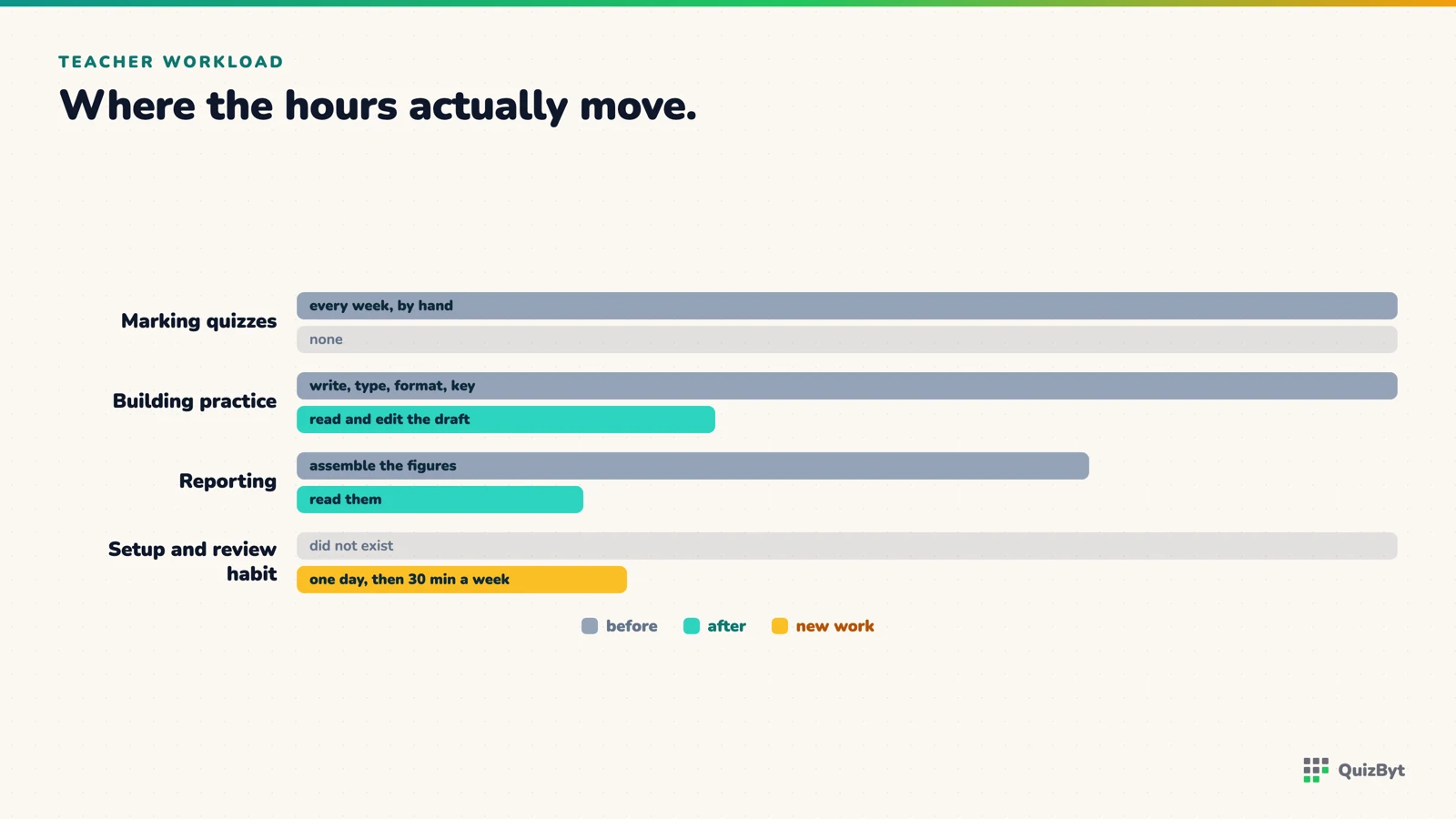
Building practice material: a large drop, not a disappearance
Before: a teacher writes a worksheet or a set of questions, types it, formats it, prints it, and writes an answer key.
After: they upload the chapter, get a draft, read every question, change the ones that need changing, and publish.
The drop is substantial and it is not to zero, because reading twenty drafted questions properly takes half an hour and that half hour is the part that must not be cut. Our own count from teachers doing this regularly is that three or four questions in twenty get rewritten or deleted on a good chapter, more on a vague one. If a teacher ever finds themselves changing nothing, that is a sign to read more carefully, not a sign of a better model.
Reporting: changes shape
The figures a head of department wants at the end of a term, which topics a cohort is weak on, which students are behind, how a class is trending, already exist as a consequence of students doing the work. Nobody assembles them.
So the saving here is not hours of spreadsheet work removed so much as hours of spreadsheet work that never need to start. The remaining work is reading and deciding, which is the work that was always worth doing.
Administration: front-loaded
Setting up a school is a day. Classes, teachers, branches, students imported from a spreadsheet, coupon codes for onboarding. That day is written up step by step.
After that the administrative load is close to flat. Adding a student is a row. Adding a class is a form. The ongoing cost is small because the data model matches how a school is actually shaped, with branches and classes and sections, rather than a flat list of users.
What it adds
Three things, and a school that is not told about them in advance feels misled.
The first fortnight. Setup, importing students, deciding which classes allow retries, which allow hints, which are full-screen for tests. Real work, done once.
Learning to review. The first few generated quizzes take longer to check than they should, because reading for subtle wrongness is a skill. It gets quick. It never gets free.
The monthly batch. If a school uses the monthly generated quizzes, someone publishes them. The review desk allows publishing a whole month at once, so this is minutes rather than hours, but it is not zero and it should not be.
The place the saving is bigger than expected
Not marking. Intervention.
The old loop is: set work, collect it, mark it over the weekend, hand it back on Tuesday, notice on Wednesday that a third of the class has the same misconception, re-teach it on Friday. Nine days from problem to fix, and by then the class has moved on and the misconception has set.
The new loop is: set work, read the topic breakdown that afternoon, start tomorrow's lesson with the ten minutes that fixes it. One day.
That is not a time saving in any spreadsheet sense. The teacher works the same hours. But eight days of a class carrying a misunderstanding is a real cost that nobody has ever put on a timesheet, and removing it is the change teachers mention first when we ask what actually improved.
Questions parents ask
Will this reduce our staffing?
That is not what it does, and we would not claim it. It moves hours from producing and marking towards teaching and intervention.
How long does setup take?
A school of a few hundred students, with classes, teachers and students imported from a spreadsheet, is a day of work for one administrator.
What is the hidden cost?
Review discipline. The time saving only holds if teachers actually read generated drafts. A school that skips review saves more hours and loses the thing that made it defensible.
Does marking really go to zero?
For quizzes, yes. For uploaded written work, no. Those are marked by hand with a score out of a maximum the teacher sets.
Responses
Sign in to join the conversation. Responses are open to people with a QuizByt account, which is how we keep this a place you would let your child read.
Loading responses…
Lessons that talk, quizzes that mark themselves, games that make kids think
QuizByt is matched to your child's class. Classes 1–10 and Cambridge O Level. Every subject opens with a free lesson, quiz and worksheet, no account needed.
 When the AI Gets It Wrong: Five Failure Modes We Plan ForGenerated questions fail in patterns, and the patterns repeat. Here are the five we see most, what each one looks like on the page, and what catches it before a child does.Read the article →
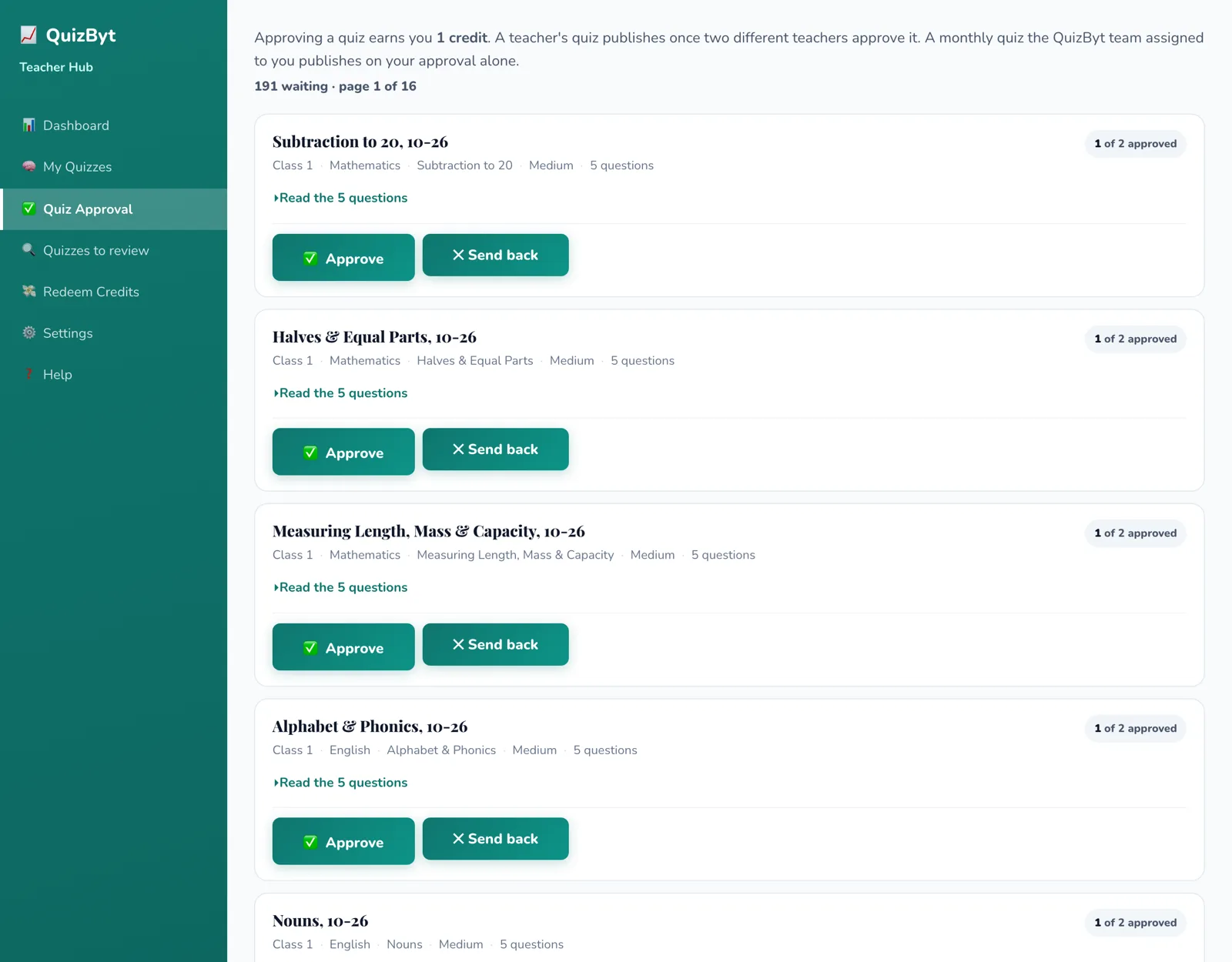 The Teacher Portal: Who Checks the Machine, and What They Earn for ItGenerated content is only as good as its review, and review only happens if someone is paid to do it. QuizByt pays teachers in credits, which convert to money. Here is exactly how the queue, the approvals and the payouts work.Read the article →
 Lessons Opened Versus Lessons FinishedThe gap between those two numbers is the clearest early warning a parent gets, and it shows up weeks before scores start to fall.Read the article →