
Timed, Retried and Reviewed: The Exam Rules a School Can Set on QuizByt
Fifteen, ten or seven minutes by difficulty. One attempt or three. Answers held back until the last try. Hints on or off, read-aloud on or off. Every rule, and where it is set.
The short version
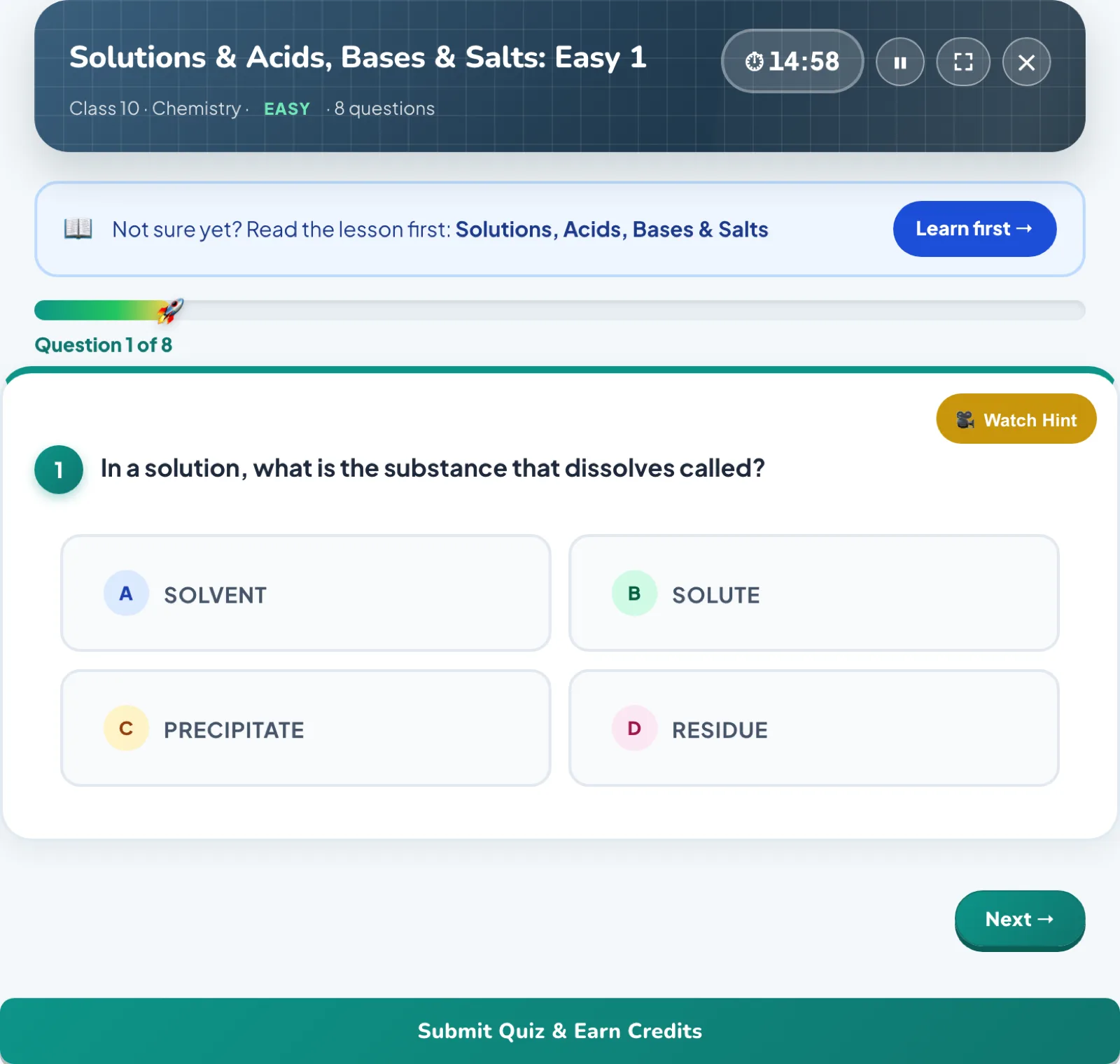
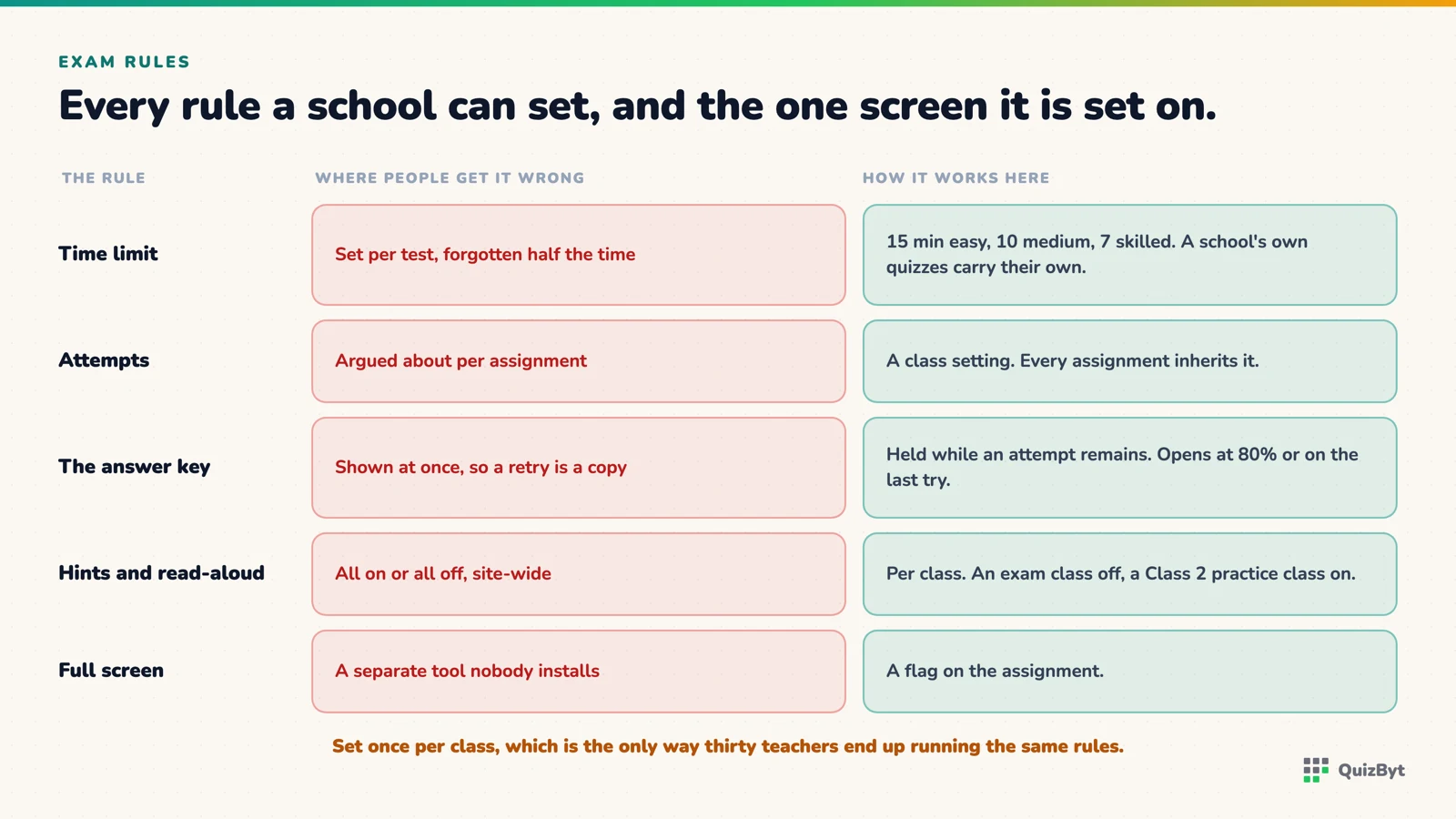
- Timers follow difficulty: 15 minutes for easy, 10 for medium, 7 for skilled, and a school's own quizzes carry their own limit.
- Attempts are a class setting: the school decides whether retries are allowed and how many, once per class, and every assignment inherits it.
- The answer key is held back while an attempt remains, and opens at 80% or on the last try, so a retry is a retry, not a copy.
- Hints and read-aloud are per class too, so an exam class can have both off while a Class 2 practice class has both on.
An exam is a quiz with rules. This is the full list of rules a school can set on QuizByt, where each one lives, and the reasoning behind the ones that are not obvious.
Time
Every catalogue quiz has a timer that follows its difficulty: 15 minutes for easy, 10 for medium, 7 for skilled. The harder the questions, the less time, because the skilled level is meant to test fluency, not only knowledge. A school's own quizzes, whether written by hand or drafted from a PDF, carry their own limit, set when the quiz is created.
Attempts
This is a class setting, not a per-exam one, and that is deliberate. Each class in the portal carries allow retries and maximum attempts. The school sets them once; every assignment to that class inherits them. A practice class might allow three attempts; an exam class allows one. A teacher assigning a test never has to remember to switch retries off, because the class already knows.
For individual (non-school) students the same rule comes from their plan: one attempt on free and trial, two on monthly and yearly, three on Premium.
The answer key
The result page holds the correct answers back while an attempt remains, and shows them on the final attempt or when the student scores 80% or above. The reason is simple: if the answers appeared after attempt one, attempt two would be a copying exercise. Holding them back is what makes a retry a genuine second try. On a one-attempt exam class, students see the full review as soon as they finish, every correct answer with the reason behind it.
There is a deliberate exception for high scores: a student who reaches 80% can review even with a retry remaining, because at that point the review is learning, not leakage.
Hints and read-aloud
Both are class settings. Read-aloud is on by default for Class 1 to 5, where a child may not yet be able to read the question; hints exist for practice. An exam class can have both off while a Class 2 class has both on, and neither has to be thought about per assignment.
Full-screen mode
An assignment can be flagged full-screen, which keeps the student on the exam page for the duration. It is not surveillance and does not claim to be. It removes the easy tab-switch, which for an in-class test on school devices is what a school actually wants.
Marking
Quizzes mark themselves the moment a student finishes. For written work (an essay, working, a diagram) an assignment can instead take an uploaded file, which the teacher marks by hand against a maximum score they set. Both kinds land in the same student record, so an exam that is half multiple-choice and half written is two assignments and one report.
Where the questions come from
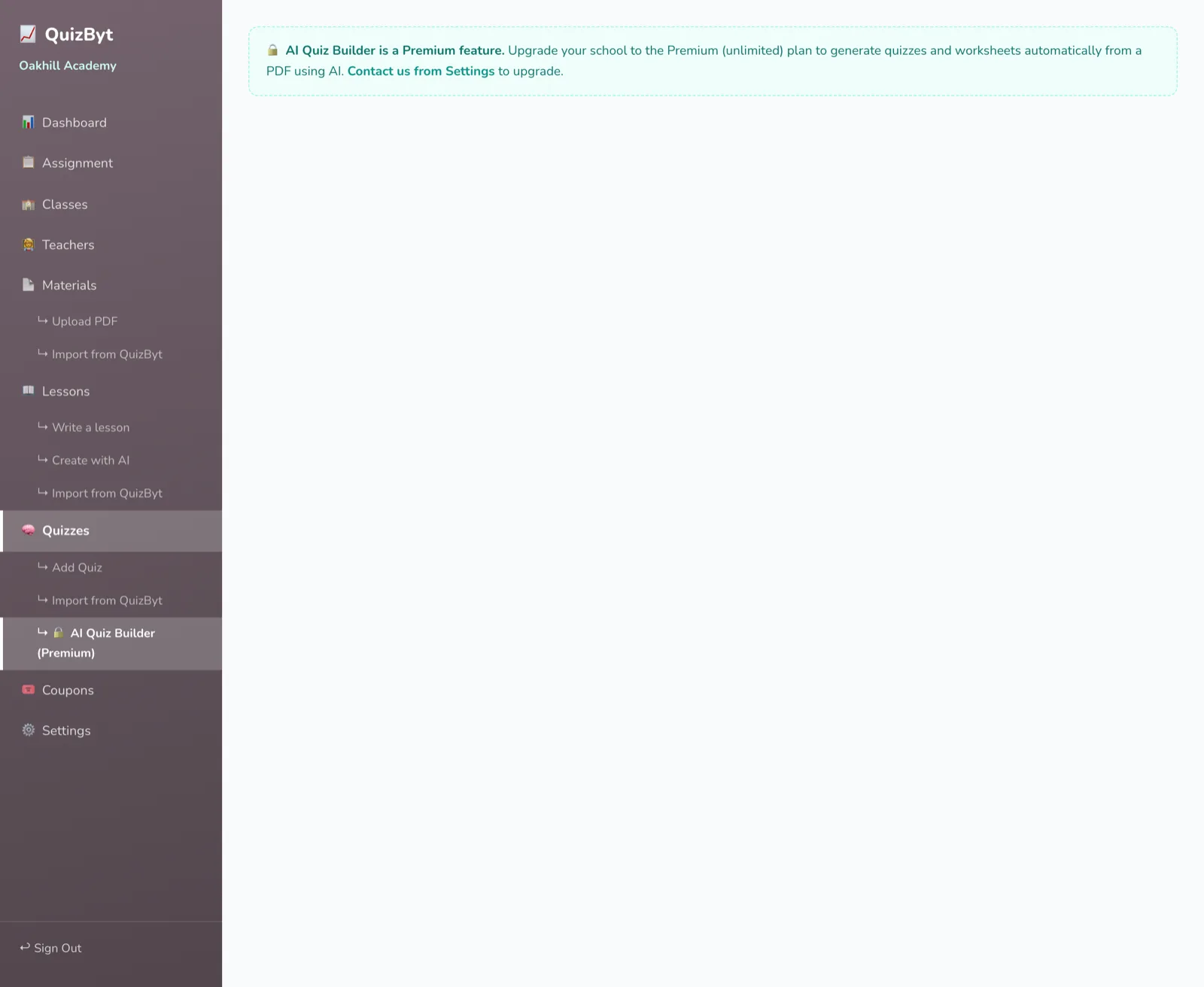
Three places: written by hand in the portal, imported from the QuizByt catalogue, or on the Premium plan drafted from a PDF with the AI builder and edited before use. That last route, and why the editing is not optional, is in an online exam system built from a PDF and a teacher's approval.
Questions parents ask
How long does a student get for a quiz?
It depends on difficulty: 15 minutes for easy, 10 for medium, 7 for skilled. A school's own quizzes, including AI-drafted ones, carry their own limit.
Can students see the answers after an exam?
The answer key is held back while a retry remains and opens at 80% or on the final attempt. In a one-attempt exam class, students see it once they finish.
Who decides the number of attempts?
The school, per class. Each class has its own allow-retries and maximum-attempts settings, and every assignment to that class inherits them.
Can questions be read aloud in an exam?
Only if the class's read-aloud setting is on. It is designed for Class 1–3 practice and can be switched off for an exam class.
Responses
Sign in to join the conversation. Responses are open to people with a QuizByt account, which is how we keep this a place you would let your child read.
Loading responses…
Lessons that talk, quizzes that mark themselves, games that make kids think
QuizByt is matched to your child's class. Classes 1–10 and Cambridge O Level. Every subject opens with a free lesson, quiz and worksheet, no account needed.
 An Online Exam System for a School, Built From a PDF and a Teacher's ApprovalUpload the chapter, get twenty questions at the level you asked for, edit them, assign them with a time limit. What the AI does, what the teacher still does, and why the second part is not optional.Read the article →
 From Chapter to Exam in an Afternoon: What AI Does and What the Teacher Still DoesA walk through one afternoon: chapter uploaded at two, draft at five past, twenty questions read and four rewritten by half past, exam assigned by three, results by four. Who did what.Read the article →
 Shapes and Colours: A Toddler's First Sixteen Words of MathematicsCircle, square, triangle, red, blue, yellow. These look like vocabulary. They are actually the labels a child needs before they can describe, compare or sort anything at all.Read the article →