
Shapes and Colours: A Toddler's First Sixteen Words of Mathematics
Circle, square, triangle, red, blue, yellow. These look like vocabulary. They are actually the labels a child needs before they can describe, compare or sort anything at all.
The short version
- Shape and colour words are the labels a child needs before they can compare, sort or describe anything, vocabulary first, reasoning after.
- Teach a shape by its defining property, not its picture: a triangle is anything with three straight sides, not only the pointy one in the book.
- Children who only ever see equilateral triangles often reject long thin ones as "not triangles".
- Eight clearly different colours beat twenty-four subtle ones at this age.
"Bring me the big red book." Four words of instruction and a toddler has to do three separate jobs: find the books, filter by colour, filter by size. Every one of those filters needs a word attached to it. Without the words, the sentence is noise.
That is what shapes and colours really are at two and three. Not a cute early topic, the labelling system that everything else gets built on.
Why vocabulary has to come first
A child cannot sort by a property they cannot name. They cannot tell you why the odd one out is odd, cannot describe a pattern, cannot follow "put the round ones here". Ask a two-year-old which one does not belong and if they have no word for "red", the honest answer is that they cannot tell you even if they can see it.
This is the reason our shapes and colours lesson comes before the patterns game and odd one out in the Kindergarten playground rather than after them. The games are built out of the same eight shapes and eight colours the lesson teaches, so that a child is reasoning about things they already have names for.
Teach the property, not the picture
Here is the single most common mistake, and almost every picture book makes it.
Children are shown one triangle. It is equilateral, it sits flat on its base, it points up. They learn "triangle" means that. Then they meet a long thin triangle, or one lying on its side, and confidently say it is not a triangle. They are not being stupid. They learned exactly what they were shown.
The fix is to teach the rule out loud, every time: a triangle is anything with three straight sides. Then show:
- A tall thin one.
- A wide flat one.
- One upside down.
- One tilted at an angle.
Count the sides aloud each time (one, two, three) and let the child count with you. The counting is what turns a picture into a definition.
The same applies to squares versus rectangles (a square is a rectangle with all four sides the same), and to circles versus ovals (a circle is the same distance round from the middle; an oval is squashed).
Eight colours, not twenty-four
Colour is easier than shape, and the temptation is to add more. Resist it. At this age a child needs a small set that are unmistakably different from each other:
red, blue, yellow, green, orange, purple, pink, brown.
Turquoise, maroon and beige are not a stretch goal, they are a distraction, and a child who is unsure whether something is blue or turquoise learns to distrust their own judgement. Eight is enough to describe almost anything in a house.
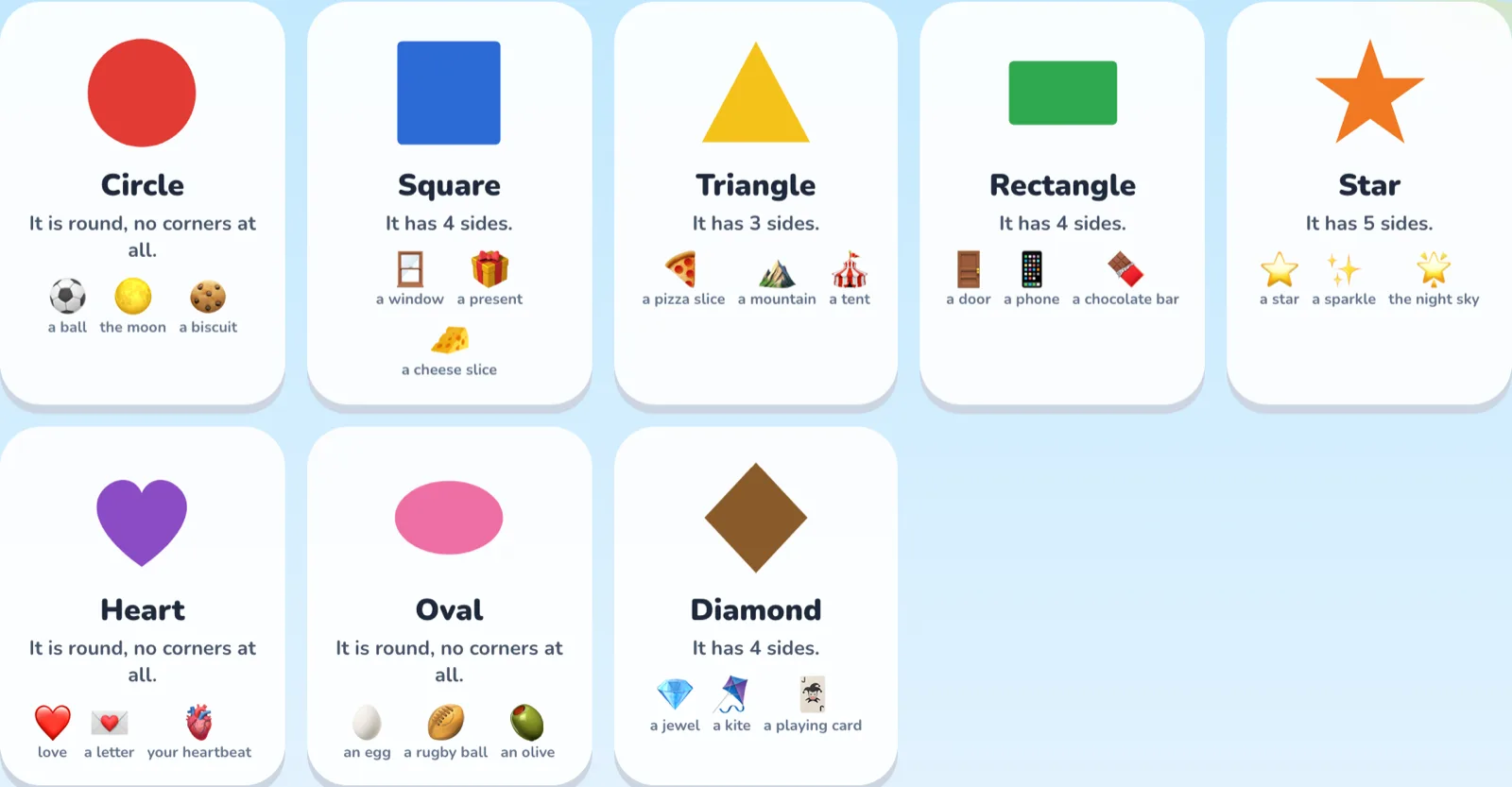
Anchor each one to real objects the child already knows. Red is an apple, a fire engine, a strawberry. Green is a leaf, a cucumber, a turtle. The object does the remembering; the word rides along with it. We built the lesson cards that way for the same reason, every colour and every shape carries three real-world things it looks like.
One property at a time
When you test, vary exactly one thing.
If you want to know whether they know "red", show four objects that are identical except for colour. If you want to know whether they know "circle", show four objects that are all the same colour. A question where both shape and colour differ lets a child land on the right answer for entirely the wrong reason, and you learn nothing about what they actually know.
That rule is built into the shapes quiz: when the question is about colour, every tile is the same shape, and when it is about shape, every tile is the same colour. It makes the quiz look almost too simple. That is what makes it work.
Where shapes go next
Shapes are the start of geometry, and the property-based way of thinking ("what makes this a square?") is the start of every definition a child will meet in mathematics. Sides, corners, curves, symmetry, size, all of it grows out of the first four shapes.
The natural progression from here:
- Name the shape → count its sides → sort a pile by shape → find the shape in the room → draw it.
The drawing comes last, because it is a motor skill as well as a knowledge one, the same reason a child can recognise a letter long before they can write it.
QuizByt's Shapes and Colours section covers all five steps: a lesson that names every shape and colour and says what they look like in the world, a quiz that asks for one at a time, and printable sheets for tracing, drawing and colouring each one on paper. The first parts are open with no account.
Questions parents ask
What age should a child know their shapes and colours?
Most children name a few colours between two and three and several shapes between three and four, but the range is wide and normal. Naming is not the same as understanding the property.
Which shapes should I teach first?
Circle, square, triangle and rectangle. Add star, heart, oval and diamond once those four are secure.
Why does my child call every triangle-ish thing a triangle but reject thin ones?
Because they have learned the picture rather than the rule. Show long, thin, tilted and upside-down triangles and count the sides aloud each time.
Do colour and shape need to be taught separately?
Yes, at first. Ask about one property at a time, a question where both vary lets a child get the right answer for the wrong reason.
Responses
Sign in to join the conversation. Responses are open to people with a QuizByt account, which is how we keep this a place you would let your child read.
Loading responses…
Lessons that talk, quizzes that mark themselves, games that make kids think
QuizByt is matched to your child's class. Classes 1–10 and Cambridge O Level. Every subject opens with a free lesson, quiz and worksheet, no account needed.
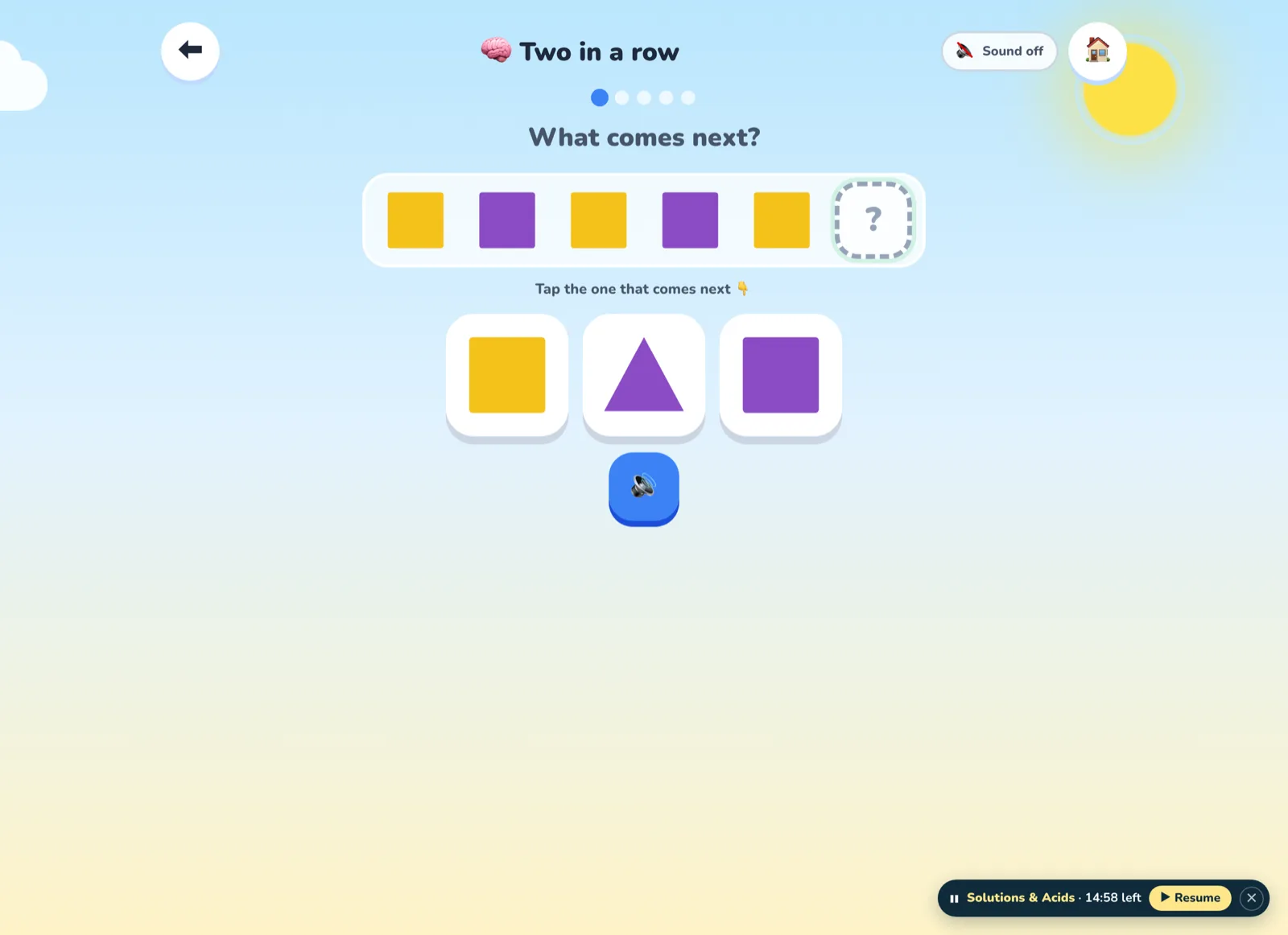 What Comes Next? Patterns Are One of the Strongest Early Predictors of MathsRed, blue, red, blue, … A child who can finish that row is doing something research has repeatedly linked to their mathematics achievement years later. Here is why, and how to practise it.Read the article →
 Counting to 20: Why Reciting Numbers Is Not the Same as CountingPlenty of three-year-olds can chant to twenty. Ask them to hand you four biscuits and many will hand you a fistful. The gap between those two things is the whole of early number sense.Read the article →
 Timed, Retried and Reviewed: The Exam Rules a School Can Set on QuizBytFifteen, ten or seven minutes by difficulty. One attempt or three. Answers held back until the last try. Hints on or off, read-aloud on or off. Every rule, and where it is set.Read the article →