
Why Kids Drift From Studies to Gadgets, and What Actually Pulls Them Back
It is not laziness. A phone game gives a child something a textbook never does: instant feedback, visible progress and a next step that is always just right. Here is how to give studying the same pull.

Every parent has seen it: the homework sits untouched for an hour, but the same child will play a phone game for two hours without being asked. The usual explanation is gadgets are addictive, studies are boring. That is half true and completely unhelpful, because it tells you nothing about what to do.
Look instead at what the game is doing that the homework is not. There are three things, and none of them are magic.
1. The game answers instantly
Tap the wrong thing in a game and you know in a tenth of a second. Write the wrong answer in an exercise book and you find out (maybe) next week, in red ink, when you have forgotten the question. Children are not impatient; they are built to learn from immediate feedback. Homework mostly refuses to give it.
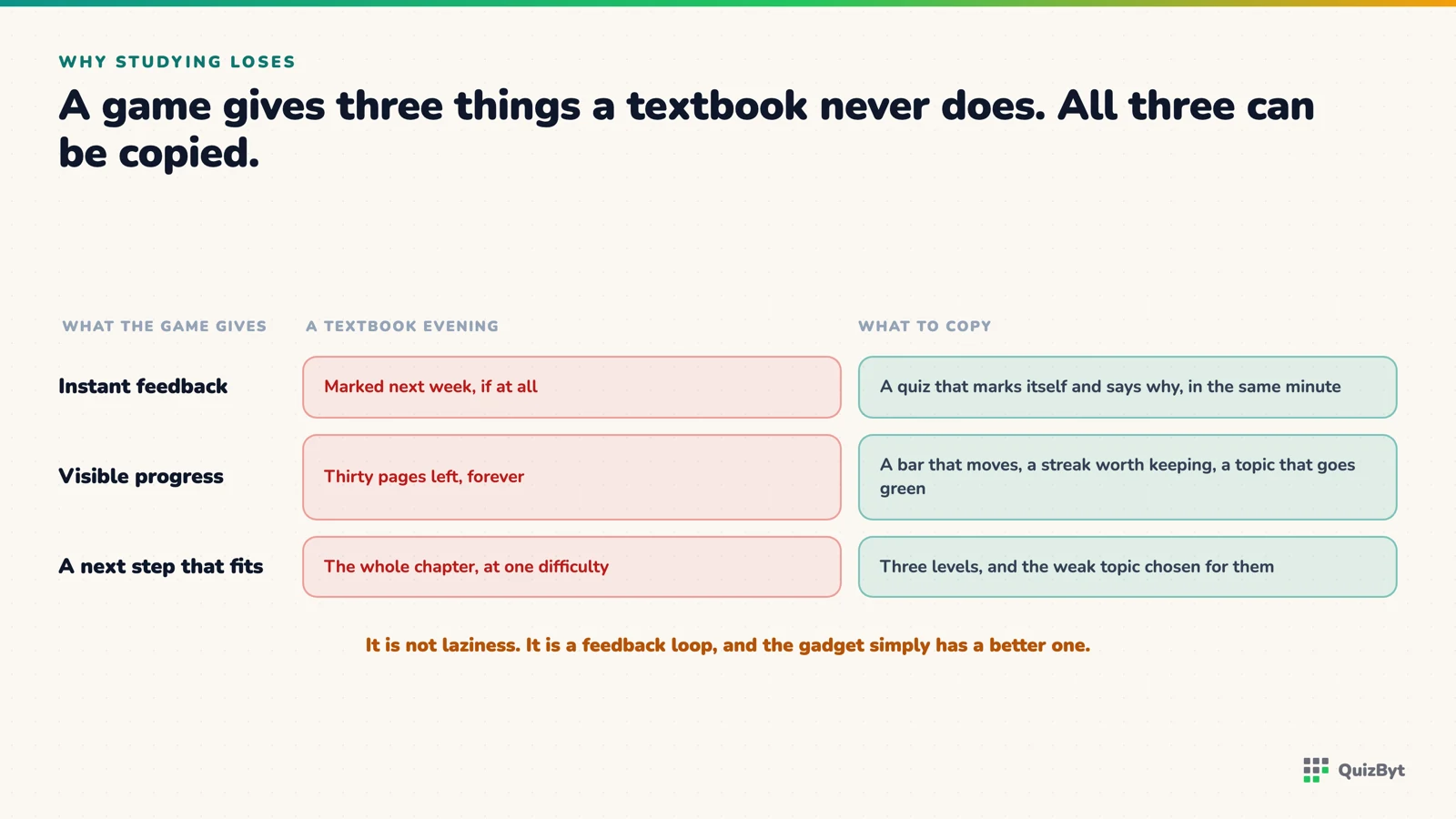
2. The game shows progress
Level 7 of 20. Three stars. A bar that fills. The child can see themselves getting somewhere. Schoolwork offers a mark at the end of term. Between those two points there is nothing to look at, so it feels like nothing is happening.
3. The game is always exactly hard enough
Good games sit you just past your ability: hard enough to need effort, easy enough to succeed with it. Psychologists call it flow. A worksheet is one difficulty for the whole class, too hard for some, boring for others, and "just right" mostly by luck.
So bring those three things to studying
This is the whole idea behind interactive learning, and it is why it works where lectures do not:
- Quizzes that mark themselves the moment an answer is tapped, with a one-line reason. That is the game's instant feedback, on the subject you want them learning.
- Progress you can see: "7 of 10 topics done in Maths", a ranking, credits earned. The dashboard becomes the level map.
- Difficulty that steps up (Easy, then Medium, then Skilled) so the next quiz is always the right one.
Then make the games part of the plan
You will not out-ban a phone. But you can put the phone to work. On QuizByt, passing a quiz earns credits, and credits unlock brain games, memory, logic, planning puzzles. The gadget that was pulling your child away from study becomes the reward for doing it, and the games themselves train exactly the thinking that schoolwork needs. See how the credits and games work.
The drift toward gadgets is a signal, not a character flaw. Read it correctly and it tells you exactly what studying was missing.
Responses
Sign in to join the conversation. Responses are open to people with a QuizByt account, which is how we keep this a place you would let your child read.
Loading responses…
Lessons that talk, quizzes that mark themselves, games that make kids think
QuizByt is matched to your child's class. Classes 1–10 and Cambridge O Level. Every subject opens with a free lesson, quiz and worksheet, no account needed.
 AI Gives Answers. Who Trains the Mind? A Parent's Duty in the Age of ChatGPTA child can now get any answer in seconds. That is genuinely useful, and it is also the fastest way ever invented to skip the thinking that school is for. What parents and communities must offer instead.Read the article →
 PDF Assignments Your Teachers Still Mark by HandNot everything should be auto-marked. Written method, working out and long answers need a human, and they should not have to live outside the system to get one.Read the article →
 Build Your Own Question Bank, Import Ours, or Draft With AIThree routes to a school question bank, and they are not alternatives. Most schools end up using all three, for different parts of the syllabus.Read the article →