
AI Gives Answers. Who Trains the Mind? A Parent's Duty in the Age of ChatGPT
A child can now get any answer in seconds. That is genuinely useful, and it is also the fastest way ever invented to skip the thinking that school is for. What parents and communities must offer instead.
Type a homework question into an AI and the answer appears, fluent and confident, before you have finished reading it back. For a parent who remembers hours with an encyclopaedia, this feels like a miracle. It is. It is also the first tool in history that lets a child complete their learning without doing any of it, and the difference between those two things is what school is for.
Answers are not the goal. The goal is the mind that can find them.
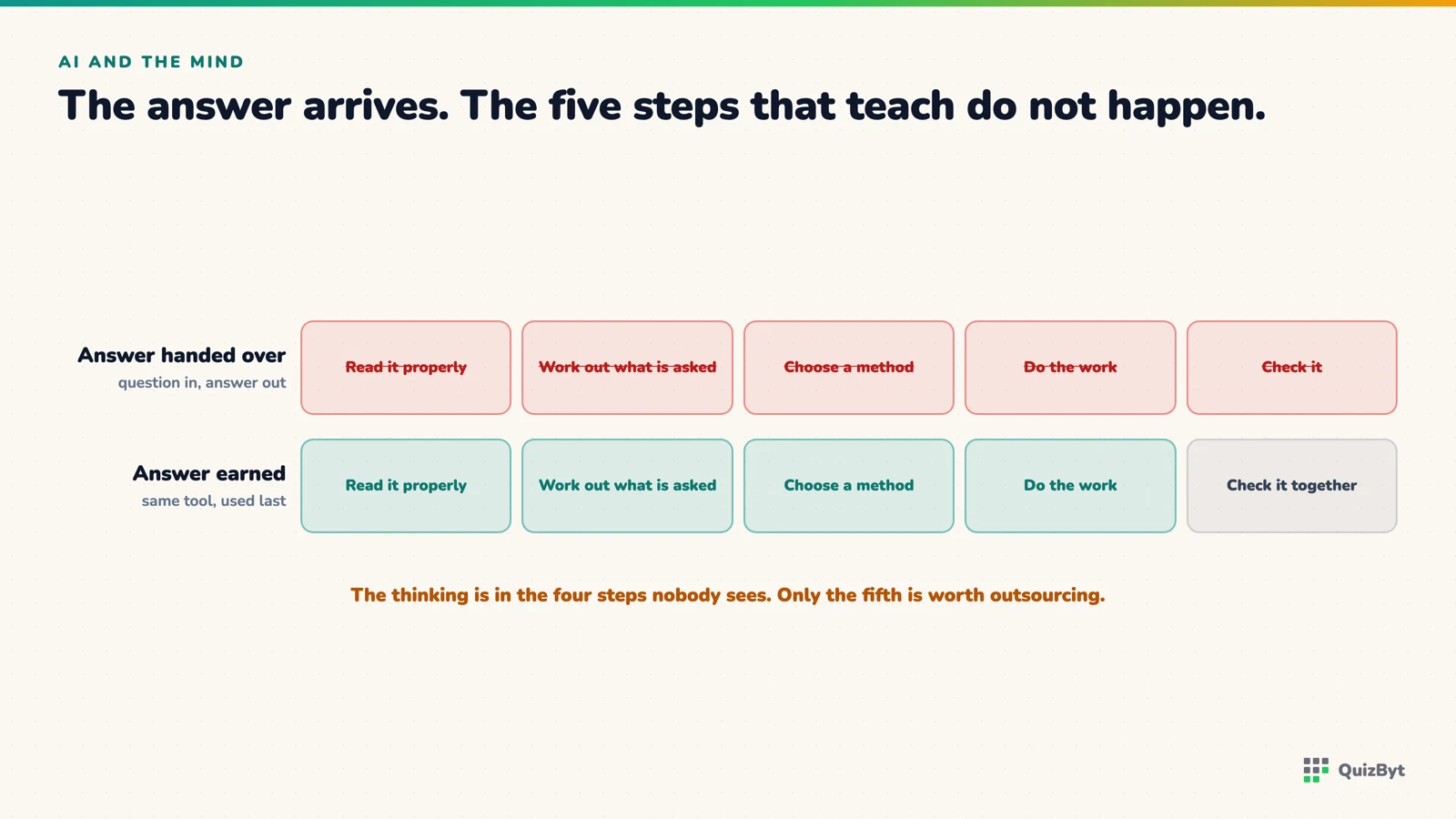
Nobody sends a child to school to collect answers. The answers to Class 7 maths are all known. The child is there to build a mind that can hold a problem, try an approach, notice it failing, and try another. That struggle is not an unfortunate side effect of learning. It is learning. Anything that removes it removes the learning with it, however good the finished homework looks.
What AI is genuinely good for
This is not an argument against the tools. Used well, they are superb:
- Explaining a step the child did not follow, after they have tried it.
- Generating practice: more questions on a topic, at the right level. (This is how we draft quizzes at QuizByt, before a teacher checks every one.)
- Checking an answer the child already has, and saying why it is wrong.
Notice the pattern: in every good use, the child thinks first and the AI responds. In the bad use, the AI thinks and the child copies.
What no AI can do
- It cannot make a child want to know.
- It cannot give a child the experience of being stuck for ten minutes and then getting it, the experience that builds confidence for the next hard thing.
- It cannot notice that a particular child always rushes, or never checks, or gives up at the second step. A parent or teacher sitting beside them can.
- It cannot be trusted blindly. AI answers are sometimes wrong in ways a child cannot detect, which is why every question on our platform is reviewed by a qualified teacher before a student sees it.
The duty that stays with us
Training a mind is slow, human work, and it belongs to the people around the child. Concretely:
- Parents: insist on the attempt before the answer. "Show me what you tried" is the most important sentence in the house. Sit beside them for the hard ten minutes rather than handing them the phone.
- Teachers: set work that rewards the process (self-marking quizzes with explanations, worksheets on paper) and check what the tools generate before children learn from it.
- Communities and schools: offer the alternatives. Interactive lessons that ask before they tell. Games that make children plan and deduce. A place where progress is visible and effort is what earns the reward.
That is what we are trying to build: a platform where the AI does the drafting, teachers do the checking, and the child does the thinking. Lessons that wait for an answer, quizzes that explain rather than just mark, and games that train the mind rather than numb it. Try it, every subject starts with a free lesson.
The answers are free now. The thinking still has to be earned, and it is our job to make sure children get the chance.
Responses
Sign in to join the conversation. Responses are open to people with a QuizByt account, which is how we keep this a place you would let your child read.
Loading responses…
Lessons that talk, quizzes that mark themselves, games that make kids think
QuizByt is matched to your child's class. Classes 1–10 and Cambridge O Level. Every subject opens with a free lesson, quiz and worksheet, no account needed.
 Why Kids Drift From Studies to Gadgets, and What Actually Pulls Them BackIt is not laziness. A phone game gives a child something a textbook never does: instant feedback, visible progress and a next step that is always just right. Here is how to give studying the same pull.Read the article →
 Why a Child's Engagement With Digital Devices Matters, and Where Parents Should LookChildren will spend their working lives with screens. The question was never whether they use devices, but whether they learn to use them as tools or get used by them. Here is what to watch.Read the article →
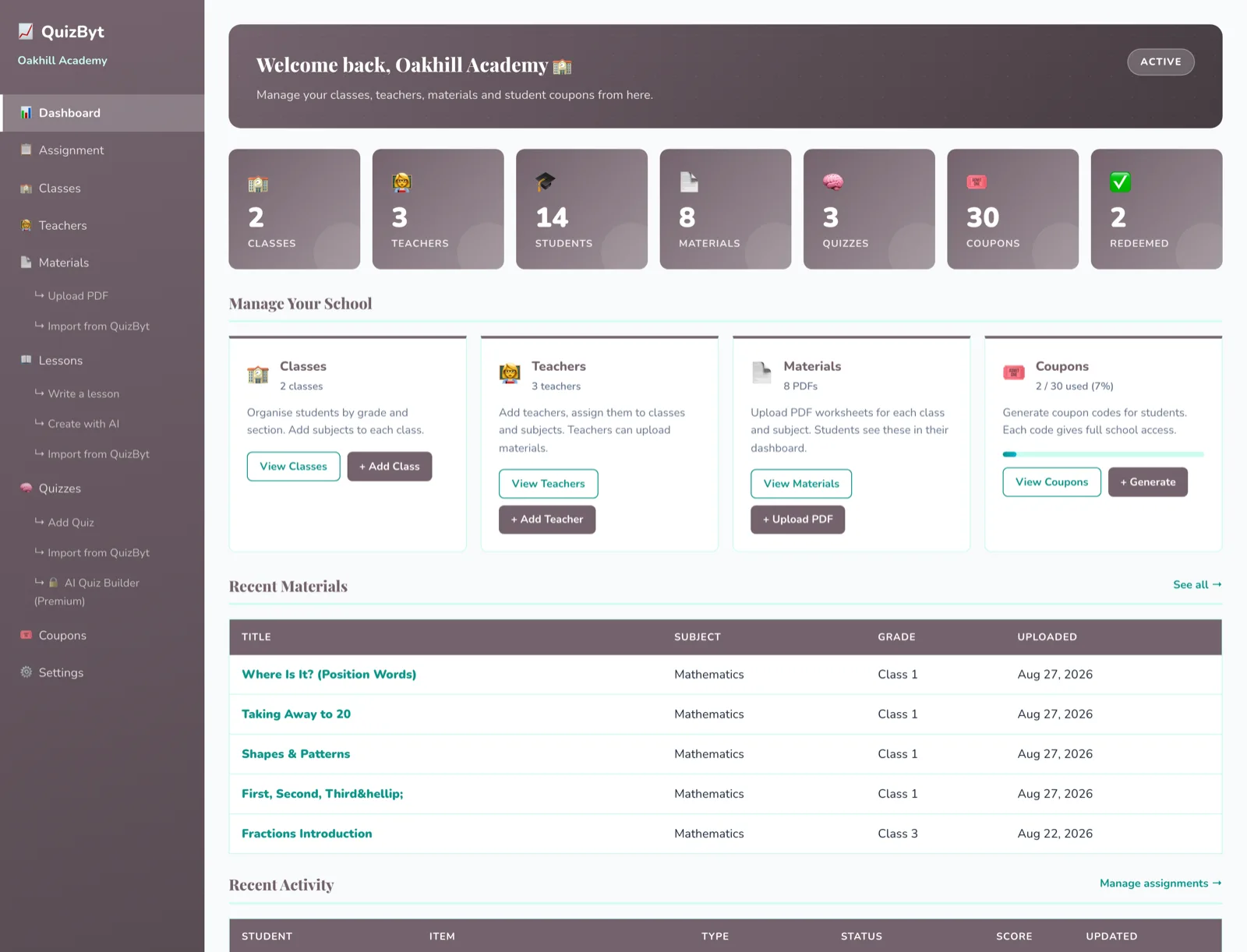 Set Up a Whole School in a DayClasses, teachers, students, materials and the first assignments, the realistic order to do it in, and the two steps that actually take the time.Read the article →