
Agentic AI and the Syllabus Problem: Comparing Cambridge, Edexcel, Oxford AQA and the Federal Board
Four boards teach the same mathematics in four different orders, under four different names, split across four different years. Mapping that by hand takes weeks. Here is what an agent does well, where it quietly invents things, and how we kept it honest.
The short version
- The hard part of comparing syllabuses is not reading them, it is that the same content appears under different names, in different years, at different depths.
- An agent is good at the first pass: gathering documents, extracting learning objectives, proposing alignments and showing its reasoning for each one.
- An agent is unreliable at the thing that matters most, which is depth. It will happily align a Class 7 objective with an O Level one because both say 'ratio'.
- Every alignment that reached our catalogue was checked against the published syllabus document by a person, and the syllabus codes are recorded in the code so the next person can check the same claim.
A school in Lahore asked us a reasonable question: their Cambridge stream and their Federal Board stream both study quadratic equations, so could they use the same practice material for both? The answer is partly yes and the interesting part is the word partly. Working out exactly which part took us into a problem that anyone building education content eventually hits.
Why syllabus comparison is hard
Put four mathematics syllabuses side by side, say Cambridge IGCSE 0580, Pearson Edexcel International GCSE Mathematics A, Oxford AQA International GCSE Mathematics and the Punjab Textbook Board matric syllabus, and four problems appear at once.
- Different names for the same thing. One board writes "Transformations", another "Vectors and transformations", a third splits reflection and rotation into separate strands and never uses the word transformation as a heading.
- Different years. Simultaneous equations appear a full year apart between two of these. A topic map that ignores the year is useless to a teacher planning a term.
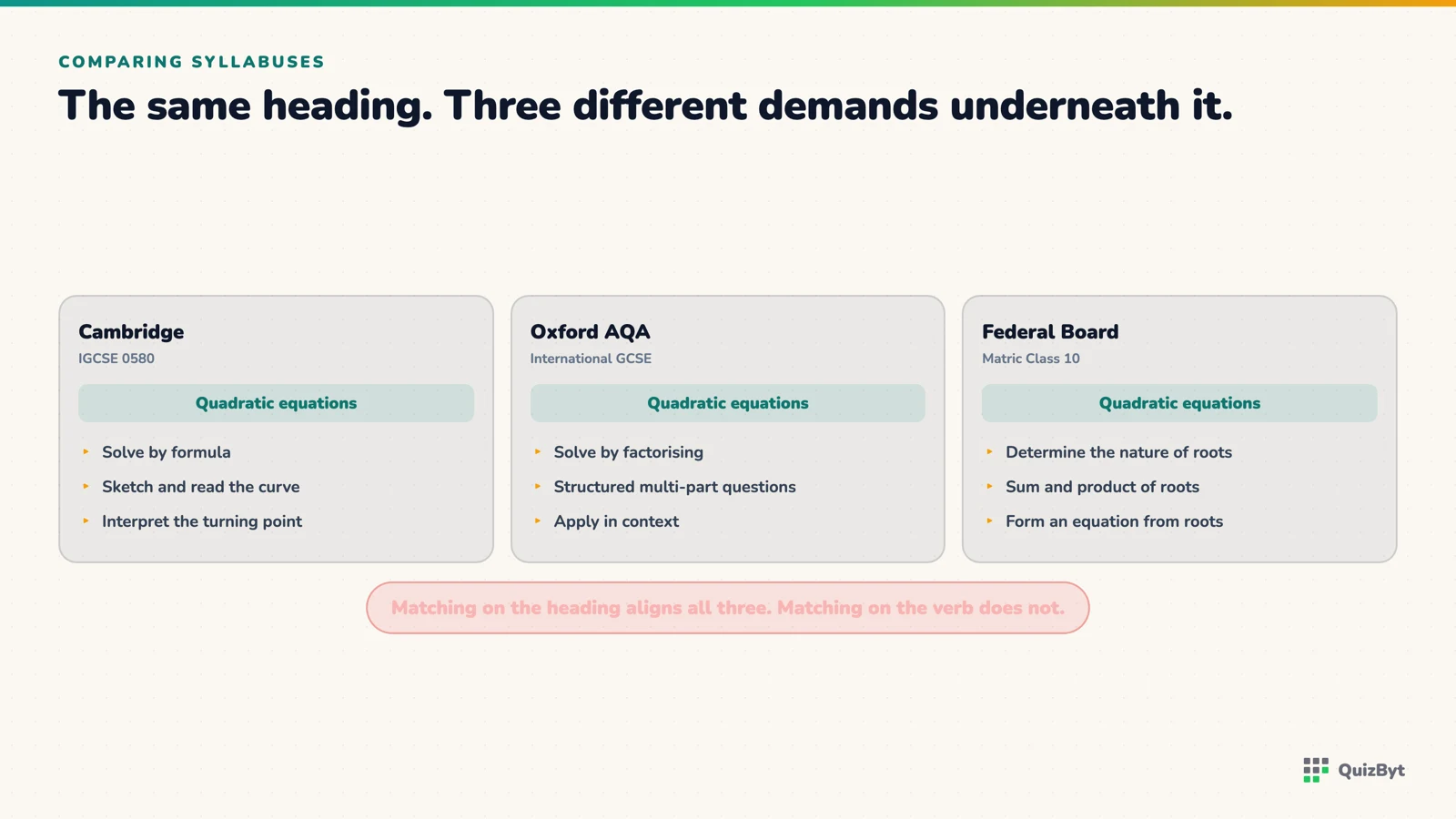
- Different depth under the same heading. This is the worst one. Two syllabuses both list "probability". One stops at single events. The other expects tree diagrams and conditional probability. The heading is identical and the teaching is a year apart.
- Different assessment style. A board that examines with structured multi-part questions is teaching a different skill from one that examines with short answers, even when the content list matches line for line.
So the real question is never "do both syllabuses contain quadratics". It is "at what depth, in which year, assessed how".
What we asked an agent to do
An agentic setup, as opposed to a single prompt, means the model is given a task, a set of tools and permission to work through several steps on its own: fetch a document, read it, extract structure, compare, write out the result, then check its own work against the source. The useful part is that each step produces an artefact you can inspect.
We ran it in four passes.
- Gather. Collect the published syllabus documents for each board and each subject, with the version year recorded. A syllabus from the wrong cycle is worse than no syllabus.
- Extract. Pull out every learning objective as a separate line, with its strand, its stage or year, and the exact wording. No paraphrasing at this stage, because paraphrase is where the depth information leaks away.
- Propose. For each objective, propose the matching objective in each other board, with a confidence level and a one-line reason. Three buckets: same content at the same depth, same content at different depth, present in one and absent in the other.
- Challenge. Run a second pass whose only instruction is to argue against the first pass. Given this proposed alignment, what is the strongest case that these two objectives are not equivalent?
That fourth pass is the one that earns its keep. A model asked to find matches finds matches, because that is what it was asked for. A model asked to break its own matches breaks a surprising number of them.
What it was genuinely good at
Coverage. It does not get tired on page ninety. Human mapping degrades across a long document in a way that is predictable and hard to notice.
Finding the odd ones out. The most valuable output was not the matches, it was the list of objectives present in one board and missing from the others. Those are the gaps a student transferring between systems falls into, and they are exactly what a hand-made comparison skips, because you compare what you are looking at and you cannot look at an absence.
Normalising vocabulary. Recognising that "directed numbers", "integers" and "positive and negative numbers" are the same strand under three house styles is tedious for a person and trivial for a model.
Showing its reasoning per line. A one-line justification for each proposed match is what makes checking fast. Without it, verification means re-doing the work.
Where it was wrong, every time
Depth. This is the failure that matters. It will align a Class 7 objective about ratio with an O Level objective about ratio, because both say ratio. Depth lives in the command verbs and in the examples, and models under-weight both.
Confidence that does not track accuracy. The confidence score is a fluency signal, not a knowledge signal. Some of the most confident alignments were the worst, which means confidence cannot be used to decide what to check. Everything gets checked.
Invented structure. Asked for a strand that a board does not have, it produces a plausible one. A syllabus has no such thing as a plausible strand. It has the strands it has.
Version drift. Give it a document and ask about a topic, and it will sometimes answer from its training data rather than the document in front of it. The fix is mechanical: every claim must quote the line it came from, and a claim with no quotable line is dropped.
What we actually built from it
The result is not a live syllabus-mapping feature, and we would rather say so than imply otherwise. It is the topic catalogue inside the product: for every class and subject, a list of topics in teaching order, assembled from the frameworks above and checked against the published documents. The syllabus codes sit in the code next to the lists, so the next person who wonders where "Vectors and transformations" for O Level came from can go and read 4024 for themselves.
Each of those topics is what quizzes, lessons and worksheets are built against. That is why a result on QuizByt reads as "two out of six on electric circuits" rather than "68% in Science".
And for a school whose syllabus is none of these
Plenty of schools follow a board, a textbook and a scheme of work that no public framework describes. For them the comparison question is beside the point, and the answer is the upload path: give the system the chapter you are teaching and the content is built from that chapter. No mapping, no approximation. That path is described here.
Questions parents ask
Does QuizByt automatically map my school's syllabus?
No, and any tool that says it does is overselling. The topic catalogue in the product was built from published frameworks and verified by people. What a school can do today is upload its own chapters, which sidesteps mapping entirely.
Which syllabuses is the catalogue built from?
Cambridge Primary Mathematics 0096, English 0058 and Science 0097; Cambridge Lower Secondary Mathematics 0862; the Punjab and Federal matric syllabus for Classes 9 and 10; and Cambridge O Level 4024 with IGCSE 0580 for O Level.
Why use an agent at all if everything is checked by a person?
Because reading six syllabus documents and producing a first-draft alignment table is days of work, and checking a draft table is hours. The agent moves the work from authoring to verification, which is a real saving and a safer shape.
What is the most common mistake an agent makes here?
Matching on vocabulary instead of on depth. Two objectives can share every noun and sit three years apart in difficulty.
Responses
Sign in to join the conversation. Responses are open to people with a QuizByt account, which is how we keep this a place you would let your child read.
Loading responses…
Lessons that talk, quizzes that mark themselves, games that make kids think
QuizByt is matched to your child's class. Classes 1–10 and Cambridge O Level. Every subject opens with a free lesson, quiz and worksheet, no account needed.
 One Chapter, Three Boards: What Changes and What Does NotTake quadratic equations across Cambridge IGCSE, Oxford AQA and the Federal Board matric syllabus. The content list looks almost identical. The teaching, the depth and the examination are not. A worked comparison.Read the article →
 Build Your Own Question Bank, Import Ours, or Draft With AIThree routes to a school question bank, and they are not alternatives. Most schools end up using all three, for different parts of the syllabus.Read the article →
 PDF Assignments Your Teachers Still Mark by HandNot everything should be auto-marked. Written method, working out and long answers need a human, and they should not have to live outside the system to get one.Read the article →