
One Chapter, Three Boards: What Changes and What Does Not
Take quadratic equations across Cambridge IGCSE, Oxford AQA and the Federal Board matric syllabus. The content list looks almost identical. The teaching, the depth and the examination are not. A worked comparison.
The short version
- Content lists overlap far more than teaching does. Three boards all list quadratic equations and expect noticeably different things from a student.
- The command verbs carry the depth. Solve, derive, prove and interpret are four different demands hiding under one topic heading.
- Shared practice material works for the overlap, which here is most of the drilling, and fails at the edges, which is where marks are won.
- A student moving between systems should be checked on the edges, not re-taught the middle.
The previous article described the method. This one does the work on a single topic, because a method you cannot see applied is a claim rather than a result. The topic is quadratic equations, at the point where a student is about sixteen, across three systems: Cambridge IGCSE Mathematics 0580, Oxford AQA International GCSE Mathematics, and the Punjab and Federal Board matric syllabus for Class 10.
Reading the content lists
At the level of a bullet list, the three look nearly identical. All three expect a student to solve quadratic equations by factorisation. All three introduce the quadratic formula. All three connect the equation to a curve. If you were building a topic map from headings alone, you would mark this as a clean three-way match and move on.
That match would be mostly right and would mislead a teacher in three specific places.
Where they separate
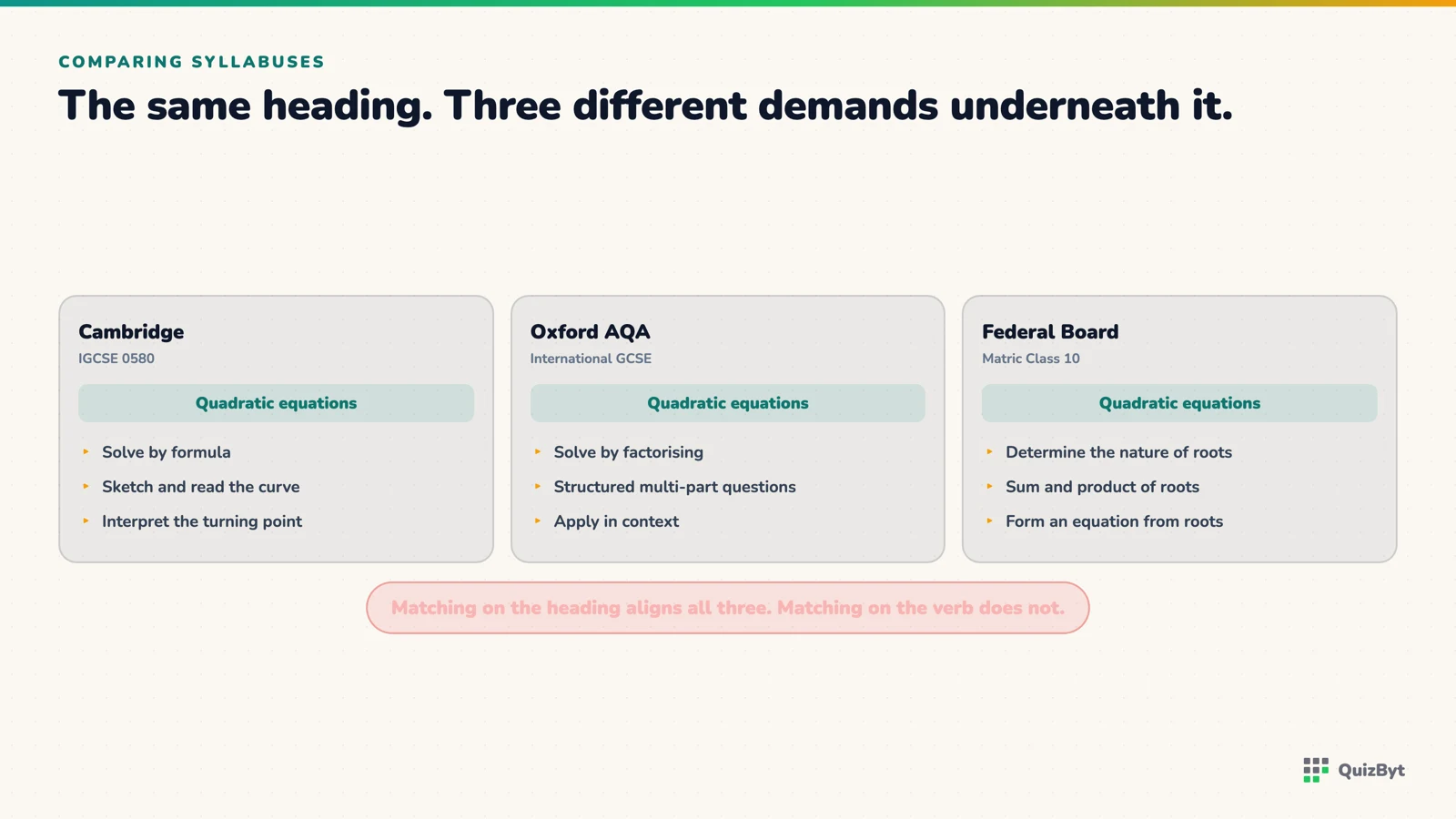
The discriminant. The Federal Board treatment gives real weight to the nature of the roots: real and equal, real and distinct, imaginary, with the discriminant as a tool to classify them before solving anything. A student is expected to answer questions about the roots without finding them. The IGCSE treatment leans more on solving and on using the formula correctly. Same symbols, different habit of mind.
Sum and product of roots. This is the clearest divergence. Forming a new equation from given roots, and evaluating symmetric expressions in the roots, sits squarely in the Federal Board Class 10 material and does not carry the same weight in the IGCSE core. A Cambridge student moving to a Federal Board class meets this as new material; the reverse direction meets it as material they will not be examined on.
Graphical interpretation. The international syllabuses lean harder on reading a quadratic graph: identifying the turning point, reading solutions off the curve, sketching from a factorised form, connecting the discriminant to how many times the curve crosses the axis. The matric treatment is more algebraic and less graphical.
How the question is asked. Oxford AQA and Cambridge both make heavy use of structured questions where part (a) feeds part (b) feeds part (c), and a student who cannot do (a) loses the rest. That is a skill in itself. A syllabus comparison that ignores assessment style has compared the content and missed the examination.
The verbs are where the depth lives
Lay the objectives out and read only the command verbs. Solve is a procedure. Derive is a proof. Interpret is a translation between a graph and a situation. Determine the nature of is a classification you make before any solving happens. Four verbs, four different demands, one topic heading.
This is the thing automated mapping gets wrong most reliably, and it is why every proposed alignment in our catalogue was checked against the actual syllabus line rather than against a summary of it. A summary drops the verb.
What this means for shared practice
Draw a line down the middle.
- Shared without reservation: factorising, completing the square, applying the formula, solving word problems that reduce to a quadratic. This is most of the practice volume, and a student from any of the three benefits from all of it.
- Shared with a caveat: the discriminant. Everyone meets it; only one of the three leans on it as a classification tool. Useful to all, weighted differently.
- Not shared: sum and product of roots, and the heavier graphical interpretation. Each belongs to its own system, and giving a student the wrong set here costs them time without buying marks.
The practical rule for a school running two streams is that routine practice can be common and the final fortnight before an examination cannot.
How the product reflects this
The topic lists are kept separate per class and per board family, so Class 10 and O Level are two lists and not one list with a different label. Where a topic exists in both, the questions can be shared; where it does not, nothing is forced into a slot it does not fit.
And for the specifics of a particular school's scheme of work, the chapter-upload path is the honest answer. A system that claims to know exactly what your board expects, without having read your scheme of work, is guessing. One that builds from the chapter you hand it is not.
Questions parents ask
Can one set of practice questions serve both an IGCSE and a Federal Board class?
For the mechanical core, yes. For the parts each board treats differently, no. Roughly, expect the drilling to transfer and the harder application questions not to.
Which board is harder?
The wrong question. They are differently shaped. One demands more algebraic manipulation, another more interpretation of context, another more structured multi-part reasoning. A student strong in one can be weak in another.
How does QuizByt handle this?
Topics are listed per class and per board family in the catalogue, so a Class 10 Federal Board topic list and an O Level topic list are separate lists, not one list relabelled.
What about a school teaching both streams?
Use the shared core for routine practice and build the board-specific parts from your own chapters. That is what the PDF upload path is for.
Responses
Sign in to join the conversation. Responses are open to people with a QuizByt account, which is how we keep this a place you would let your child read.
Loading responses…
Lessons that talk, quizzes that mark themselves, games that make kids think
QuizByt is matched to your child's class. Classes 1–10 and Cambridge O Level. Every subject opens with a free lesson, quiz and worksheet, no account needed.
 Upload a PDF, Get a Lesson, a Quiz and a WorksheetA school uploads the chapter it is actually teaching. Out comes a scrolling lesson, a self-marking quiz and a printable worksheet, all drafts, all waiting for a teacher. What happens in between, and what makes it fail.Read the article →
 Agentic AI and the Syllabus Problem: Comparing Cambridge, Edexcel, Oxford AQA and the Federal BoardFour boards teach the same mathematics in four different orders, under four different names, split across four different years. Mapping that by hand takes weeks. Here is what an agent does well, where it quietly invents things, and how we kept it honest.Read the article →
 Remote and Home Schooling That Students Actually FinishThe hard part of remote learning was never delivering the material. It was that nobody was in the room, and self-paced work only works when finishing is designed in.Read the article →