
Games That Make Kids Think: Puzzles, Memory and Logic as Homework
Not every game is a waste of time. Some train exactly the skills schoolwork runs on, working memory, planning, deduction. Here are the kinds worth a place in the study routine, and why.

"Stop playing games and study" assumes the two are opposites. For most games on a phone, they are. But there is a family of games that do the same thing studying does (make the child hold ideas in their head, plan ahead, spot patterns and reason to a conclusion) and do it in a form the child will do voluntarily. Those games are not a break from learning. They are training for it.
The skills underneath schoolwork
Psychologists call them executive functions: working memory (holding several things in mind at once), planning (working out the steps before acting) and cognitive flexibility (changing approach when the first one fails). A child solving a two-step word problem in maths is using all three. So is a child playing the right game.
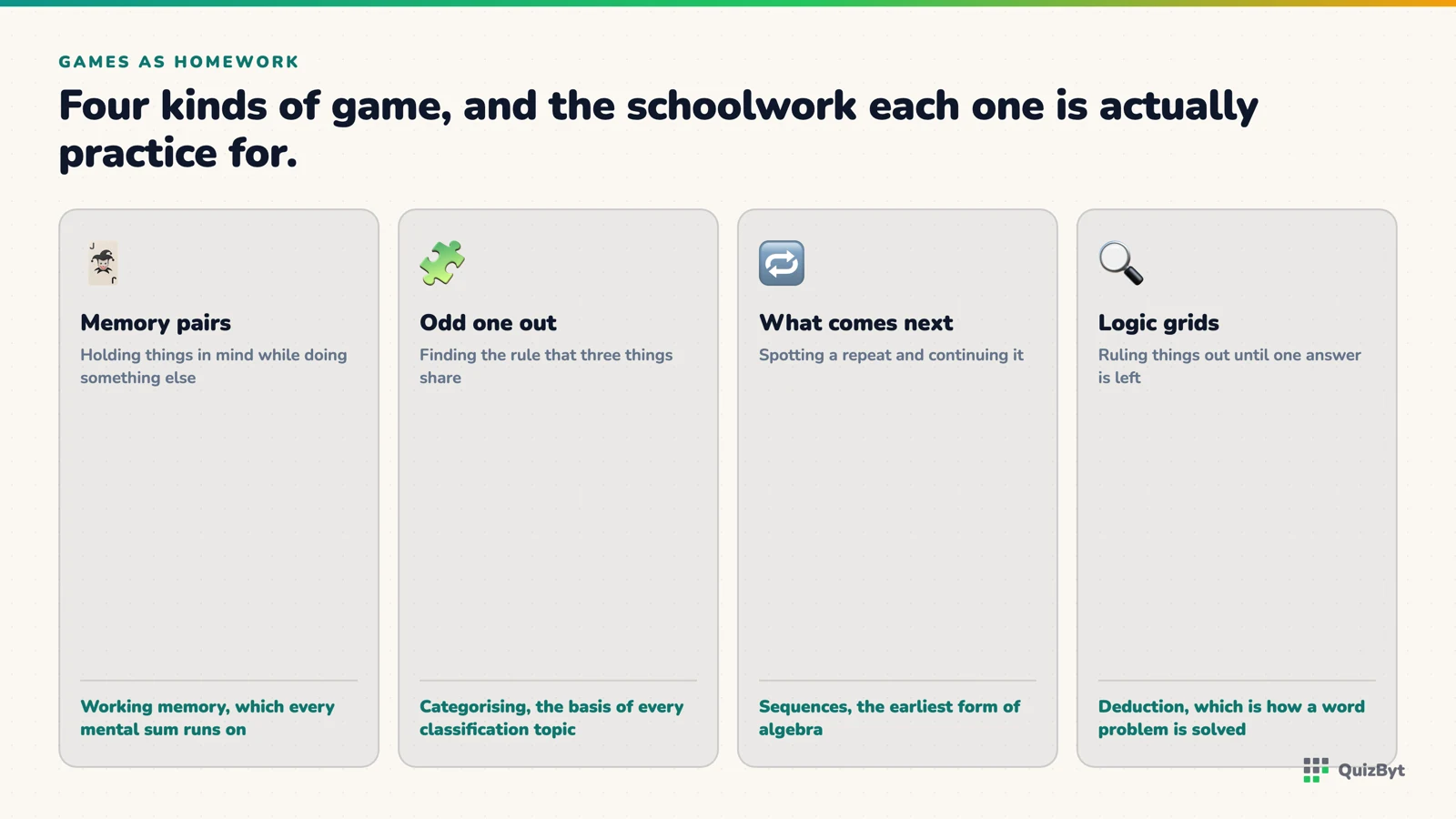
Games worth the time
- Memory match. Turn cards, remember where the pairs are. Pure working memory, and it gets harder exactly as fast as the child improves.
- Tower of Hanoi. Move the stack one disc at a time, never a bigger on a smaller. It is impossible without planning several moves ahead, and a child who cracks it has learned what planning feels like.
- Mini Sudoku and logic grids. "If this is here, then that cannot be there." This is deduction, the core of every science and maths proof they will ever write, dressed as a puzzle.
- Mastermind. Guess the hidden code from feedback. Hypothesis, test, revise, the scientific method in six rows.
- Knight's Tour, maze and box-push puzzles. Spatial planning and the willingness to undo a move and try another. That flexibility is what separates a child who gets stuck from one who gets unstuck.
- Sequence games. Repeat the pattern, one step longer each time. Working memory again, with a clear, visible personal best.
What makes a game train rather than just entertain
- It has a goal and an end. Levels, not a feed.
- Difficulty rises with the player. A game a child has mastered has stopped teaching.
- Failure is cheap and immediate. Undo, retry, no penalty, that is what makes children persist.
- No adverts, no purchases, no timer pushing them to hurry.
Making games part of studying, not the enemy of it
The trick is the order. On QuizByt, a child earns credits by passing quizzes, and credits unlock the games above, all of them are in the catalogue, matched to the child's class level. Study comes first because it has to; the game comes second because it was earned; and the game itself is building the thinking the next quiz will need. Several are free to try without an account.
Responses
Sign in to join the conversation. Responses are open to people with a QuizByt account, which is how we keep this a place you would let your child read.
Loading responses…
Lessons that talk, quizzes that mark themselves, games that make kids think
QuizByt is matched to your child's class. Classes 1–10 and Cambridge O Level. Every subject opens with a free lesson, quiz and worksheet, no account needed.
 "No Phone Until Fifteen": The Case For and Against a Total BanSome parents keep devices away from children entirely. They have good reasons, and they are missing something. An honest look at both sides, and a middle path that keeps the benefits of each.Read the article →
 How to Judge a Learning App for a Four-Year-Old: Seven TestsEvery app in the education category says it is educational. Seven checks, none of which take more than a minute, will tell you whether this one is built for your child or for your attention.Read the article →
 QuizByt vs Google Classroom: What Each One Actually DoesThey are not the same kind of tool, and pretending otherwise helps nobody. Classroom is a place to hand things out; QuizByt is a place where the work marks itself. Here is exactly where they overlap and where they do not.Read the article →