
Prime and Composite Numbers, Class 5: A Ten-Minute Lesson and a Quiz
A prime number has exactly two factors, itself and one. That single sentence is the whole topic, and most of the confusion comes from never being told it plainly. Here it is, plainly, with the lesson and quiz to follow.
The short version
- A prime number has exactly two factors: 1 and itself. A composite number has more than two.
- 1 is neither prime nor composite, because it has only one factor. Teach that before anything else or it comes back as an exam mistake.
- To test a number, try dividing by 2, 3, 5 and 7. For any number under 100, if none of those divide it, it is prime.
- Class 5 meets the idea; Class 6 uses it for HCF and LCM, where prime factors are the whole method.
Ask a Class 5 child what a prime number is and you will often hear "a number that can only be divided by one and itself". It is nearly right, and the gap between nearly right and right is exactly where the marks go.
The one sentence that is the whole topic
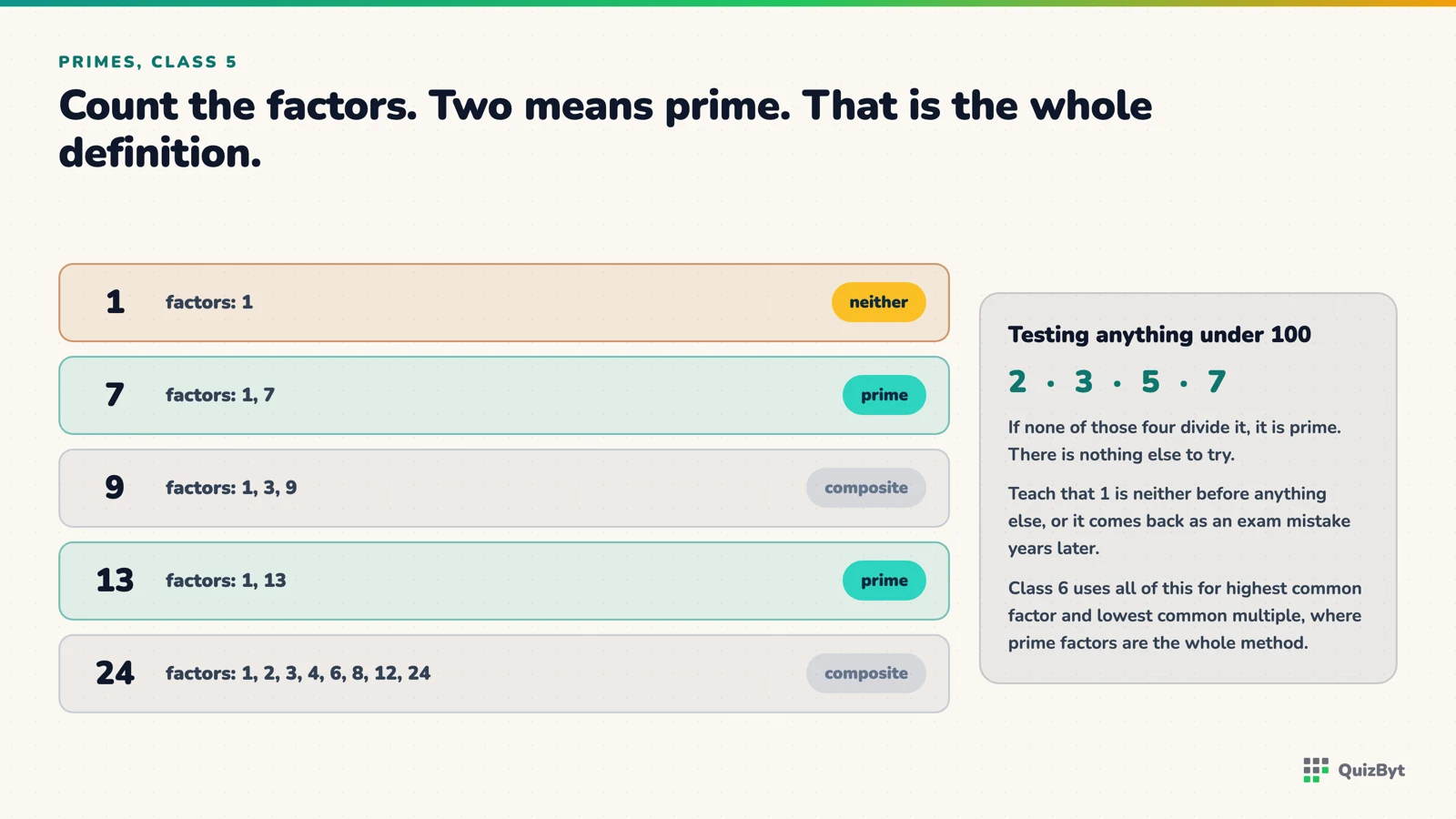
A prime number has exactly two factors: 1 and itself. A composite number has more than two. That is all of it.
Notice what the sentence does that the usual version does not. It counts factors instead of describing division. Counting factors settles every awkward case at once:
- 1 has one factor (itself). Not two. So it is neither prime nor composite.
- 2 has two factors (1 and 2). Prime, and the only even one.
- 9 has three factors (1, 3, 9). Composite, even though it is odd, which surprises a lot of children who have quietly decided that odd means prime.
A quick test for any number under 100
Try dividing by 2, 3, 5 and 7. If none of them go in exactly, the number is prime. That works for everything below 100 because the next prime, 11, squared is 121.
Take 91. It is odd, so not 2. Its digits add up to 10, so not 3. It does not end in 0 or 5, so not 5. Now 7: 7 × 13 is 91. Composite. Most children guess 91 is prime; the test says otherwise in four steps.
Why it matters more than it looks
Primes are the atoms of arithmetic. Every whole number above 1 is either prime or a product of primes, and that product is unique. Class 6 uses exactly this to find the highest common factor and lowest common multiple: write each number as a product of primes and read the answer off. A child who learned primes as "odd numbers, mostly" cannot do that. A child who learned to count factors can.
Where to practise
The Class 5 lesson Prime and Composite Numbers is free to read without an account. It walks through the definition, the test and the common traps one screen at a time, then ends on a quiz about the same topic. The Class 6 follow-on, Primes, HCF and LCM, is also free and picks up where the first one stops.
The quizzes come at three levels. Start with the easy one: it takes about ten minutes, marks itself, and shows every correct answer with the reason at the end. Fifty per cent or better earns credits that open the maths games.
Questions parents ask
Is 1 a prime number?
No. A prime has exactly two different factors, 1 and itself. The number 1 has only one factor, so it is neither prime nor composite. This is the most common wrong answer in the topic.
Is 2 a prime number?
Yes, and it is the only even prime. Every other even number divides by 2, so every other even number is composite.
How do I check if a number is prime quickly?
Try dividing by 2, 3, 5 and 7. If none of them divide it exactly and the number is under 100, it is prime. For 97: not even, digits sum to 16 so not divisible by 3, does not end in 0 or 5, and 7 × 13 is 91 and 7 × 14 is 98. So 97 is prime.
Where does this go after Class 5?
Class 6 uses prime factors to find the highest common factor and lowest common multiple. A child who can factorise into primes finds HCF and LCM almost mechanical.
Responses
Sign in to join the conversation. Responses are open to people with a QuizByt account, which is how we keep this a place you would let your child read.
Loading responses…
Lessons that talk, quizzes that mark themselves, games that make kids think
QuizByt is matched to your child's class. Classes 1–10 and Cambridge O Level. Every subject opens with a free lesson, quiz and worksheet, no account needed.
 Adjectives for Class 2 and 3: Describing Words a Child Can Actually UseChildren can name adjectives long before they use them well. The gap closes when the word is attached to a thing in front of them, not a list on a page. How the two lessons do that, and how to do it at the dinner table.Read the article →
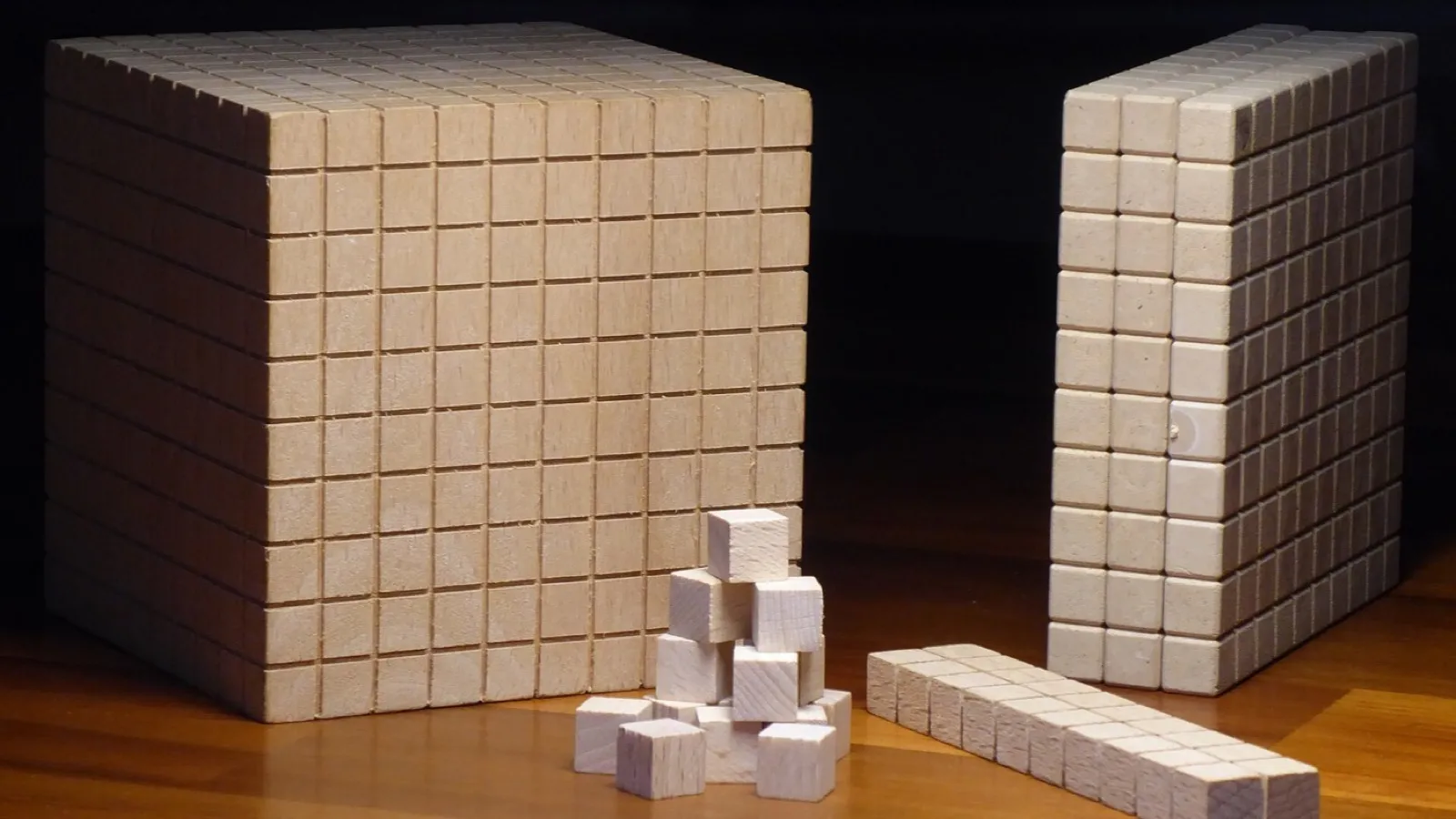 Place Value for Class 1 to 3: Digits, Tens and Hundreds Without TearsThe digit 4 means four things in 4, forty things in 40 and four hundred things in 400. A child who really understands that can add, subtract, round and compare. A child who does not is memorising tricks.Read the article →
 A Parent's Guide to the Kindergarten-to-A-Level JourneyWhat your job is at each stage, and (more usefully) what it stops being. The commonest mistake is running stage two parenting during stage five.Read the article →