
Adjectives for Class 2 and 3: Describing Words a Child Can Actually Use
Children can name adjectives long before they use them well. The gap closes when the word is attached to a thing in front of them, not a list on a page. How the two lessons do that, and how to do it at the dinner table.
The short version
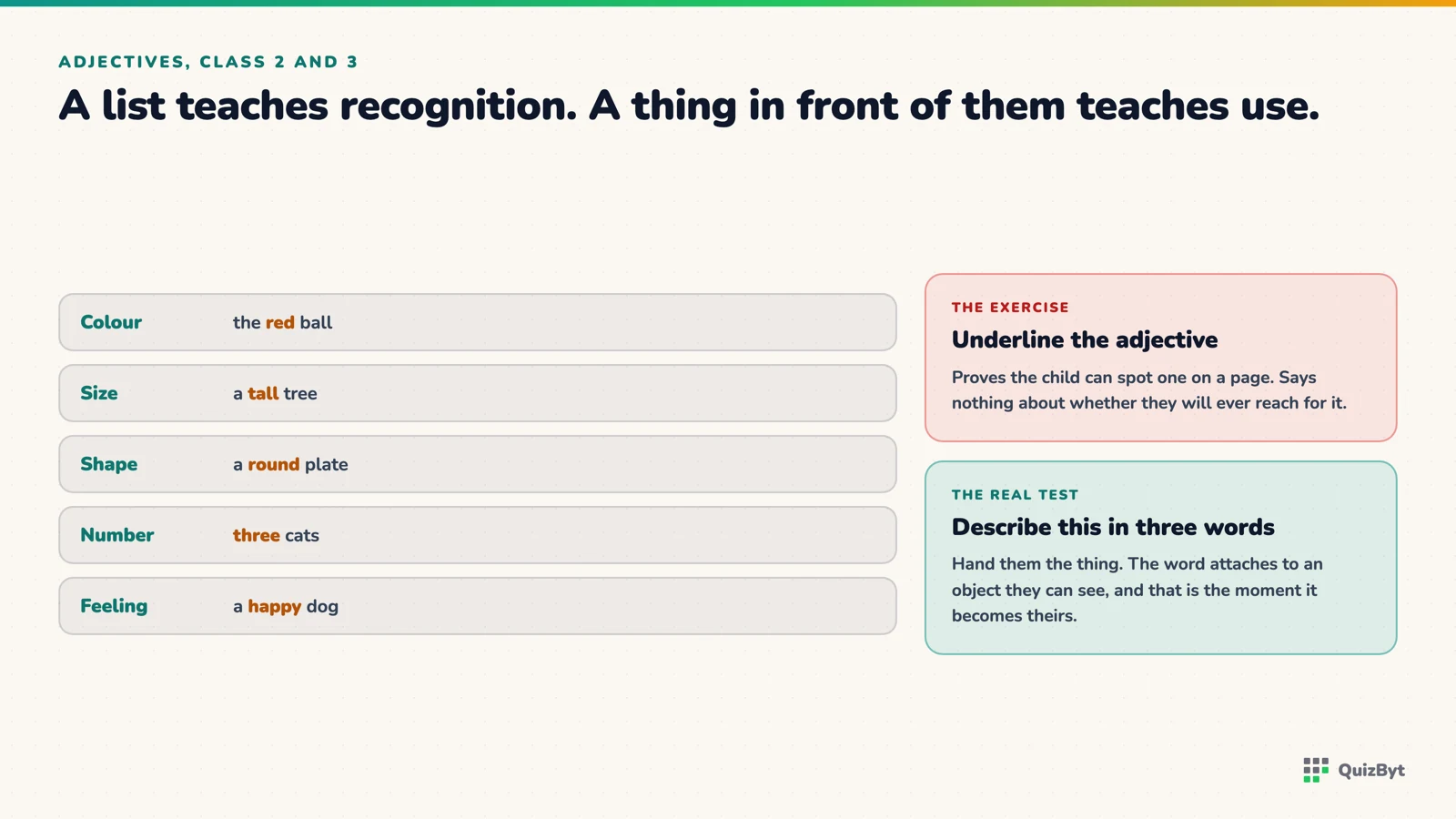
- An adjective describes a noun: the red ball, a tall tree, three cats. Colour, size, shape, number and feeling are the five kinds children meet first.
- Class 2 introduces adjectives on their own. Class 3 adds adverbs, which describe verbs, and the two are confused for years if taught as a list.
- Lists of adjectives teach recognition, not use. A child uses a word when it is attached to something they can see.
- The test is not "underline the adjective" but "describe this in three words".
Here is a small experiment. Ask a Class 2 child to name some adjectives and they will probably manage it: big, small, red, happy. Then ask them to describe the chair they are sitting on. Silence, or "it's a chair". The words are known and not yet usable, and that gap is what the topic is really about.
What an adjective is
A word that tells you more about a thing. The red ball. A tall tree. Three cats. Children meet five kinds first: colour, size, shape, number and feeling. That grouping matters because it gives a child five places to look when they are stuck for a word.
Class 2, then Class 3
The Class 2 lesson, Adjectives, does one thing: attaches describing words to pictures of real objects, one screen at a time, and ends on a quiz where the child picks the word that fits the picture. No lists.
The Class 3 lesson, Adjectives and Adverbs, adds the word that trips everyone up. An adjective describes a thing; an adverb describes an action. A fast car, but she ran quickly. Taught as two lists they blur for years. Taught as "is it about the thing or about the doing?" they separate in a week.
Why lists do not work
A list of adjectives builds recognition. A child who has seen the list can underline the adjective in a sentence, which is what the worksheet asks, so the worksheet is passed. But underlining is not writing. The child who writes "the dog ran" instead of "the muddy dog ran fast" has not failed to learn adjectives; they have learned them in the wrong direction.
Production comes from describing real things, out loud, often. The dinner table is the best classroom for this that exists.
How the quiz helps
Both lessons end on a quiz with pictures, and the quiz asks the productive question: which word fits? Answers are shown at the end with the reason for each, and a wrong answer says why it was wrong ("tall describes size; the picture shows colour"), which is the correction a parent rarely has time to make.
Questions parents ask
What is an adjective, in words a Class 2 child understands?
A word that tells you more about a thing. The ball is red: red tells you more about the ball. Big, small, happy, three, round are all adjectives.
What is the difference between an adjective and an adverb?
An adjective describes a thing (a noun): a fast car. An adverb describes an action (a verb): she ran quickly. Class 3 introduces the second one, and the -ly ending is the usual clue, though not always.
My child can pick out adjectives but never uses them in writing. Why?
Because recognising and producing are different skills. Recognition comes from lists and underlining. Production comes from describing real things out loud, often, until the words are in the mouth and not only on the page.
Are these lessons free?
The adjectives lessons need a free account, which takes a minute to create. The account also saves quiz scores and earns credits.
Responses
Sign in to join the conversation. Responses are open to people with a QuizByt account, which is how we keep this a place you would let your child read.
Loading responses…
Lessons that talk, quizzes that mark themselves, games that make kids think
QuizByt is matched to your child's class. Classes 1–10 and Cambridge O Level. Every subject opens with a free lesson, quiz and worksheet, no account needed.
 Fractions From Halves to Equivalence: Class 2 to Class 6Fractions are where a lot of children decide they are "bad at maths". Almost always the decision is made in one specific place: the jump from halves and quarters to equivalent fractions. Here is the whole road, and where to slow down.Read the article →
 Prime and Composite Numbers, Class 5: A Ten-Minute Lesson and a QuizA prime number has exactly two factors, itself and one. That single sentence is the whole topic, and most of the confusion comes from never being told it plainly. Here it is, plainly, with the lesson and quiz to follow.Read the article →
 O Level: What Actually Changes, and How to PrepareThe jump to Cambridge O Level is not mainly about more content. It is that memorising worked examples stops being enough, and applying a method to something unfamiliar starts being the whole thing.Read the article →