
Tenses for Class 2 to 4: Past, Present and Future in a Week
Most children already use tenses correctly when they talk. The lesson is not teaching them the tenses; it is teaching them the names for what they already do, and then the exceptions. That changes how you approach it.
The short version
- A child who says "I went to school" already uses the past tense correctly. The lesson names what they do and then covers the exceptions.
- Class 2: verbs and the idea of tense. Class 3: past, present and future. Class 4: all the forms, including continuous and perfect.
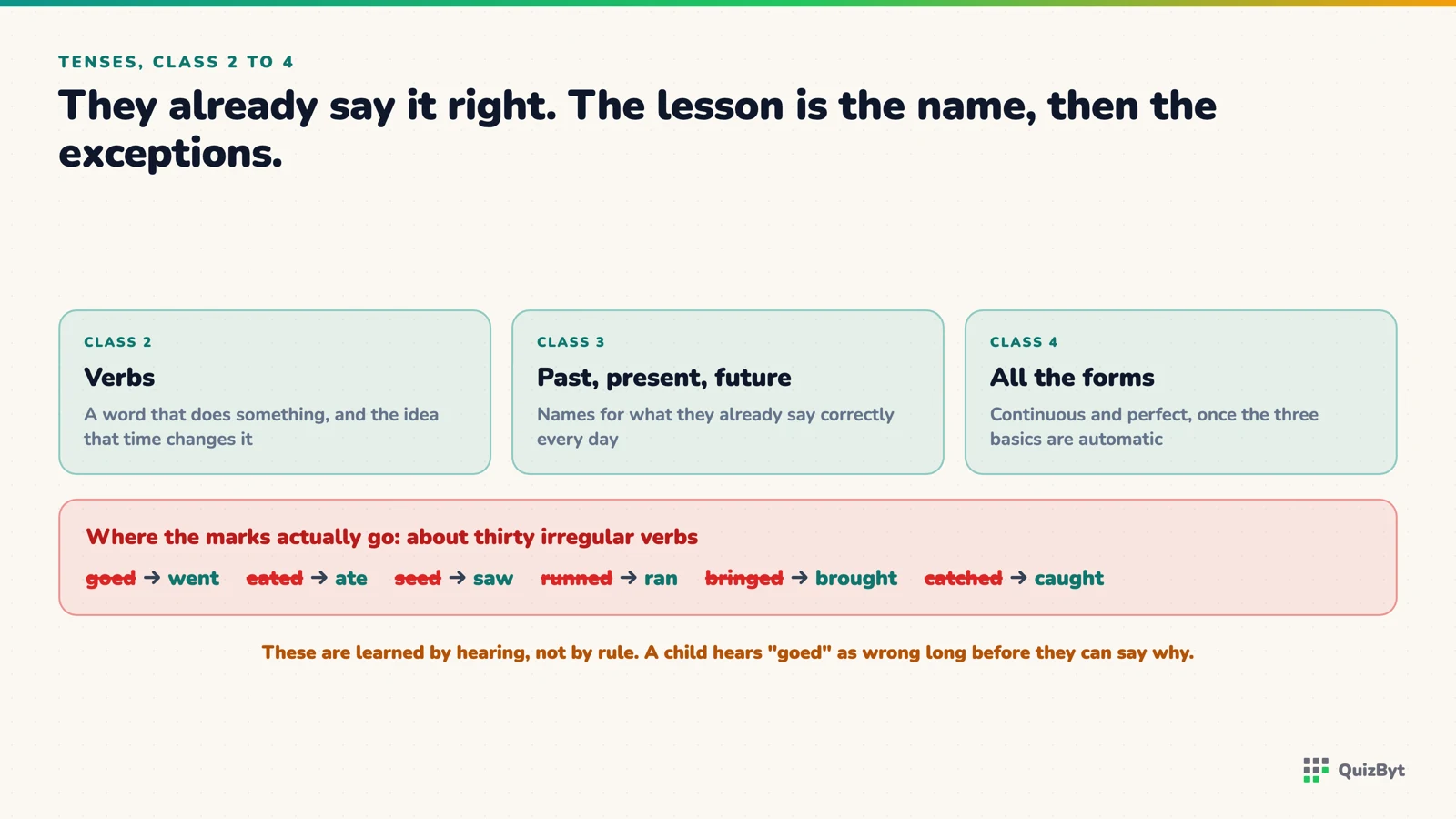
- Irregular verbs are where marks go: went not goed, ate not eated, saw not seed. There are about thirty that matter, and they are learned by hearing, not by rule.
- Read-aloud matters here more than in most topics. A child hears "goed" as wrong before they can explain why.
A Class 2 child who says "yesterday I went to my grandmother's house and we ate mangoes" has just used the past tense twice, both times irregularly, both times correctly. They do not know the word "tense". They do not need to yet. The lessons on tenses are mostly about giving names to something the child already does, and then dealing with the exceptions where the ear has not caught up.
Class by class
- Class 2: what a verb is, and the idea that verbs change with time. Verbs and Tenses.
- Class 3: past, present and future, named and practised. Tenses: Past, Present and Future, free, and read aloud.
- Class 4: all the forms, including "I am walking" and "I have walked". Tenses: All Forms.
The exceptions are the topic
The regular rule is easy: add -ed. Walk, walked. Jump, jumped. Children pick it up in a day and then, as good learners do, apply it everywhere. Go, goed. Eat, eated. See, seed. The marks in this topic are lost almost entirely on irregular verbs, and there are only about thirty that matter at this age.
They are not learned by rule, because there is no rule. They are learned by hearing them used, often, until "goed" sounds wrong before the child can say why. This is why the Class 3 lesson reads its examples aloud: the ear does the work that a table of verbs cannot.
Class 4: more forms than a child expects
English has twelve tense forms, and Class 4 meets most of them. The grammar is not the hard part; a child who can say "I have been waiting for ages" already has it. The hard part is the names. "Present perfect continuous" is harder than the thing it describes. The Class 4 lesson introduces each form with what it is for (something that started in the past and is still going) before it gives the name, which is the order children actually learn in.
A week of practice
Read the lesson for your child's class once, then take the quiz every day for a week, easy level. Ten minutes. The quiz marks itself and shows the correct answer with the reason for each, so "goed" is corrected the moment it appears rather than in red ink days later.
Questions parents ask
What are the three basic tenses?
Past (I walked), present (I walk) and future (I will walk). Class 3 teaches these three; Class 4 adds the continuous forms (I am walking) and the perfect forms (I have walked).
Why does my child write "goed" and "eated"?
Because they have learned the rule (add -ed for the past) and are applying it to the verbs that break it. That is a sign of good learning, not bad. The fix is exposure: the thirty or so common irregular verbs are learned by hearing them used, which is why the Class 3 lesson is read aloud.
How long does it take to learn tenses?
The basic three, a week of short daily practice for most Class 3 children. The full set of forms in Class 4 takes longer because there are twelve of them, and the names (present perfect continuous) are harder than the grammar.
Which lesson is free?
The Class 3 lesson, Tenses: Past, Present and Future, is free to read without an account.
Responses
Sign in to join the conversation. Responses are open to people with a QuizByt account, which is how we keep this a place you would let your child read.
Loading responses…
Lessons that talk, quizzes that mark themselves, games that make kids think
QuizByt is matched to your child's class. Classes 1–10 and Cambridge O Level. Every subject opens with a free lesson, quiz and worksheet, no account needed.
 Forces for Class 1 to 3: Push, Pull, Gravity and FrictionA push or a pull. That is a force, and a six-year-old can feel one. The trouble starts when the words arrive before the feeling. Three lessons that keep the order right, from opening a door to why a ball rolls to a stop.Read the article →
 Fractions From Halves to Equivalence: Class 2 to Class 6Fractions are where a lot of children decide they are "bad at maths". Almost always the decision is made in one specific place: the jump from halves and quarters to equivalent fractions. Here is the whole road, and where to slow down.Read the article →
 Classes 4 to 8: When Marks Start to Mean SomethingThis is where most students quietly pick up the study habit that limits them for the next eight years, and where it is easiest to replace.Read the article →