
Forces for Class 1 to 3: Push, Pull, Gravity and Friction
A push or a pull. That is a force, and a six-year-old can feel one. The trouble starts when the words arrive before the feeling. Three lessons that keep the order right, from opening a door to why a ball rolls to a stop.
The short version
- A force is a push or a pull. Everything else in the topic is a kind of push or pull, or what one does to an object.
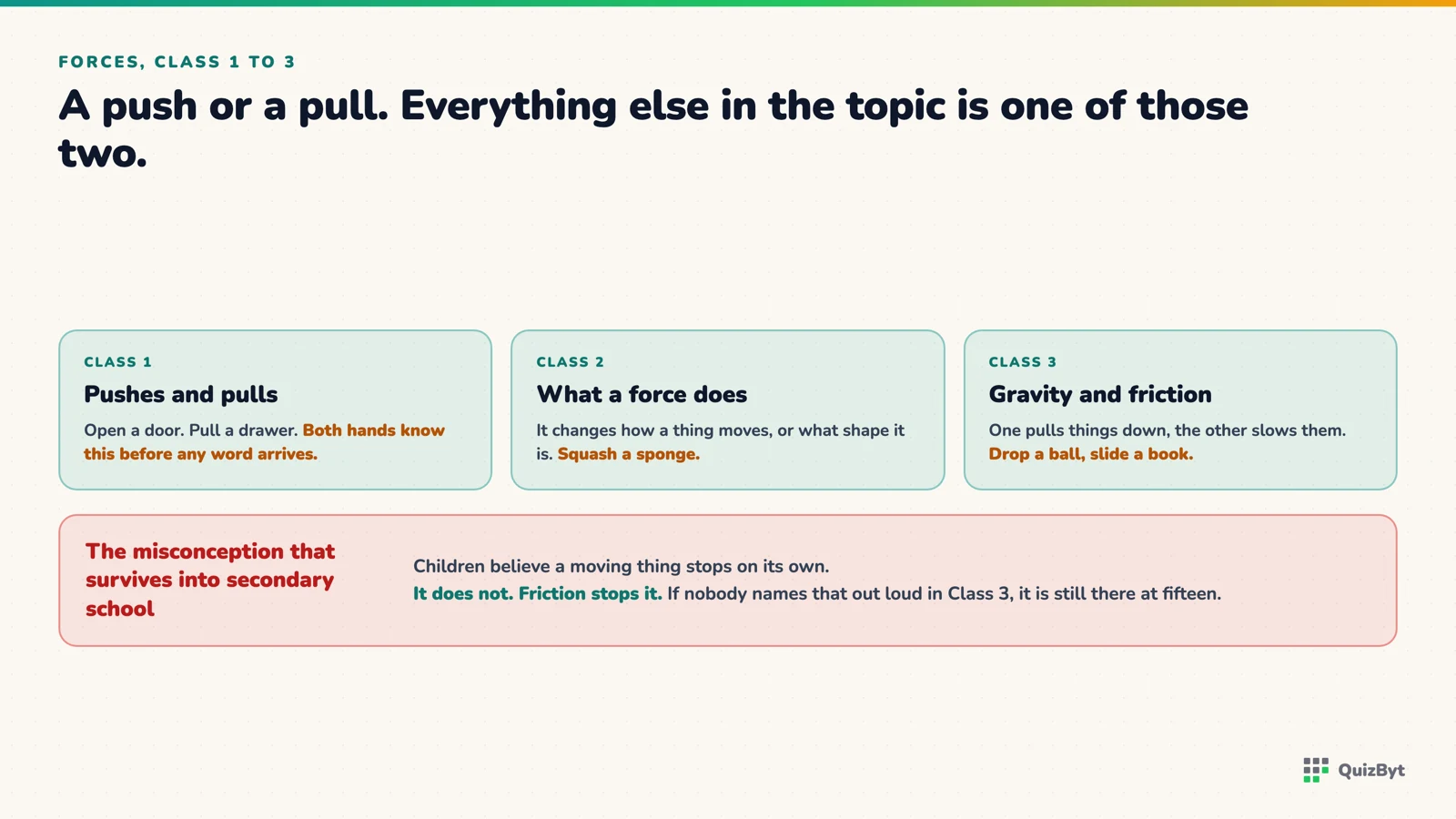
- Class 1: pushes and pulls. Class 2: forces change how things move and what shape they are. Class 3: gravity pulls things down and friction slows them.
- Children believe a moving thing stops on its own. It does not; friction stops it. That misconception survives into secondary school if nobody names it.
- Every example in these lessons is something a child can do with their hands: open a door, squash a sponge, drop a ball, slide a book.
Science at this age has one rule: the feeling comes before the word. A child who has pulled a door open and pushed a toy car understands force. A child who has been told "a force is a push or a pull" and asked to write it down has learned a sentence.
The ladder
- Class 1: pushes and pulls, found in the room. Push and Pull Forces, free, and read aloud.
- Class 2: what a force does. It changes movement (start, stop, faster, slower, turn) or shape (squash, stretch, bend, twist). Forces, Movement and Shape.
- Class 3: two forces with names. Gravity pulls everything down. Friction slows things that rub. Forces, Gravity and Friction.
The misconception that lasts
Roll a ball along the floor and it stops. Ask why and almost every child, and a fair number of adults, will say it ran out of push. It did not. Nothing runs out of push. It stopped because the floor rubbed against it, and that rubbing is friction. On ice it would go much further, and in space it would never stop at all.
This is worth getting right in Class 3 because it comes back, in Class 9 physics, as Newton's first law, and a child who still believes things stop on their own will find that law incomprehensible. Named early, it is a fact. Named late, it is an argument with intuition.
Why every example is a thing to do
The lessons use a door, a sponge, a ball and a book because the child has all four. A diagram of a force is an arrow, and an arrow is an abstraction; a sponge in the hand is not. Class 1 and 2 are read aloud so a child who cannot yet read the word "friction" can still learn what it does.
The quiz
Each lesson ends on a quiz with pictures: which one is a push, which one is a pull, what will happen when the ball reaches the carpet. Answers appear at the end with the reason for each. Fifty per cent or better earns credits for the games, which for this age include a maze and a shape sorter that are, unannounced, more forces practice.
Questions parents ask
What is a force, for a Class 1 child?
A push or a pull. When you open a door you pull it. When you kick a ball you push it. That is the whole definition at this age.
What does Class 2 add?
That forces do two things: change how something moves (start it, stop it, speed it up, turn it) and change its shape (squash, stretch, bend, twist). Squeeze a sponge and you have done the second one.
What is friction, simply?
The force that slows things down when they rub against each other. A ball rolls to a stop because of friction with the ground. Without it the ball would keep going, which children find hard to believe until they think about ice.
Which lesson is free?
The Class 1 lesson, Push and Pull Forces, is free to read without an account.
Responses
Sign in to join the conversation. Responses are open to people with a QuizByt account, which is how we keep this a place you would let your child read.
Loading responses…
Lessons that talk, quizzes that mark themselves, games that make kids think
QuizByt is matched to your child's class. Classes 1–10 and Cambridge O Level. Every subject opens with a free lesson, quiz and worksheet, no account needed.
 Cells From Class 6 to Class 9: The Same Idea, Three Times DeeperEvery living thing is made of cells. Class 6 says it. Class 8 opens one up. Class 9 explains how each part works. A child who reads the three in order sees biology as one story rather than three exams.Read the article →
 Tenses for Class 2 to 4: Past, Present and Future in a WeekMost children already use tenses correctly when they talk. The lesson is not teaching them the tenses; it is teaching them the names for what they already do, and then the exceptions. That changes how you approach it.Read the article →
 Classes 1 to 3: The Years That Decide Whether Study Feels SafeAlmost nothing academic that happens between six and nine survives to adulthood. The attitude does. Here is what to actually do with these three years.Read the article →