
A Level: Independent Study That Actually Works
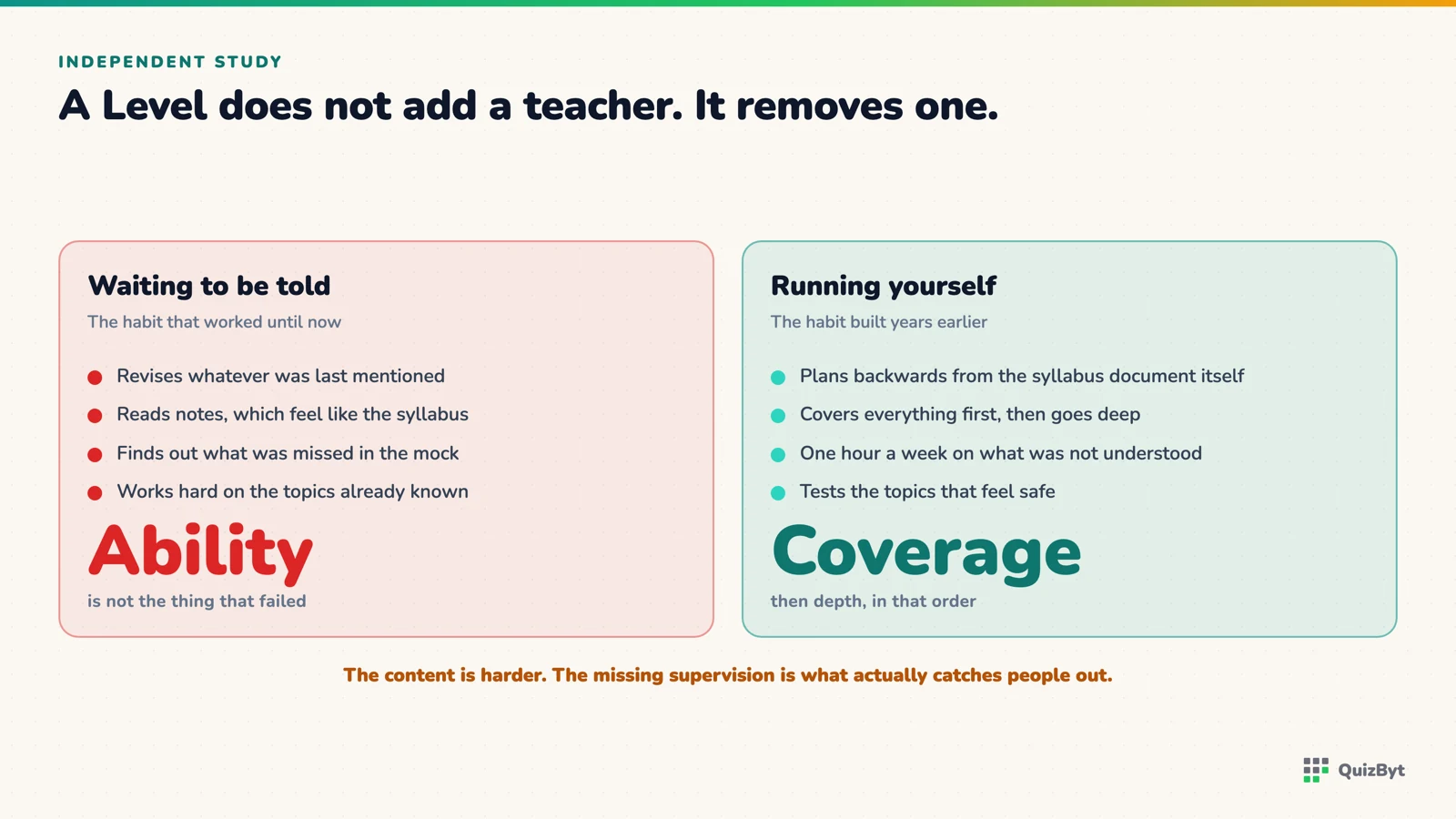
A Level removes the supervision. Students who built self-testing years earlier barely notice; students who relied on being told what to revise struggle regardless of ability.

The short version
- A Level's real difficulty is self-direction: the content is harder, but the missing supervision is what catches most students out.
- Plan backwards from the syllabus document itself rather than from lesson notes.
- Depth matters more than at any earlier stage, but only after coverage is genuinely complete.
- A weekly review of what you did not understand this week is the single highest-value hour in the timetable.
The difficulty of A Level is usually described as the content. Talk to students a term in and it is rarely the content they name. It is that nobody tells them what to do this evening.
Plan backwards from the syllabus, not forwards from your notes
Notes record what was taught. The syllabus records what can be examined, and the two are never quite the same. Print the syllabus, turn each statement into a line you can rate, and revise against that list.
This is the Class 9 topic map again, at higher resolution. See the board exam plan for the original version. The method scales; the stakes changed.
Self-testing is now the whole method
Nothing else survives contact with A Level volume. Re-reading two years of material is not a plan. Retrieval is the only technique that scales, and it is one of only two rated high utility in the evidence on study techniques.
Practically: for each syllabus line, can you produce the content and the reasoning, from memory, on paper? If not, that line is the work.
Depth, but only after coverage
A Level rewards depth in a way earlier stages do not, the nuance, the exception, the comparison between two models. But depth on a syllabus with holes in it scores worse than complete coverage at moderate depth. Finish the map first, then deepen.
The weekly hour that is worth the most
Once a week, write down everything you did not fully understand that week. Not "revise chapter 4", the specific thing: why does the rate not depend on concentration here.
Then deal with that list: work it out, look it up, or take it to a teacher. Almost all A Level disasters are a small list of misunderstandings that were never written down and therefore never resolved, discovered at the end.
Explaining is the fastest audit
If you can explain a topic without notes to someone who does not know it, including why, you know it. If you find yourself reciting phrases, you do not. This takes minutes and no materials, and it is more accurate than any amount of feeling prepared.
QuizByt's catalogue runs to O Level, so at A Level it is most useful for shoring up the foundations underneath a topic, the Class 9–10 and O Level material a new topic assumes you still have. Browse the subjects, and see how to read a score when one of those foundations turns out to be softer than expected.
Questions parents ask
How many hours a week should an A Level student study independently?
Less useful a question than how it is spent. Spaced, self-tested hours across the week beat a large undirected block, and the number that matters is topics closed rather than hours logged.
Should I use the syllabus document directly?
Yes. It is the definitive list of what can be examined, and working from it prevents the common failure of revising your notes rather than the course.
Is group study useful at A Level?
If it involves explaining to each other, yes, explaining is retrieval. If it involves reading in the same room, it is company rather than study.
What should I do when I do not understand something at all?
Flag it and move on the same day, then bring it to a teacher within the week. The expensive failure is quietly avoiding it until the final month.
Responses
Sign in to join the conversation. Responses are open to people with a QuizByt account, which is how we keep this a place you would let your child read.
Loading responses…
Lessons that talk, quizzes that mark themselves, games that make kids think
QuizByt is matched to your child's class. Classes 1–10 and Cambridge O Level. Every subject opens with a free lesson, quiz and worksheet, no account needed.
 What a Falling Quiz Score Is Actually Telling YouA score is a measurement, not a verdict. Read properly, a bad one is the most useful thing that happened all week, and there are only about four things it can mean.Read the article →
 QuizByt vs Google Classroom: What Each One Actually DoesThey are not the same kind of tool, and pretending otherwise helps nobody. Classroom is a place to hand things out; QuizByt is a place where the work marks itself. Here is exactly where they overlap and where they do not.Read the article →
 "No Phone Until Fifteen": The Case For and Against a Total BanSome parents keep devices away from children entirely. They have good reasons, and they are missing something. An honest look at both sides, and a middle path that keeps the benefits of each.Read the article →