
Classes 9 and 10: A Board Exam Plan That Starts Early
Board exams are the first test of coverage rather than cleverness. The students who do well are rarely the quickest. They are the ones who knew their weak topics in month two.

The short version
- Board exams reward complete coverage, so the first task is a map of every topic, not more study of the topics you like.
- Rate every topic yourself early, then test the ones you rated highest: confidence is where the nasty surprises hide.
- Past papers are a late-stage tool; topic quizzes are the early-stage one.
- The month before the exam should be revision of known weaknesses, not first contact with new material.
The defining feature of a board exam is that it can ask about anything on the syllabus. Not the interesting parts, not the parts the teacher emphasised, anything. That single fact should shape the whole plan, and usually does not.
Step 1: build the map before you study anything
Write out every topic in every subject. Not chapters: topics. For most subjects this is between twenty and forty lines, and producing it takes an evening.
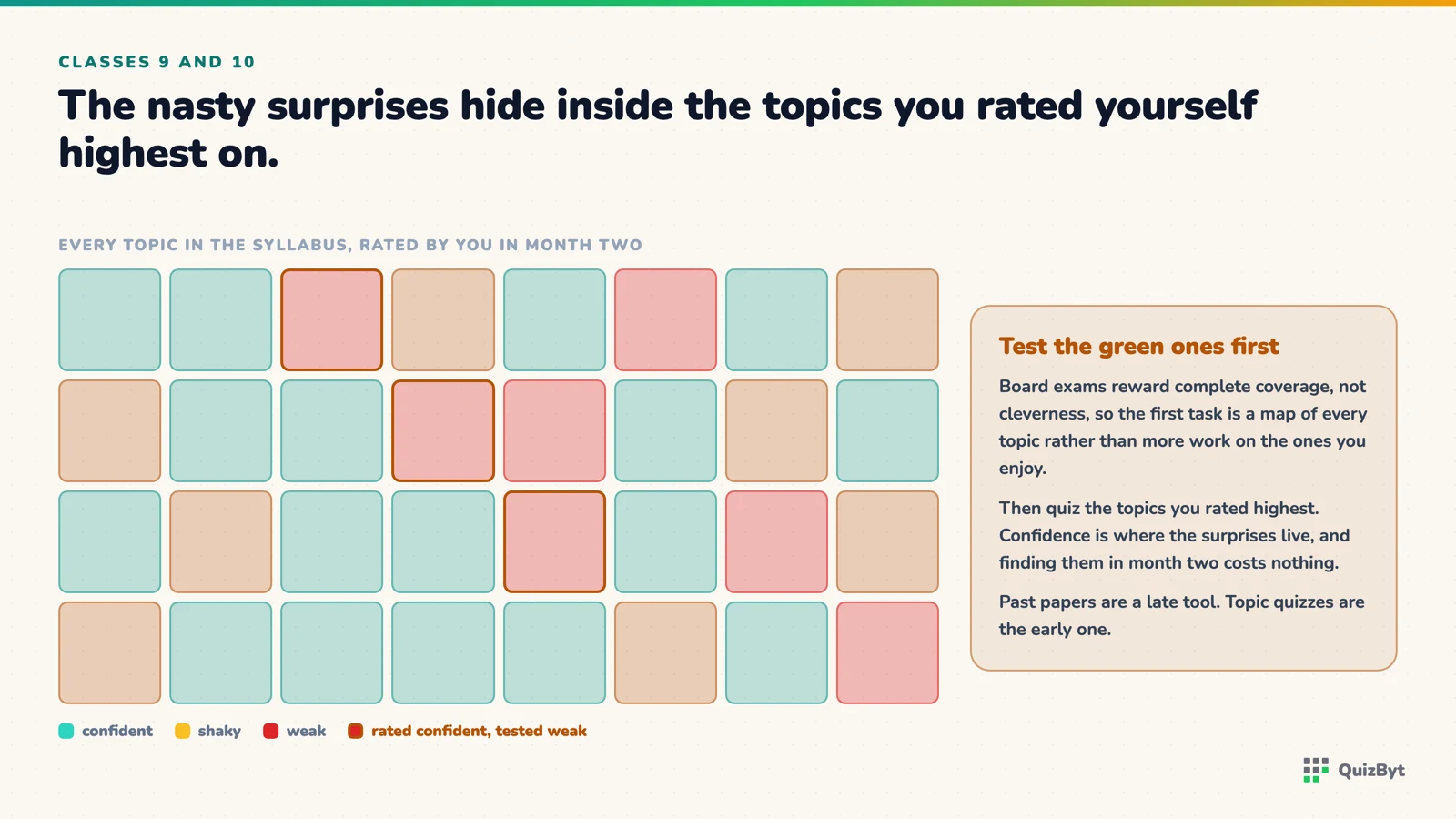
Then rate each one yourself, honestly: solid / shaky / have not really understood it. This list is the plan. Everything else is execution.
Step 2: test the ones you rated "solid"
This is the counterintuitive step and the one that pays. Students are reliably overconfident about topics they have re-read, and confidence is exactly where board exams do their damage. Take a short quiz on three topics you were sure about. Some of them will not survive.
QuizByt's quizzes suit this because they are topic-sized (around six questions at a chosen difficulty) so auditing a self-rating takes minutes rather than an afternoon. Class 9, Class 10 and O Level content is all in the same catalogue.
Step 3: weekly, work the weak list
Each week, take the two weakest topics. Read the lesson once, take the quiz, read only the explanations you got wrong, and come back to that same topic the following week. Re-rate it when you do.
The twenty-minute structure works unchanged here; there are simply more weeks of it.
Step 4: past papers, and not before
Past papers are a test of assembly, timing, question interpretation, how much to write. They are close to useless while the underlying topics are still shaky, because a bad paper score in month three tells you what you already knew.
Start them once the map is mostly "solid", typically the final two to three months. Then do them properly: full timing, no notes, marked strictly.
Step 5: the last month is not for new material
If a topic is genuinely new in the final month, it is usually better to make it shallow-but-present than to attempt depth. Depth in the final month comes from the weak list you have been working since Class 9.
The worksheet habit
Board exams are written by hand, at speed, for hours. That is a physical skill and it decays without practice. Printed worksheets are worth doing on paper for that reason alone, every QuizByt topic has one, and answer keys are included on Premium so it can be marked without waiting for anyone.
Heading to Cambridge instead? O Level asks for something different.
Questions parents ask
When should board exam preparation start?
At the start of Class 9, not partway through Class 10. Not with intensity, with coverage, so no topic is met for the first time late.
How many past papers should I do?
Enough to learn the paper's shape and timing, which is usually fewer than students think. Past papers test assembly; topic quizzes build the parts being assembled.
What is the biggest mistake in board exam preparation?
Revising the topics that feel good. Time spent on a strong topic returns almost nothing; the same hour on a weak one moves the grade.
Is it too late to start in the last three months?
No, but the plan changes: triage to the highest-weight topics, and accept that some coverage will be shallow. Starting earlier is cheaper than starting harder.
Responses
Sign in to join the conversation. Responses are open to people with a QuizByt account, which is how we keep this a place you would let your child read.
Loading responses…
Lessons that talk, quizzes that mark themselves, games that make kids think
QuizByt is matched to your child's class. Classes 1–10 and Cambridge O Level. Every subject opens with a free lesson, quiz and worksheet, no account needed.
 Classes 4 to 8: When Marks Start to Mean SomethingThis is where most students quietly pick up the study habit that limits them for the next eight years, and where it is easiest to replace.Read the article →
 O Level: What Actually Changes, and How to PrepareThe jump to Cambridge O Level is not mainly about more content. It is that memorising worked examples stops being enough, and applying a method to something unfamiliar starts being the whole thing.Read the article →
 Fractions From Halves to Equivalence: Class 2 to Class 6Fractions are where a lot of children decide they are "bad at maths". Almost always the decision is made in one specific place: the jump from halves and quarters to equivalent fractions. Here is the whole road, and where to slow down.Read the article →