
O Level: What Actually Changes, and How to Prepare
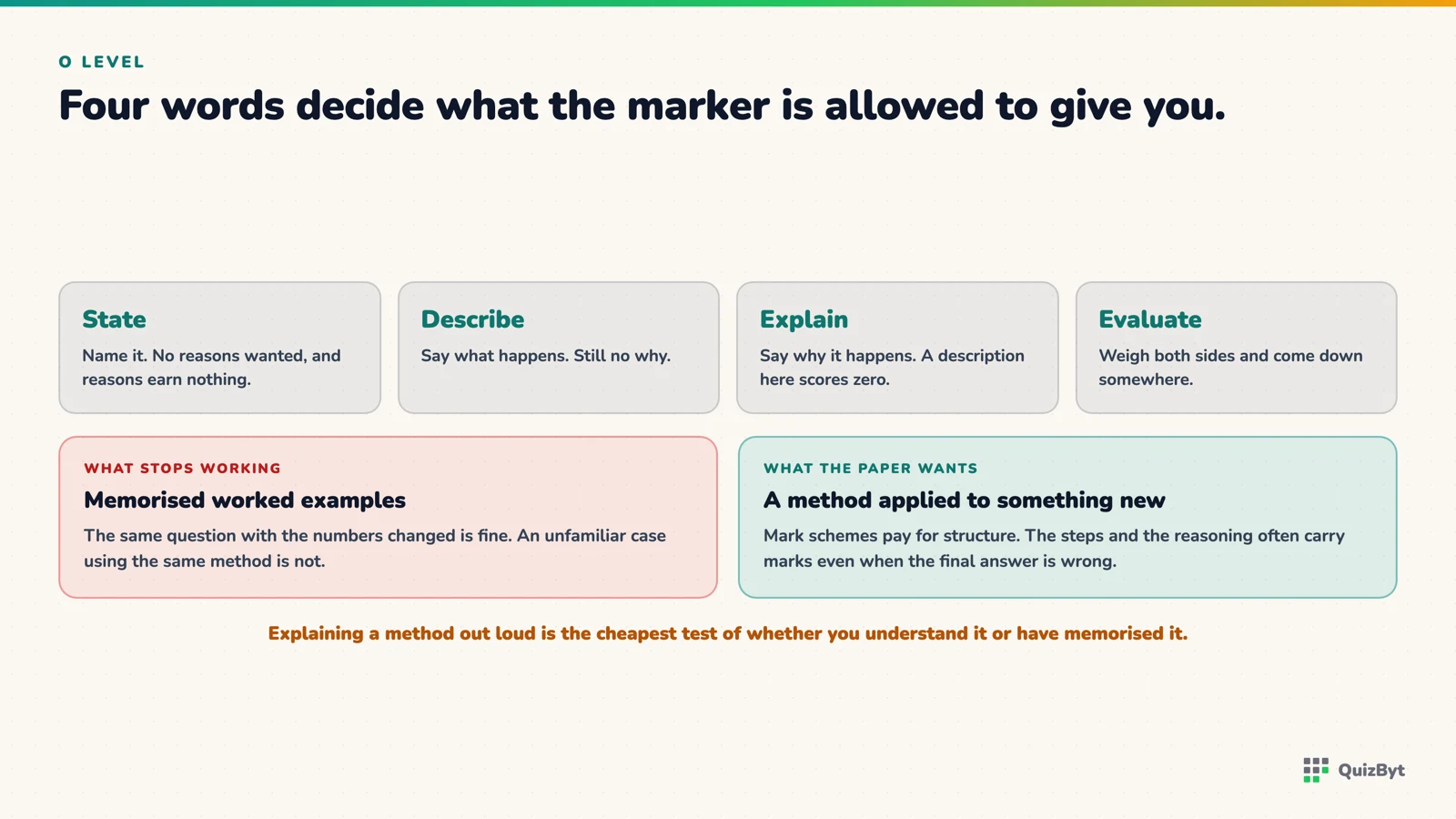
The jump to Cambridge O Level is not mainly about more content. It is that memorising worked examples stops being enough, and applying a method to something unfamiliar starts being the whole thing.
The short version
- O Level rewards applying a method to an unfamiliar case, which memorised worked examples do not prepare you for.
- Mark schemes reward structure: the steps and the reasoning often carry marks even when the final answer is wrong.
- Explaining a method out loud is the cheapest test of whether you understand it or have memorised it.
- Command words (state, describe, explain, evaluate) are instructions, and answering the wrong one loses marks you had earned.
Students who did well in national board exams often have a bruising first term of O Level, and usually conclude the subject got harder. Mostly it did not. The question changed.
From "do you know it" to "can you use it"
A board-style question tends to ask you to reproduce a method on a familiar case. A Cambridge question is more likely to give you a situation you have never seen and expect you to work out which method applies.
That is why memorising twenty worked examples stops paying. The twenty-first is not on the list, and the skill being tested was never the examples. It was knowing why the method works and therefore when it applies.
The test for whether you understand something
Explain the method out loud, without notes, to someone who does not know it, including why each step is there. If you can only say what to do and not why, you have memorised a procedure.
This costs two minutes per topic and is brutally reliable. It is the older sibling of asking a small child why, and it works for the same reason.
Read the mark scheme as well as the paper
Most students do past papers and check whether the answer matched. The mark scheme is more useful than the answer: it shows that marks are frequently awarded for the steps, the reasoning, the correct units, the stated assumption, often several marks before the final line.
Two consequences. Showing method matters even when you are unsure. And a wrong final answer with correct reasoning is worth far more than a bare correct answer, which is the opposite of what students assume.
Command words are instructions
State wants one line. Describe wants what happens. Explain wants why it happens. Evaluate wants both sides and a judgement. Answering the wrong verb is one of the most common ways to lose marks on material you actually knew.
Underline the command word before writing anything. It takes a second and it is free marks.
A preparation shape that matches
- Topic quizzes for the recall-and-method layer, at the skilled difficulty rather than the comfortable one.
- Explain-it-out-loud for every method, to catch memorisation posing as understanding.
- Past papers with the mark scheme open, marking yourself strictly, in the final months.
- Written practice by hand, because the exam is handwritten and structuring an answer under time pressure is its own skill.
QuizByt carries O Level alongside Classes 1–10 in the same catalogue, with three difficulty levels per topic and printable worksheets for the handwritten layer. Browse by subject.
Questions parents ask
Is O Level harder than a national board exam?
Different rather than uniformly harder. O Level asks you to transfer a method to a new situation; a national board exam usually asks for thorough coverage of a defined syllabus. Students strong at memorising often find O Level harder at first.
How important are mark schemes?
Very. They show where marks are actually awarded, which is frequently for method and reasoning rather than the final line. Reading them changes how you write answers.
What are command words?
The verb that tells you what kind of answer is wanted, state, describe, explain, compare, evaluate. Writing an excellent description when the question said explain loses marks on a correct answer.
Can I prepare for O Level with topic quizzes?
For the recall and method layer, yes. For the writing layer you also need past-paper practice against a mark scheme, because structuring the answer is a separate skill.
Responses
Sign in to join the conversation. Responses are open to people with a QuizByt account, which is how we keep this a place you would let your child read.
Loading responses…
Lessons that talk, quizzes that mark themselves, games that make kids think
QuizByt is matched to your child's class. Classes 1–10 and Cambridge O Level. Every subject opens with a free lesson, quiz and worksheet, no account needed.
 Classes 9 and 10: A Board Exam Plan That Starts EarlyBoard exams are the first test of coverage rather than cleverness. The students who do well are rarely the quickest. They are the ones who knew their weak topics in month two.Read the article →
 A Parent's Guide to the Kindergarten-to-A-Level JourneyWhat your job is at each stage, and (more usefully) what it stops being. The commonest mistake is running stage two parenting during stage five.Read the article →
 Adjectives for Class 2 and 3: Describing Words a Child Can Actually UseChildren can name adjectives long before they use them well. The gap closes when the word is attached to a thing in front of them, not a list on a page. How the two lessons do that, and how to do it at the dinner table.Read the article →