
Why a Child's Engagement With Digital Devices Matters, and Where Parents Should Look
Children will spend their working lives with screens. The question was never whether they use devices, but whether they learn to use them as tools or get used by them. Here is what to watch.

A child born today will apply for jobs, manage money, learn new skills and talk to friends through screens for the rest of their life. Keeping them away from devices until sixteen does not prepare them for that; it just delays the lesson until nobody is watching. The goal is a child who uses devices rather than one who is used by them. That is a skill, and like every skill it is learned by doing, with guidance.
Engagement is not the same as time
Two children spend an hour on a tablet. One followed a lesson, answered twenty questions, got twelve right, saw why eight were wrong, and unlocked a puzzle. The other watched forty short videos chosen by an algorithm. Same hour. One child was engaged; the other was occupied. When people talk about digital engagement mattering, this is the distinction they mean, and it is the one the "how many hours" debate keeps missing.
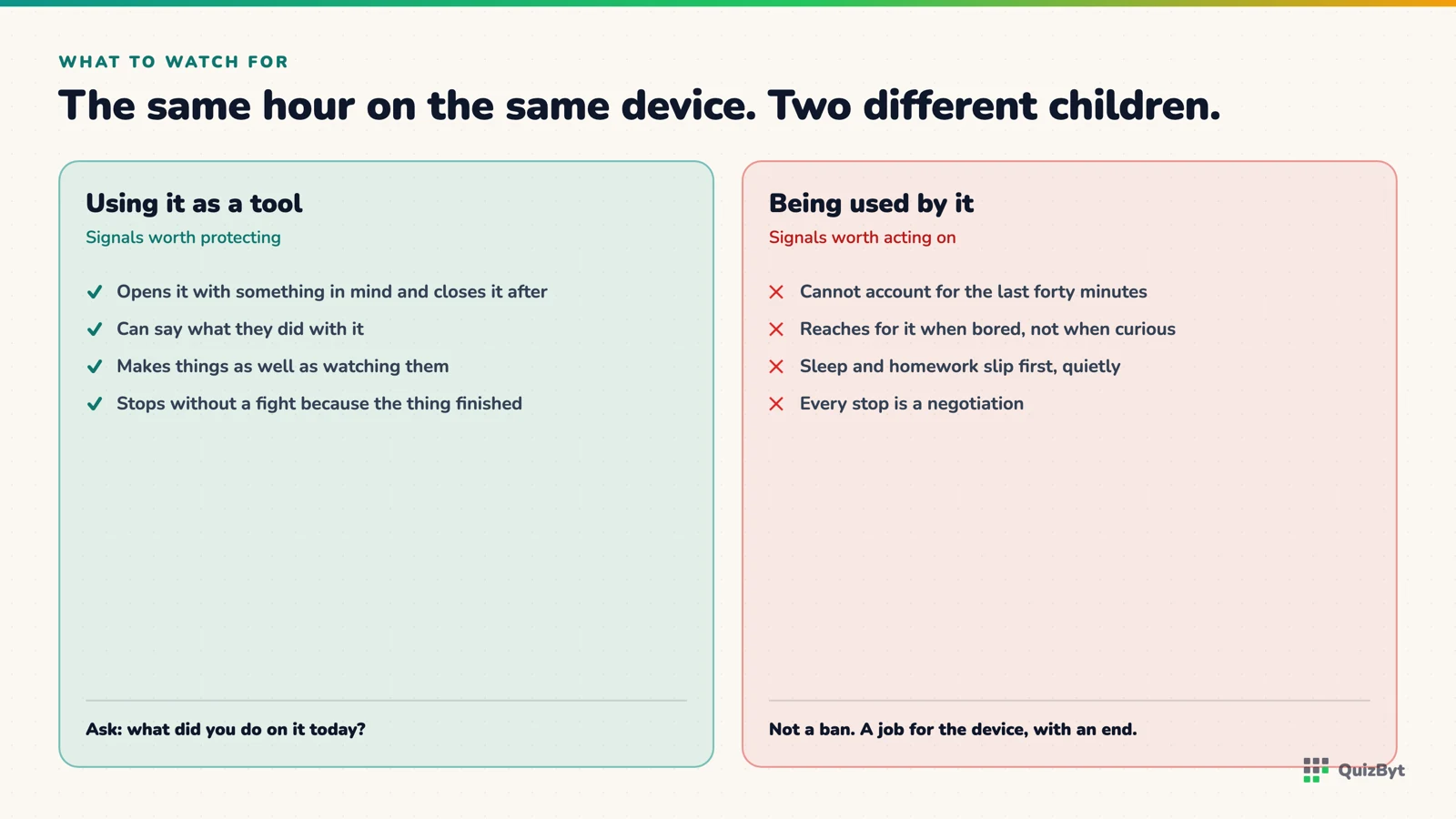
Four things to actually watch
1. Direction of attention
Is the child driving, or being driven? Choosing a topic, replaying a scene, trying a harder quiz, that is a child in charge. Swiping to whatever appears next is the reverse.
2. What they can do afterwards
Engagement leaves a trace. After a good session a child can tell you something, show you something, or do something they could not before. After a passive one they can name what they watched and nothing else.
3. How it ends
A lesson ends with a quiz and a result. A game ends with a win or a retry. Healthy digital activity has a shape: a beginning, work, a finish. Watch for activities with no end. Those are the ones that end in an argument.
4. Mood on the way out
A child who finishes a learning session is usually a little proud. A child pulled off a feed is usually irritable. The mood on exit tells you more than any timer.
Where the community comes in
Parents cannot do this alone, and should not have to. Schools that set homework on interactive platforms make active use the default. Teachers who check every quiz question mean a parent does not have to. A child's friends using the same learning games turns study into something social. That is why we built QuizByt with a school portal and a Teacher Hub alongside the student side: engagement is easier when everyone around the child is pointing the same way.
Responses
Sign in to join the conversation. Responses are open to people with a QuizByt account, which is how we keep this a place you would let your child read.
Loading responses…
Lessons that talk, quizzes that mark themselves, games that make kids think
QuizByt is matched to your child's class. Classes 1–10 and Cambridge O Level. Every subject opens with a free lesson, quiz and worksheet, no account needed.
 AI Gives Answers. Who Trains the Mind? A Parent's Duty in the Age of ChatGPTA child can now get any answer in seconds. That is genuinely useful, and it is also the fastest way ever invented to skip the thinking that school is for. What parents and communities must offer instead.Read the article →
 The Community's Job: Raising Digital Learners TogetherA child's relationship with screens is shaped by parents, teachers, schools and friends, not by one rule at one kitchen table. What each of them can do, and how a shared platform makes it easier.Read the article →
 Why Students Scroll, and How to Use It Instead of Fighting ItThe habit schools complain about is a trained skill: rapid evaluation, self-pacing, and instant abandonment of anything that does not earn attention. Learning material can meet that standard.Read the article →