
Cells From Class 6 to Class 9: The Same Idea, Three Times Deeper
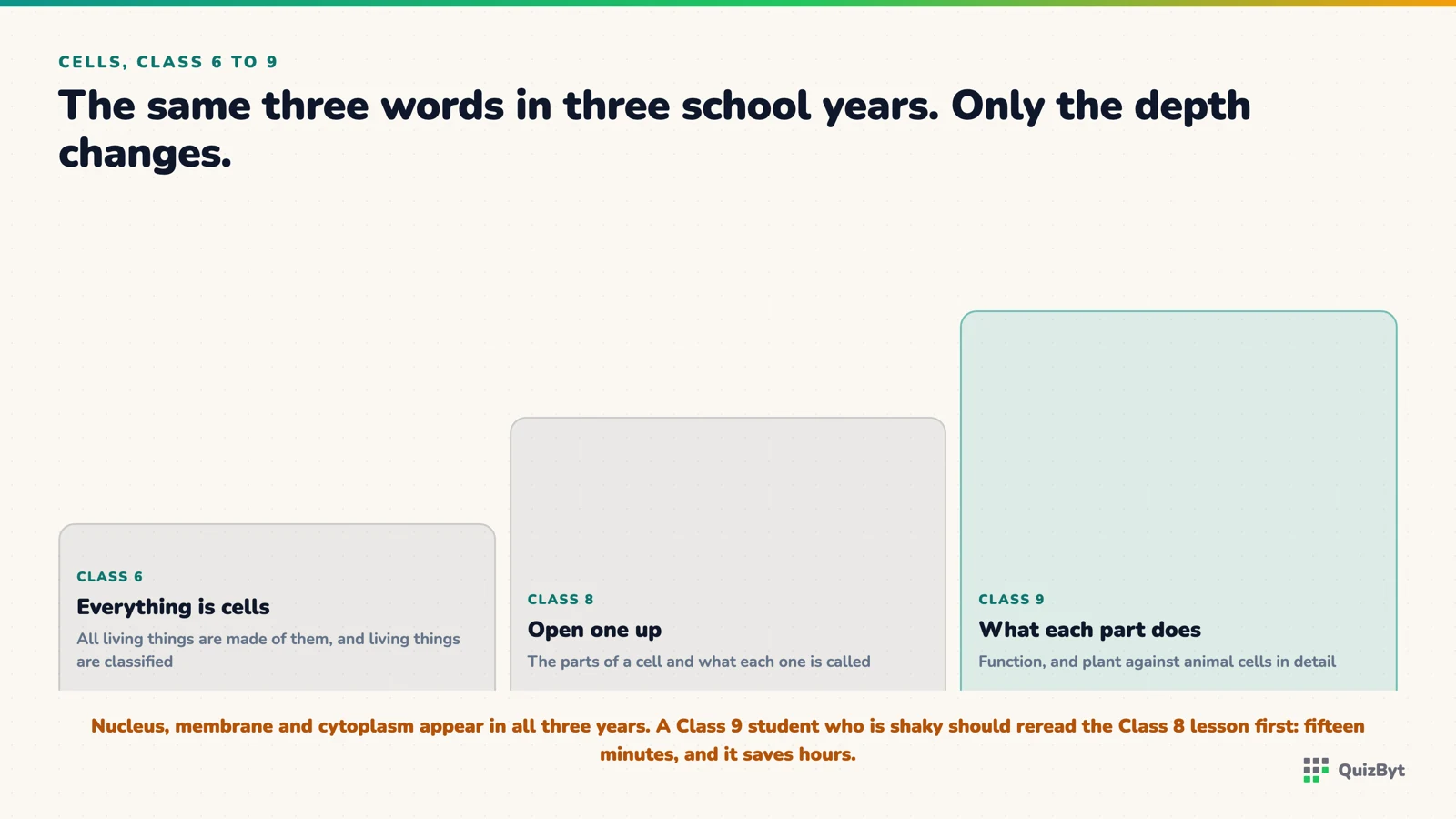
Every living thing is made of cells. Class 6 says it. Class 8 opens one up. Class 9 explains how each part works. A child who reads the three in order sees biology as one story rather than three exams.
The short version
- Class 6: all living things are made of cells, and living things are classified. Class 8: the parts of a cell and what they are called. Class 9: what each part does, and plant versus animal cells in detail.
- The nucleus, membrane and cytoplasm appear in all three years. The names do not change; the depth does.
- A child revising for Class 9 who is shaky on the basics should reread the Class 8 lesson first. It takes fifteen minutes and saves hours.
- All three lessons are free to read without an account.
Biology has a habit of teaching the same thing several times, and children experience it as three unrelated topics with the same pictures. It is one topic. The cell is introduced in Class 6, opened up in Class 8 and explained in Class 9, and a child who knows that is what is happening finds each year easier than the last instead of harder.
The three passes
- Class 6: all living things are made of cells, and living things can be sorted into groups. Cells and Classification of Living Things, free.
- Class 8: the parts of a cell, named and drawn. Nucleus, membrane, cytoplasm, and for plants the wall, the chloroplasts and the vacuole. Cell Structure and Function, free.
- Class 9: what each part does, and why the plant cell has the extra parts. Introduction to Biology and Cell Structure, free.
The names stay, the depth changes
The nucleus appears in all three years. In Class 6 it is "the control centre". In Class 8 it is a labelled circle in a diagram. In Class 9 it holds the chromosomes and controls which proteins the cell makes. Same word, three depths. A child who has met the word twice before is not learning it in Class 9; they are adding to it.
This is why the order matters more than the pace. A Class 9 student who cannot label a cell diagram has a Class 8 problem, and the fastest fix is to go back and read the Class 8 lesson, which takes fifteen minutes and is not embarrassing because nobody is watching.
Plant and animal
The comparison every exam asks for. Plant cells have three things animal cells do not: a cell wall (for support, because plants have no skeleton), chloroplasts (for photosynthesis, because plants make their own food) and a large vacuole (for storage and for keeping the cell firm). Each extra part exists for a reason a child can understand, and the Class 9 lesson gives the reason rather than the list.
Revising with the quizzes
Each lesson ends on a quiz at three levels. For Class 9 revision, take the Class 8 quiz at the hard level first. A high score means the foundation is there and the time should go into Class 9 material. A low score means the foundation is the problem, and the Class 9 lesson will not fix it.
Questions parents ask
What is a cell, in one sentence?
The smallest unit of a living thing that is itself alive. Your body is made of trillions of them; a bacterium is one.
What is the difference between a plant cell and an animal cell?
A plant cell has a cell wall, chloroplasts and a large vacuole; an animal cell has none of those. Both have a nucleus, a cell membrane and cytoplasm. Class 8 names the differences; Class 9 explains what each extra part is for.
My Class 9 child is struggling with cell biology. Where should they start?
With the Class 8 lesson, Cell Structure and Function, even though it is a year behind. Most Class 9 confusion is Class 8 material that was memorised rather than understood. It is free and takes about fifteen minutes.
Are the lessons free?
Yes, all three linked in this article are free to read without an account. The quizzes need a free account so the score can be saved.
Responses
Sign in to join the conversation. Responses are open to people with a QuizByt account, which is how we keep this a place you would let your child read.
Loading responses…
Lessons that talk, quizzes that mark themselves, games that make kids think
QuizByt is matched to your child's class. Classes 1–10 and Cambridge O Level. Every subject opens with a free lesson, quiz and worksheet, no account needed.
 The Periodic Table From Class 7 to O Level ChemistryThe periodic table looks like a thing to memorise. It is the opposite: it is the thing that means you do not have to memorise. Read it right and it tells you how an element behaves before you have met it.Read the article →
 Forces for Class 1 to 3: Push, Pull, Gravity and FrictionA push or a pull. That is a force, and a six-year-old can feel one. The trouble starts when the words arrive before the feeling. Three lessons that keep the order right, from opening a door to why a ball rolls to a stop.Read the article →
 The Twenty-Minute Daily Habit That Moves a GradeNot three hours on Sunday. Twenty minutes a day, structured a particular way, across one term, and the reason it works is the gap between the sessions, not the minutes inside them.Read the article →