
The Twenty-Minute Daily Habit That Moves a Grade
Not three hours on Sunday. Twenty minutes a day, structured a particular way, across one term, and the reason it works is the gap between the sessions, not the minutes inside them.
The short version
- The same total study time spread across several days beats the same time concentrated in one session.
- Twenty minutes is long enough for one lesson and one quiz, which is a complete cycle rather than a fragment.
- Study at a fixed point in an existing routine (after dinner, before a game) rather than at a fixed clock time.
- Missing a day costs nothing; missing the habit costs the term.
The most common revision plan in the world is "I will do a big session at the weekend". It fails for a reason that has nothing to do with discipline: memory is built by repetition with gaps, and a single long session contains no gaps.
The research position is consistent, spacing the same amount of study across several days outperforms concentrating it, with a robust small-to-medium effect for spaced over massed practice. You are not being asked to work more. You are being asked to work the same amount in a different shape.
The twenty minutes
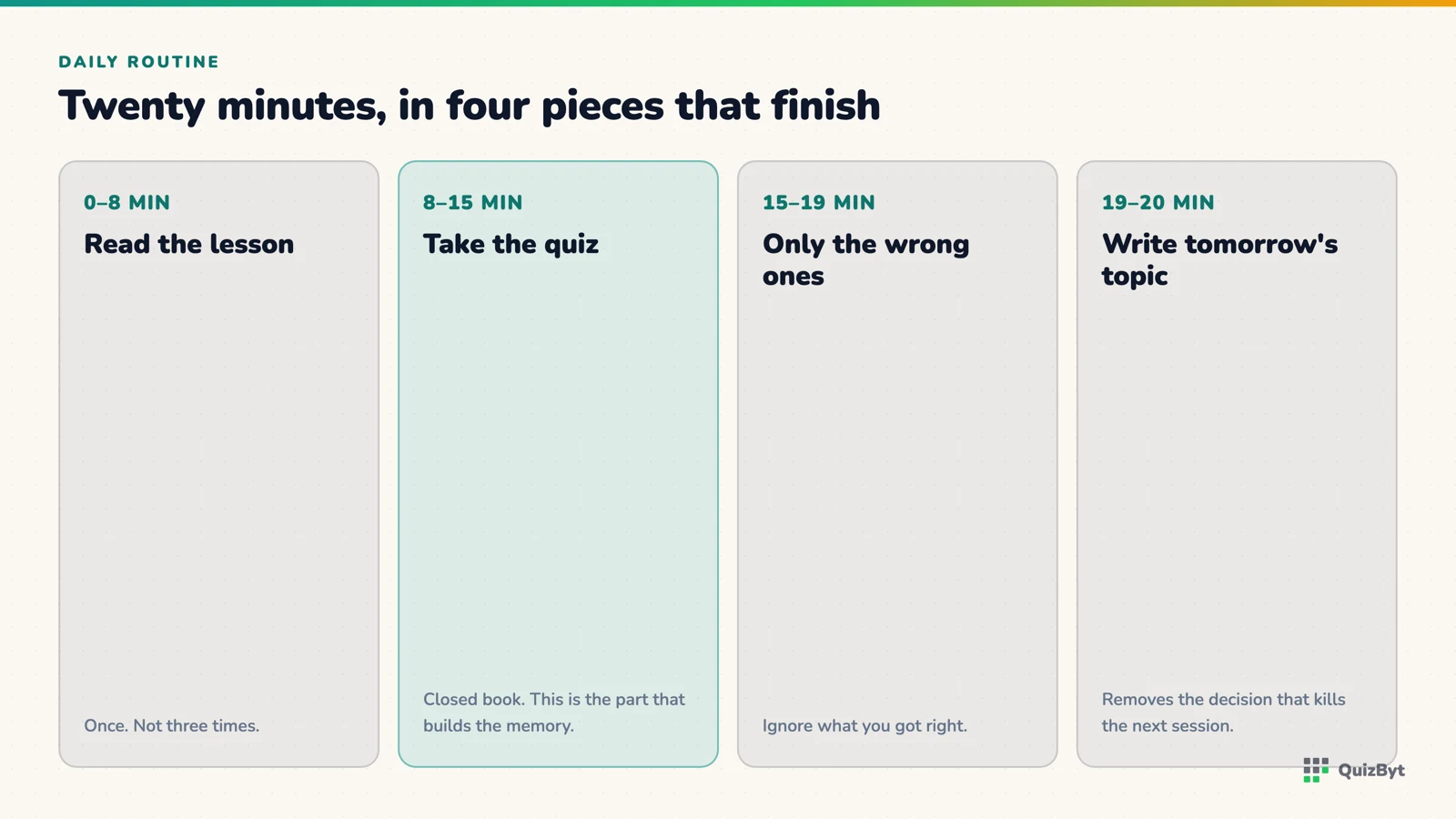
- 0–8 minutes: one lesson, once. One topic. Read it through once, properly, and do not re-read it.
- 8–15 minutes: the quiz on that topic. Immediately, with the lesson closed. This is the part that builds the memory.
- 15–19 minutes: only the wrong answers. Read the explanation for the questions you missed. Ignore the ones you got right.
- 19–20 minutes: write down tomorrow's topic. One line. It removes the decision that usually kills the next session.
That is a complete cycle: input, retrieval, correction, and a hook into tomorrow. Most twenty-minute sessions fail because they are a fragment of a bigger plan that never gets finished.
Anchor it to an event, not a time
"I will study at 6pm" collapses the first evening something happens at 6pm. "I will study after dinner, before I play anything" survives, because the anchor moves with the day.
This is also the honest version of a screen-time bargain. Study first, then games, not as a punishment but because the order is what makes both happen. QuizByt is built around that shape: quizzes earn credits at 50% or better, and credits unlock the games. Parents can go further and set the game window explicitly. See games on a schedule.
What a term looks like
Twenty minutes, five days a week, for a twelve-week term is twenty hours of spaced, self-tested study. The equivalent crammed into the fortnight before exams is twenty hours of panic that produces a fraction of the retention.
The measurable difference is not that the student knows more facts. It is that they know which facts they do not know, because they have been finding out weekly rather than discovering it in the exam hall.
Watch the right number
Track how many topics you have finished, not how many hours you have sat. Hours reward sitting; topics reward finishing. On QuizByt the dashboard shows lessons read per subject and quizzes completed with average scores, so the number in front of you is progress rather than attendance.
Related reading: why a quiz beats re-reading, and how to read your own scores.
Questions parents ask
Is twenty minutes a day really enough?
For maintaining and steadily building, yes. It is roughly seven hours a month, all of it spaced, which the evidence favours over the same hours crammed. Exam season needs more, but a student who has spaced all term needs far less of it.
What time of day is best to study?
Less important than consistency. Attach it to something that already happens every day, because a habit anchored to an event survives better than one anchored to a clock.
What if I miss a day?
Nothing is lost. Start again the next ordinary day. The failure mode is abandoning the routine after a missed day, not the missed day itself.
Should I study one subject a day or several?
One topic per session, rotating subjects across the week. Mixing related problem types within a subject also helps, but switching topic every five minutes does not.
Responses
Sign in to join the conversation. Responses are open to people with a QuizByt account, which is how we keep this a place you would let your child read.
Loading responses…
Lessons that talk, quizzes that mark themselves, games that make kids think
QuizByt is matched to your child's class. Classes 1–10 and Cambridge O Level. Every subject opens with a free lesson, quiz and worksheet, no account needed.
 Kindergarten to A Level: The Whole Road, MappedEleven or more years of school, and the thing that has to change at each stage is not how hard a student works but what "studying" actually means. Here is the whole progression in one place.Read the article →
 Classes 1 to 3: The Years That Decide Whether Study Feels SafeAlmost nothing academic that happens between six and nine survives to adulthood. The attitude does. Here is what to actually do with these three years.Read the article →
 Cells From Class 6 to Class 9: The Same Idea, Three Times DeeperEvery living thing is made of cells. Class 6 says it. Class 8 opens one up. Class 9 explains how each part works. A child who reads the three in order sees biology as one story rather than three exams.Read the article →