
The Periodic Table From Class 7 to O Level Chemistry
The periodic table looks like a thing to memorise. It is the opposite: it is the thing that means you do not have to memorise. Read it right and it tells you how an element behaves before you have met it.
The short version
- The table is arranged so that elements in the same column (group) behave alike. That is its whole purpose, and the reason it is worth understanding rather than memorising.
- Class 7: what elements are and the first twenty. Class 9: groups, periods and the trends down and across. O Level: periodicity, the reasoning behind the trends, in the depth the Cambridge paper asks for.
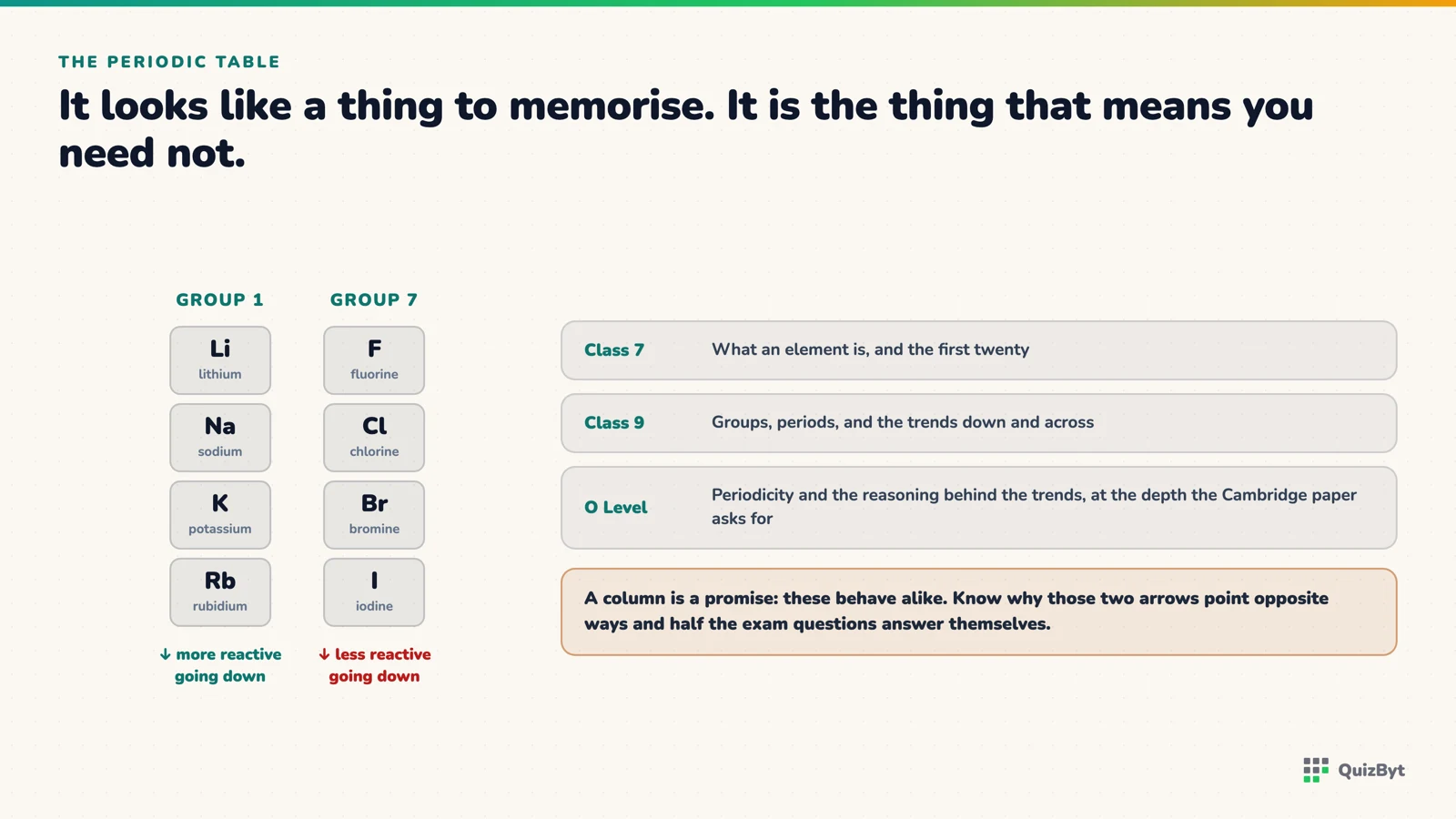
- Group 1 metals get more reactive going down; Group 7 non-metals get less reactive going down. Know why and half the exam questions answer themselves.
- A student who can place an unfamiliar element and predict its behaviour has understood the table. One who has memorised it has not.
Students arrive at the periodic table expecting a memory test and are relieved, or should be, to find the reverse. The table exists so that you do not have to memorise. Its shape encodes how every element behaves, and a student who can read the shape can predict the chemistry of an element they have never heard of. That is the skill the exam is testing, and it is learnable in three passes.
Three passes
- Class 7: what an element is, symbols, and the first twenty. Introduction to the Periodic Table.
- Class 9: groups and periods, and the trends going down a group and across a period. Periodic Table and Periodicity.
- O Level: periodicity properly, with the electron-shell reasoning the Cambridge paper wants written out. The Periodic Table.
What the shape means
A column is a group. Every element in a group has the same number of electrons in its outer shell, and the outer shell is what reacts, so elements in a group behave alike. Sodium and potassium both fizz in water; they are both in Group 1. Chlorine and bromine both bleach; they are both in Group 7.
A row is a period. Going across, each element has one more proton and one more electron than the one before, and the outer shell fills up. That is why the far left is violently reactive metal and the far right is a gas that reacts with nothing.
The two trends that answer half the questions
Going down Group 1, the metals get more reactive: lithium fizzes, sodium fizzes hard, potassium catches fire. Going down Group 7, the non-metals get less reactive: fluorine is ferocious, iodine is mild. Both trends have the same cause, the distance of the outer electron from the nucleus, and a student who can explain that cause in two sentences has answered most of what O Level asks about the table.
Using the lessons for revision
An O Level student should take the Class 9 quiz at the hard level before reading the O Level lesson. A comfortable score means the O Level lesson is the right place to spend time. A poor one means the Class 9 lesson comes first, and the fifteen minutes it takes will show up in every later topic, because bonding, reactivity and electrolysis all lean on this one.
Questions parents ask
Do I have to memorise the periodic table?
No, and at O Level a copy is provided in the exam. What to know by heart is the first twenty elements, the group names, and the trends. Everything else you read off the table.
What is a group and what is a period?
A group is a column: elements in the same group have the same number of outer electrons and behave alike. A period is a row: going across a period, each element has one more proton and one more electron than the last.
Why do Group 1 metals get more reactive going down?
The outer electron is further from the nucleus and more shielded by inner electrons, so it is lost more easily, and losing it is what the reaction is. Class 9 introduces this; O Level expects it explained.
Which lesson should an O Level student start with?
The O Level lesson, The Periodic Table, if the Class 9 material is secure. If groups and periods are still shaky, the Class 9 lesson first. Fifteen minutes there is worth it.
Responses
Sign in to join the conversation. Responses are open to people with a QuizByt account, which is how we keep this a place you would let your child read.
Loading responses…
Lessons that talk, quizzes that mark themselves, games that make kids think
QuizByt is matched to your child's class. Classes 1–10 and Cambridge O Level. Every subject opens with a free lesson, quiz and worksheet, no account needed.
 How to Choose an Online Quiz System for Your School: Twelve Questions to AskEvery vendor demo shows a quiz being taken. Almost none shows what happens the next morning. Twelve questions that separate a quiz system a school will still be using in a year from one it will quietly abandon.Read the article →
 Cells From Class 6 to Class 9: The Same Idea, Three Times DeeperEvery living thing is made of cells. Class 6 says it. Class 8 opens one up. Class 9 explains how each part works. A child who reads the three in order sees biology as one story rather than three exams.Read the article →
 The Twenty-Minute Daily Habit That Moves a GradeNot three hours on Sunday. Twenty minutes a day, structured a particular way, across one term, and the reason it works is the gap between the sessions, not the minutes inside them.Read the article →