
Counting to 20: Why Reciting Numbers Is Not the Same as Counting
Plenty of three-year-olds can chant to twenty. Ask them to hand you four biscuits and many will hand you a fistful. The gap between those two things is the whole of early number sense.
The short version
- Reciting the number sequence and counting objects are different skills: the first is memorised, the second has to be understood.
- The key idea is cardinality: the last number you say is how many there are, not only the name of the final object.
- One-to-one correspondence (one number per object, touching as you go) is the habit to build first.
- Counting a fixed set backwards, in a different order, or in a ring proves a child really understands it.
Ask a confident three-year-old to count to twenty and many will do it perfectly. Then ask the same child to give you four grapes. A surprising number will grab a handful, or count "one, two, three, four, five, six" while pushing grapes towards you, and stop when the grapes run out.
They have not forgotten how to count. They never were counting. They were reciting.
Two completely different skills
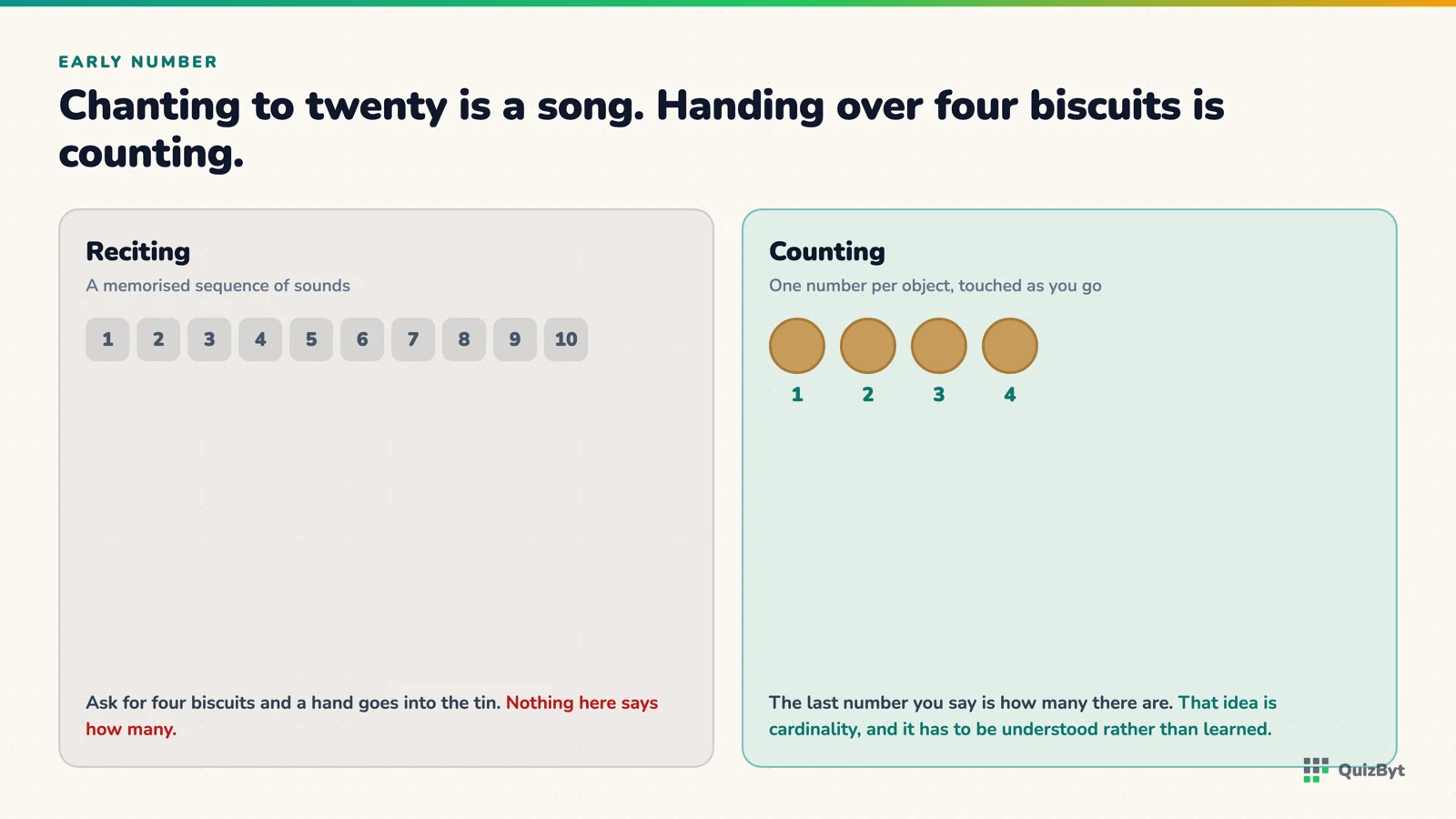
The number sequence ("one, two, three, four…") is a memorised list, like the alphabet song. It is genuinely useful and worth learning, but a child can produce it with no idea that the words refer to quantities. Plenty of children can sing the alphabet before they can identify a single letter, and this is the same phenomenon.
Counting objects is a set of ideas. There are several, and children acquire them one at a time over a couple of years:
- One-to-one correspondence. Exactly one number word per object. No object gets two words, no word gets two objects.
- Stable order. The words always come in the same sequence.
- Cardinality. The last number you said is how many there are. This is the big one.
- Order irrelevance. It does not matter which object you start with: the answer is the same.
- Abstraction. You can count anything: biscuits, steps, claps, ideas.
How to spot the cardinality gap
This is the easiest and most revealing test you can run, and it takes ten seconds.
Put five buttons on the table. Ask your child to count them. They say "one, two, three, four, five". Now ask: "So how many buttons are there?"
A child who has cardinality says "five" without hesitating. A child who has not will start counting again from one, because to them, "five" was the name of the last button, not a fact about the whole group. It is a lovely, clear moment, and once you have seen it you cannot unsee it.
Touch everything
The single most effective habit to build is moving each object as it is counted. Not pointing: moving. Slide each grape to one side as you say its number.
Pointing lets a child's eyes run ahead of their voice, which is exactly how double-counting and skipping happen. Physically moving each item makes one-to-one correspondence impossible to get wrong, and after a few weeks the child internalises the rhythm and no longer needs to.
When a child miscounts, the fault is nearly always the correspondence, not the sequence. Watch their hands, not their mouth.
"How many do you see?" beats a number line
Counting is about quantity, so practice should start from quantity. Show a group of things and ask how many, then let the child pick the numeral.
That is exactly the shape of the How Many? quizzes in our Kindergarten section: a group of objects appears, the child counts them, and taps the number. The numeral is the answer to a question about the world, rather than a symbol to be memorised on its own. Children meet the digit "7" as the name of this many things, which is the correct order and the one that sticks.
Once a number has meaning, tracing the numeral is worth doing, and that is where the number tracing and the printable number sheets come in. Meaning first, symbol second.
Counting is everywhere and free
You do not need materials. Nearly every daily routine has counting in it:
- Stairs, on the way up. Every single time.
- Plates and forks as the table is laid. This one also teaches one-to-one correspondence beautifully, because each person gets exactly one.
- Buttons while dressing.
- Claps, jumps, hops.
- Shopping: "can you find me three lemons?"
The last one is the most valuable of all, because it is the give-me-N task, and that task is the one that actually requires cardinality. A child who can reliably fetch you exactly six of something has understood number in a way that reciting to a hundred does not demonstrate.
What comes after counting
Once counting objects is solid, the next moves are comparing ("which pile has more?"), recognising small quantities without counting at all (seeing three dots and knowing it is three), and simple adding by counting on. None of them work if the counting underneath is shaky, which is why it is worth being patient here.
Two companion skills worth building in parallel: patterning, which research repeatedly links to later mathematics achievement, and shape and colour vocabulary, which gives a child the words to describe what they are counting.
Questions parents ask
My child can count to 20, is that good for age 3?
It is a nice party trick and genuinely useful, but it is memorised sequence, not number sense. The real test is whether they can give you exactly four things when asked.
What is cardinality in counting?
Understanding that the last number counted tells you how many there are altogether. A child without it will recount from one when you ask "so how many?"
What is one-to-one correspondence?
Saying exactly one number word for each object, usually by touching or moving each one as it is counted. It is the habit that stops a child double-counting or skipping.
How high should a four-year-old be able to count objects?
Accurate object counting to about ten is a reasonable expectation around four to five, but the ceiling matters much less than whether the counting is genuinely accurate.
Responses
Sign in to join the conversation. Responses are open to people with a QuizByt account, which is how we keep this a place you would let your child read.
Loading responses…
Lessons that talk, quizzes that mark themselves, games that make kids think
QuizByt is matched to your child's class. Classes 1–10 and Cambridge O Level. Every subject opens with a free lesson, quiz and worksheet, no account needed.
 Shapes and Colours: A Toddler's First Sixteen Words of MathematicsCircle, square, triangle, red, blue, yellow. These look like vocabulary. They are actually the labels a child needs before they can describe, compare or sort anything at all.Read the article →
 The One Question That Doubles What a Young Child LearnsIt is three letters long, it costs nothing, it works on every subject, and most of us stop asking it the moment the child gets the answer right.Read the article →
 From Chapter to Exam in an Afternoon: What AI Does and What the Teacher Still DoesA walk through one afternoon: chapter uploaded at two, draft at five past, twenty questions read and four rewritten by half past, exam assigned by three, results by four. Who did what.Read the article →