
What Comes Next? Patterns Are One of the Strongest Early Predictors of Maths
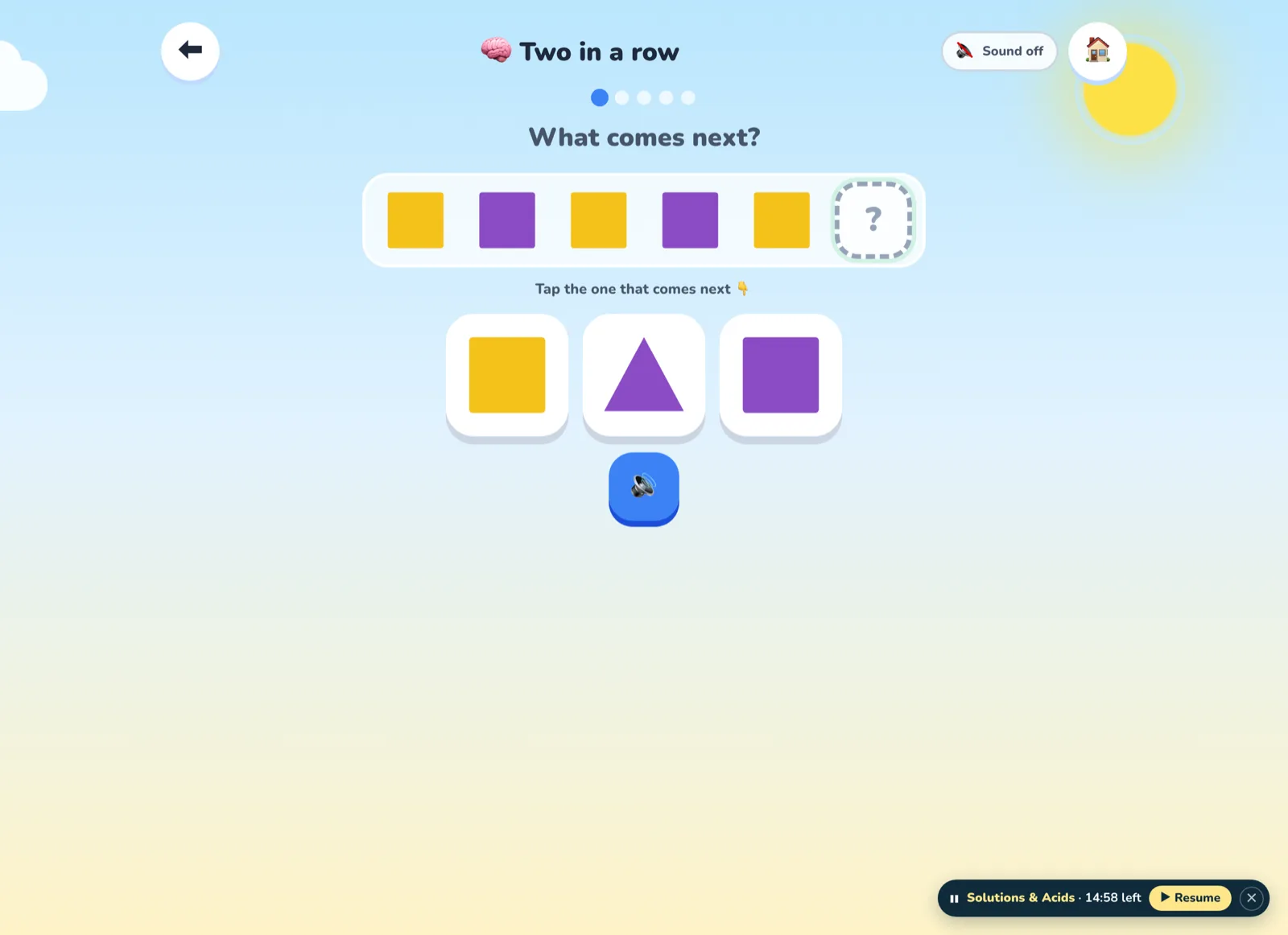
Red, blue, red, blue, … A child who can finish that row is doing something research has repeatedly linked to their mathematics achievement years later. Here is why, and how to practise it.
The short version
- Repeating patterning skill at the end of preschool has been found to predict mathematics achievement as far ahead as fifth grade.
- Start with AB patterns (red, blue, red, blue), then AAB, then ABC, one step at a time, over months, not days.
- Say the pattern out loud as you point: the rhythm is what a young child hears before they see it.
- Patterns are everywhere off-screen (stairs, cutlery, pavement tiles, clapping) and cost nothing to practise.
Lay out a red block, a blue block, a red block, a blue block. Point to the empty space at the end and ask your three-year-old what comes next. If they say red, they have just done something that researchers have been quietly excited about for two decades.
What the research actually found
Patterning is not a warm-up activity. It is one of the more robust early predictors of mathematical achievement that developmental psychology has.
Work from Vanderbilt University's Children's Learning Lab found that repeating patterning in pre-K predicts kindergarten mathematics knowledge, and follow-up work reported that end-of-preschool repeating-patterning knowledge predicted maths achievement on standardised assessments years later, including in fifth grade. Crucially, patterning predicted maths over and above spatial skills and general cognitive ability. It is not simply a proxy for being a bright child. Their published analysis is readable if you want the detail.
The intuition behind it is simple enough. To continue a pattern you must find the repeating unit (the chunk that comes round again) and then apply it. That is structurally the same move as seeing that 2, 4, 6, 8 has a rule, that multiplication is repeated addition, or that a written algorithm does the same thing at each column. Mathematics is largely the study of structure, and patterning is where a child first notices that structure exists.
The progression, in order
Patterning has a clear difficulty ladder. Skipping steps is the usual reason a child "doesn't get patterns".
- AB: red, blue, red, blue. Two elements alternating. Start here, around two and a half or three, and stay here for a long time.
- AAB or ABB: red, red, blue, red, red, blue. Much harder than it looks, because the unit is no longer "swap every time".
- ABC: three different elements in rotation. Usually four to five.
- Changing two things at once: where both shape and colour vary. This is the top of the early range.
Our Thinking Games follow exactly this ladder across six rounds, using the same eight shapes and eight colours a child meets in the shapes and colours lesson, because a child cannot reason about a property they cannot yet name. The lesson teaches the words; the game asks them to notice a rule.
Say it out loud: the rhythm comes first
Here is the practical trick most parents miss. A young child hears a pattern before they see one.
"Red… blue… red… blue…" said aloud in a steady beat as you point is dramatically easier to continue than the same row studied in silence. The auditory rhythm does the work; the eyes catch up afterwards. This is also why clapping patterns (clap-clap-stamp, clap-clap-stamp) are such good practice, and why we deal the row out on screen one tile at a time with a beat between them rather than showing it all at once.
Patterns are free and everywhere
You do not need materials. You need to notice out loud:
- Stripes on a shirt, tiles on a floor, railings on a staircase.
- Days of the week, the biggest repeating pattern in a child's life.
- Bedtime routine: bath, book, bed. Bath, book, bed.
- Steps: left, right, left, right.
- Beads, buttons, pasta shapes, leaves, stones.
Every one of those is an AB or ABC pattern, and naming it as one ("look, that's a pattern: dark, light, dark, light") is most of the teaching.
What it looks like when they get it
The milestone to watch for is not finishing a pattern. It is making one, and then breaking one to catch you out. A child who builds red-blue-red-blue-green and laughs at you has understood the rule well enough to break it knowingly. That is a stronger signal than any number of correct answers.
The companion skill is its opposite: spotting the one that does not belong. Sequencing and sorting are the two halves of early logic, and together they carry a child a long way before they ever see a written sum.
Where to practise it
The patterns game lives in the free QuizByt Kindergarten playground, next to tracing, counting, shapes and colours. Nothing is timed, a wrong tap never says "wrong", and the whole row stays on one screen so a child can see the rhythm rather than scroll to find it. The first round is open to everyone, start here.
Questions parents ask
What is a repeating pattern in early maths?
A sequence built from a unit that repeats: red-blue-red-blue is an AB pattern, red-red-blue is AAB, red-blue-yellow is ABC. The child's task is to spot the unit and continue it.
Why do patterns matter for mathematics?
Finding a repeating unit is the same mental move as finding structure in numbers. Research has found preschool repeating-patterning skill predicts later maths achievement even after accounting for counting and spatial skills.
What age should a child start patterns?
Around two and a half to three for simple AB patterns with colour. Three-part ABC patterns usually come between four and five.
How do I practise patterns without an app?
Lay out cutlery, buttons, socks or blocks in a repeating unit, say it aloud as you point, and stop one short. Clapping and stamping patterns work just as well and need nothing at all.
Responses
Sign in to join the conversation. Responses are open to people with a QuizByt account, which is how we keep this a place you would let your child read.
Loading responses…
Lessons that talk, quizzes that mark themselves, games that make kids think
QuizByt is matched to your child's class. Classes 1–10 and Cambridge O Level. Every subject opens with a free lesson, quiz and worksheet, no account needed.
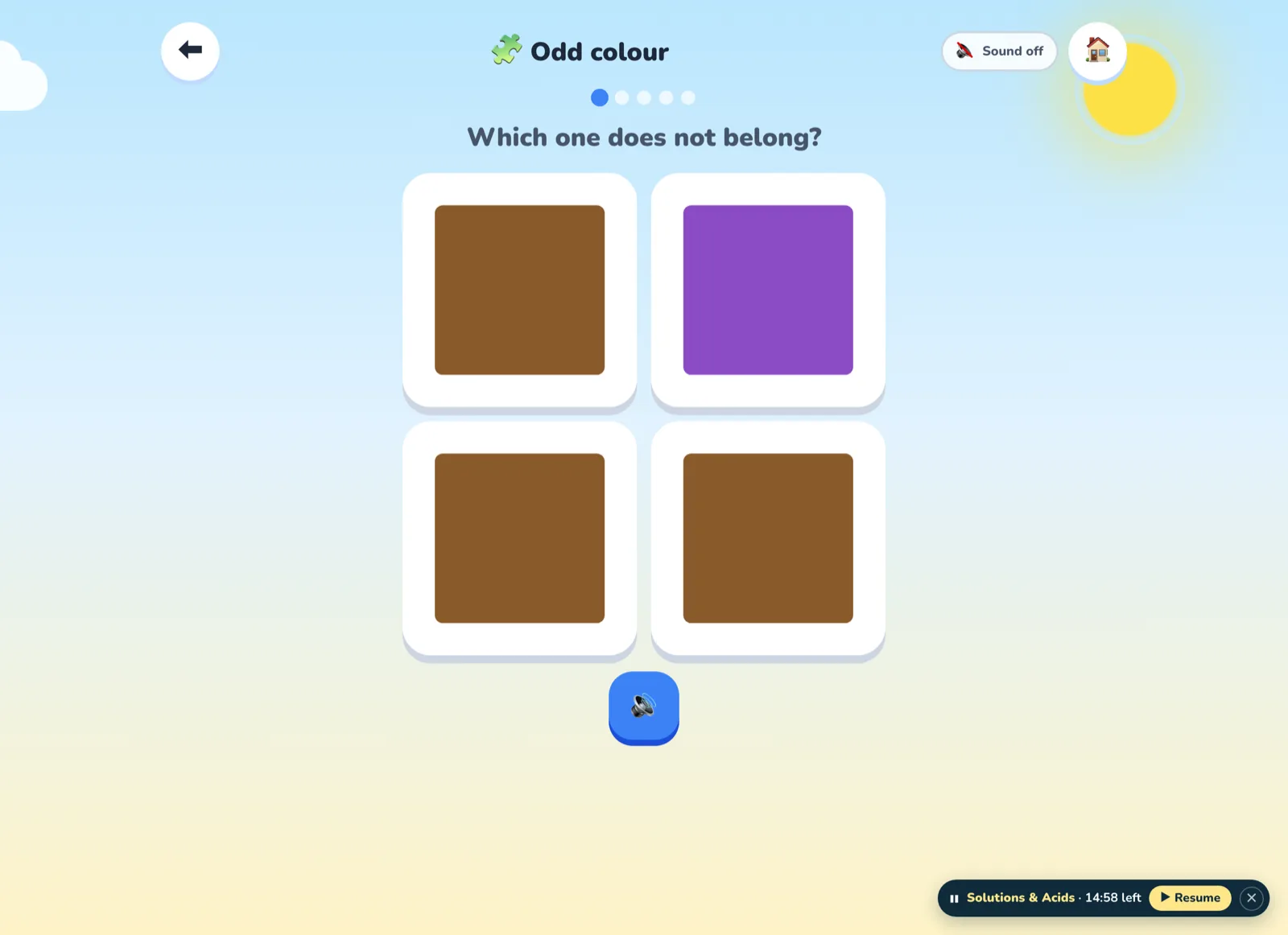 Odd One Out: The Two-Minute Game That Teaches a Three-Year-Old to ReasonFour pictures, one that does not belong. It looks like a puzzle, but it is the first piece of real logical thinking a small child can do, and the learning happens in the answer to "why?", not the tap.Read the article →
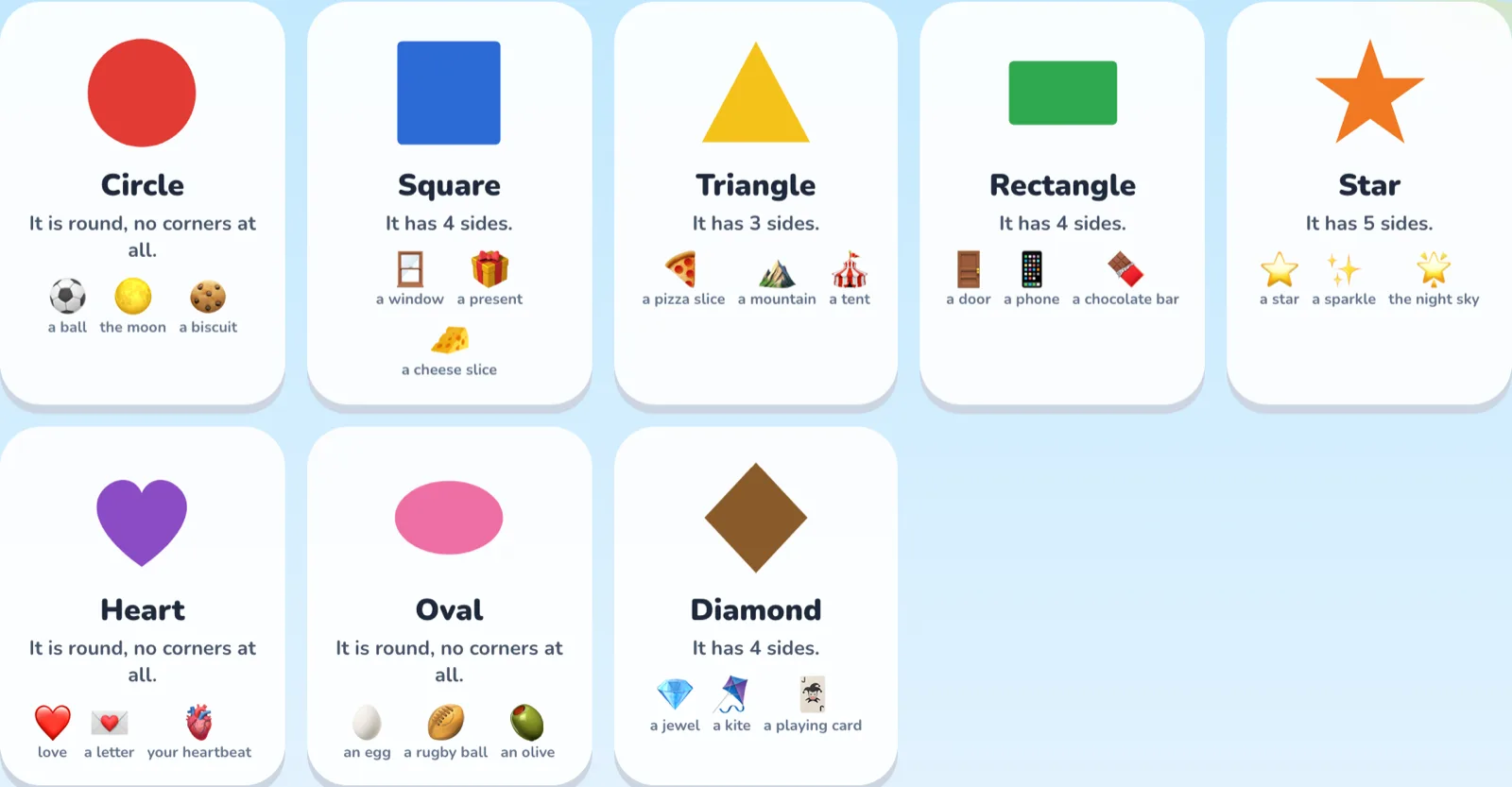 Shapes and Colours: A Toddler's First Sixteen Words of MathematicsCircle, square, triangle, red, blue, yellow. These look like vocabulary. They are actually the labels a child needs before they can describe, compare or sort anything at all.Read the article →
 An Online Exam System for a School, Built From a PDF and a Teacher's ApprovalUpload the chapter, get twenty questions at the level you asked for, edit them, assign them with a time limit. What the AI does, what the teacher still does, and why the second part is not optional.Read the article →