
The One Question That Doubles What a Young Child Learns
It is three letters long, it costs nothing, it works on every subject, and most of us stop asking it the moment the child gets the answer right.
The short version
- Asking a child to explain a right answer is what turns a lucky guess into reasoning they can reuse.
- Ask "why" after correct answers, not only wrong ones, or the question becomes a signal that they got it wrong.
- A child who cannot explain an answer has usually pattern-matched rather than understood, which is useful to know.
- Retelling is the cheapest revision there is: two minutes at bedtime beats another worksheet.
Your child taps the right answer. The app plays a chime, awards a star, and moves on. Everybody is pleased.
Now ask them why.
The gap between a child who can answer that and one who cannot is the gap between learning and performing, and it is usually invisible until you ask.
A right answer proves less than it looks
There are at least three ways to get a four-option question right:
- Reasoning. The child worked it out. This transfers to new questions.
- Recognition. They have seen this exact question before. This transfers to nothing.
- An irrelevant cue. The right answer was the biggest, or in the middle, or the one that looked different. This actively misleads, the child now believes their strategy works.
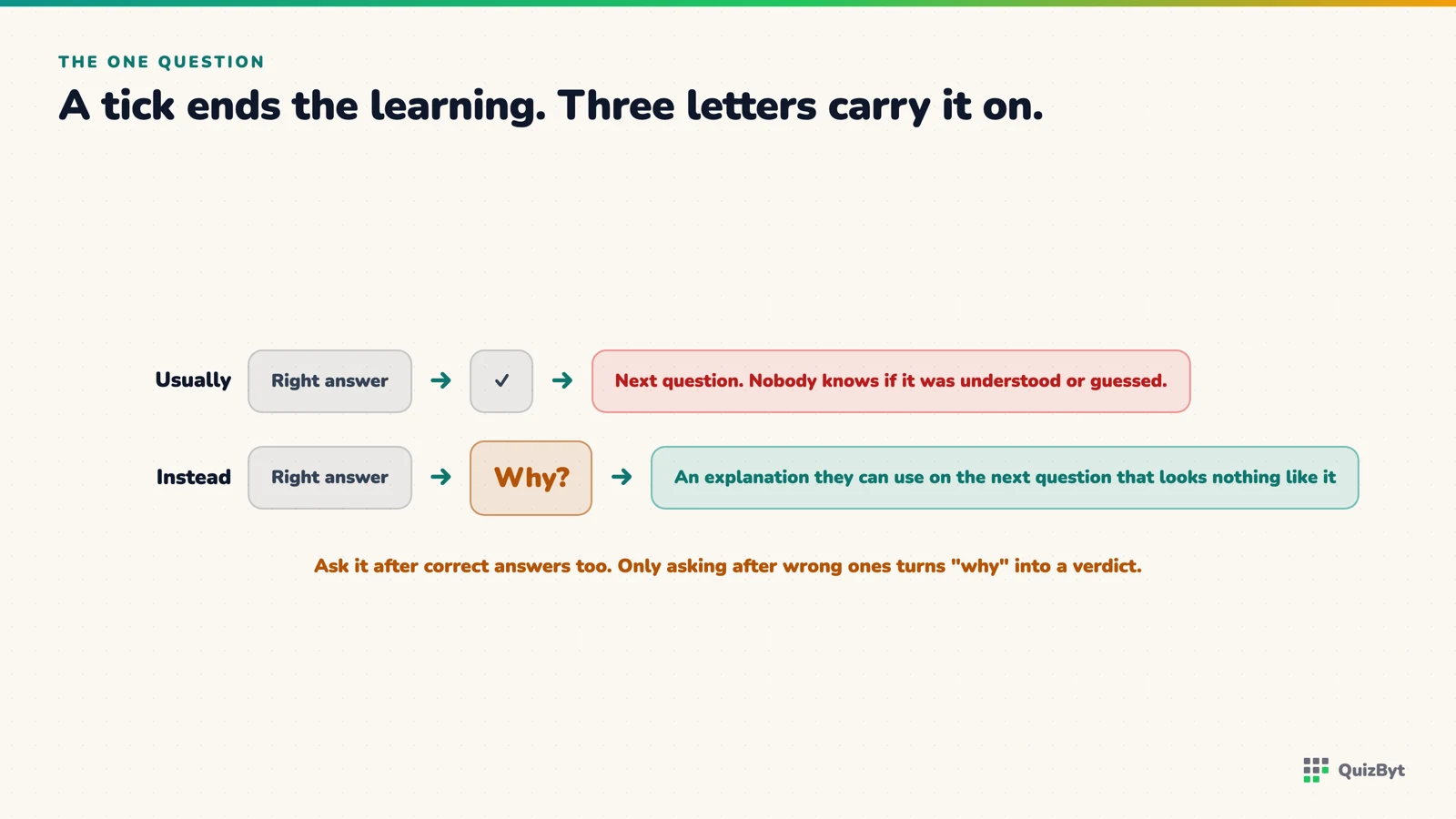
All three produce the same green tick. Only the explanation tells them apart.
This matters most in exactly the activities that look like pure play. In an odd-one-out puzzle, a child who points at the blue circle among three red ones might have reasoned about colour, or might just like blue. "Because the others are red" is the difference, and it is the reason our Odd One Out game says the reason out loud after every correct answer and leaves it on screen rather than moving straight on.
Ask about the right answers as well as the wrong ones
This is the part that goes wrong in most homes and most classrooms.
If "why do you think that?" only ever appears after a mistake, children learn its real meaning very fast: you got it wrong, try again. After that, being asked to explain becomes a threat, and the honest ones start changing their answer the moment you ask.
So ask it when they are right. Ask it when you already know the answer. Ask it when it is obvious. It should be so routine that it carries no information about whether they were correct, at which point children start volunteering reasons unprompted, which is the whole goal.
When they cannot answer
Very often a three or four-year-old will know the answer and have no words for it. That is developmentally normal and not a problem to solve with pressure.
What works:
- Offer the words. "I think it's because the other three are all red, is that what you saw?" Most will nod, and some will correct you, which is even better.
- Ask them to say it back. Not as a test. As a game: "say it with me."
- Ask a smaller question. "What's the same about these two?" is much easier than "why?" and gets to the same place.
- Move on cheerfully. If it is not there today it will be in a month.
What does not work is repeating "but why?" with increasing intensity. The child ends up learning that explaining is unpleasant.
Retelling is the cheapest revision there is
The same mechanism drives the single most underrated study habit at any age: asking a child to explain what they learned to someone else.
Retrieving and reorganising an idea in order to say it is a far more effective way to consolidate it than re-reading or re-watching. For a four-year-old, "tell Dad what we did" after a lesson does more than a second lesson would. It costs two minutes and no materials.
Where to use it
Everywhere, but especially in the activities that have a rule underneath:
- Odd one out: "why doesn't that one belong?"
- Patterns: "how did you know what came next?"
- Counting: "how many? how do you know?"
- Shapes: "how can you tell that's a triangle?" (Answer: three sides. See why the property matters more than the picture.)
Three letters, several times a day, for free. There is not much else in early education with that ratio.
Questions parents ask
Why should I ask my child to explain a right answer?
Because a correct answer can come from reasoning, from a guess, or from an irrelevant cue. Only the explanation tells you which, and stating the rule out loud is what makes it reusable.
Won't asking "why" make my child think they are wrong?
It will if you only ask after mistakes. Ask after correct answers too, and often, so the question reads as interest rather than correction.
What if my child cannot explain their answer?
Say the reason yourself, simply and warmly, and ask them to repeat it. Do not treat it as a failure, at three or four, having the answer before the words is completely normal.
How long should this take?
Seconds. One exchange after a game or a lesson is enough. This is a habit, not an activity.
Responses
Sign in to join the conversation. Responses are open to people with a QuizByt account, which is how we keep this a place you would let your child read.
Loading responses…
Lessons that talk, quizzes that mark themselves, games that make kids think
QuizByt is matched to your child's class. Classes 1–10 and Cambridge O Level. Every subject opens with a free lesson, quiz and worksheet, no account needed.
 Counting to 20: Why Reciting Numbers Is Not the Same as CountingPlenty of three-year-olds can chant to twenty. Ask them to hand you four biscuits and many will hand you a fistful. The gap between those two things is the whole of early number sense.Read the article →
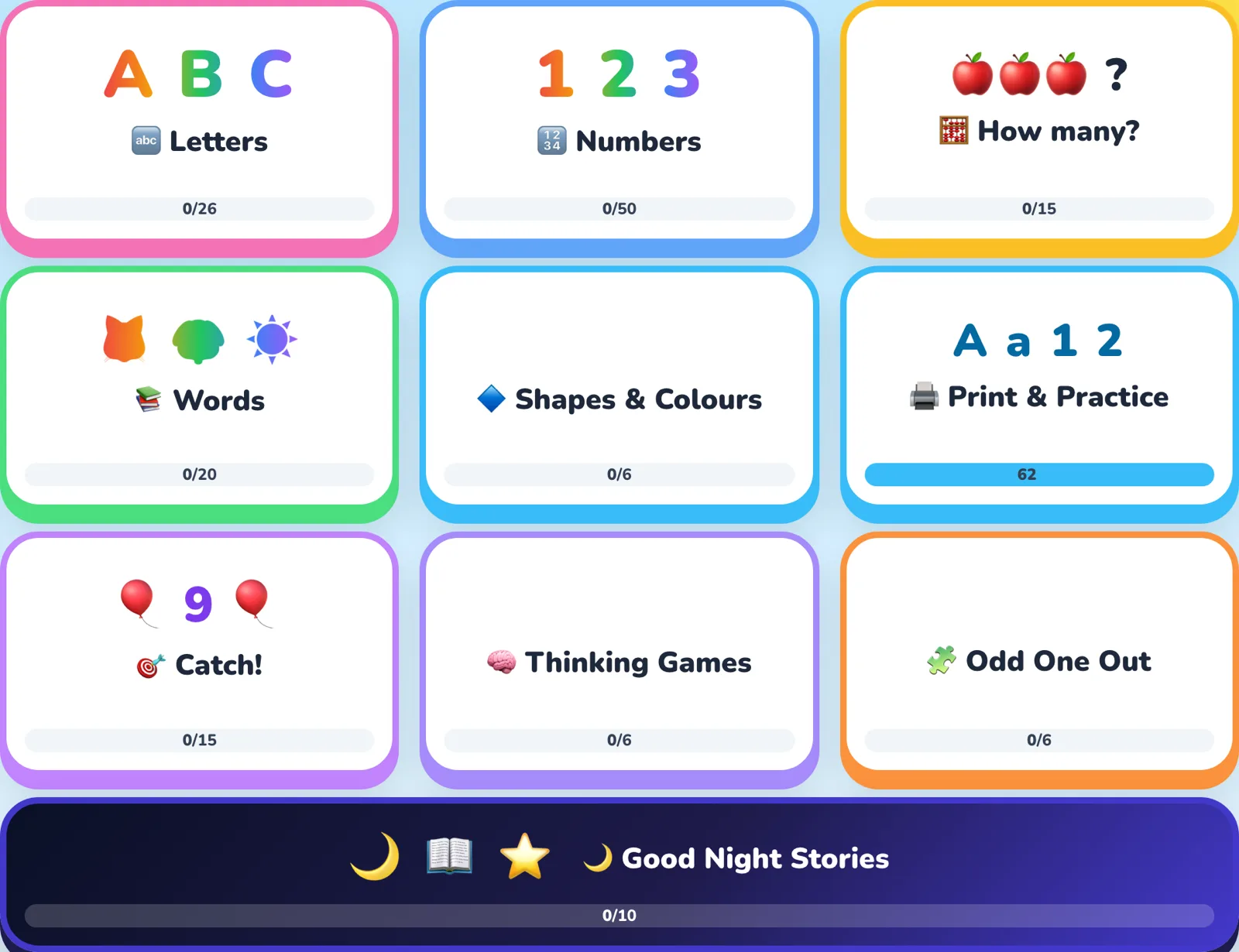 Kindergarten at Home: A Realistic Week for a Two to Six-Year-OldNot a curriculum. A week of ten-minute sessions that covers letters, numbers, shapes and thinking, designed around the attention span a small child actually has.Read the article →
 From Chapter to Exam in an Afternoon: What AI Does and What the Teacher Still DoesA walk through one afternoon: chapter uploaded at two, draft at five past, twenty questions read and four rewritten by half past, exam assigned by three, results by four. Who did what.Read the article →