
Five Levels Per Game: Why Class 2 and O Level Play the Same Game Differently
Every game has a five-rung ladder, and the rungs bend by age. A seven-year-old gets twice the time and a lower pass mark on level one; an O Level student does not. Here is the design.

The short version
- Every single-player game has five levels; each opens only when the one below it has been beaten, and progress is stored per game.
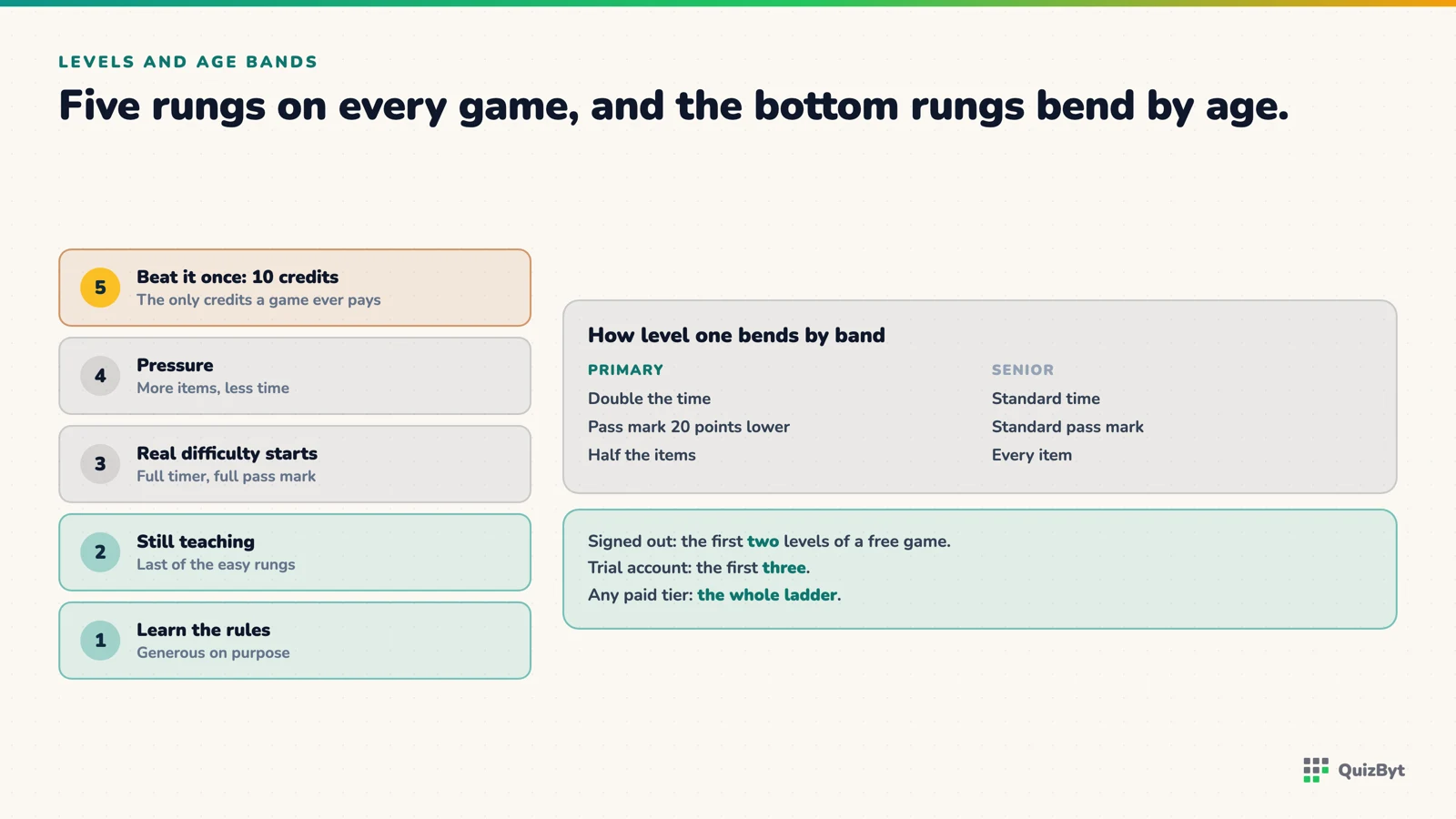
- The rungs bend by age: on level one a primary player gets double the time, a pass mark 20 points lower and half the items; older players get less of each.
- A signed-out visitor can play the first two levels of a free game; a trial account the first three; every paid tier has the whole ladder.
- Levels one and two exist to teach the rules, which is why they are generous, a first meeting with a game should not be a race.
A game that is the right difficulty for a fifteen-year-old is the wrong difficulty for a seven-year-old, and a game that ships with three fixed settings (easy, medium, hard) has the same problem three times. So every single-player game on QuizByt has a five-level ladder, and the ladder bends by age.
The ladder
A player starts on level one with the rest locked. Each level opens only when the one below has been beaten. Progress is stored per game, so being a master at Memory Match says nothing about Mini Sudoku, a child climbs each one separately.
Each level sits on one of the three difficulty sets a game already has, and then a per-level modifier is applied on top: how much time, how high the pass mark, how many things to do. That is how five rungs are made from three sets without authoring a hundred and thirty-five separate games, and it is why level one is a genuine warm-up and level five is a real test of the same game.
Where age comes in
The modifier has two columns: one for primary players (Kindergarten and Class 1 to 5), one for everyone else. On level one a primary player gets twice the time, a pass mark 20 points lower, and half the items. An older player on the same level gets one and a half times the time, 15 points off, and 60% of the items. The gap narrows rung by rung; by level five both columns are close to the game as designed.
The reasoning is simple. Levels one and two exist to teach the rules. A seven-year-old meeting Simon Sequence for the first time should learn what "repeat the colours" means without a clock making that harder, and once they have learned it, the clock can arrive. This is the same logic the research on spaced and graduated practice keeps finding: difficulty that arrives after the basics are secure is productive; difficulty that arrives before them is just failure.
Who can climb how far
- Signed out: levels one and two of the free games. They are open outright rather than climbed, because there is no account to record a guest's win in.
- Free trial: up to level three.
- Any paid plan, including school accounts: the whole ladder, won rung by rung.
The top rung
Beating level five pays 10 bonus credits, once per game. It is the only place credits come from other than a quiz, and it is kept small: a reward for persistence at the thing the game was teaching, not a farm. What those credits then open is in the unlock ladder explained.
Why this matters more for the youngest
An older student who finds a game too hard shrugs and tries again. A young child who fails on first contact decides the game is not for them and does not come back. The generous first two rungs are the difference between a child who learns Tower of Hanoi over a fortnight and one who never opens it twice. The wider case for these games is in games that make kids think, and which games a child sees at all is in how QuizByt picks games by age.
Questions parents ask
How many levels does a game have?
Five. A player starts on level one and each level opens when the one below has been beaten. Progress is per game, so mastering one says nothing about another.
Are the levels the same for every age?
No. Each rung applies a modifier to time, pass mark and number of items, and the primary band (Class 1–5) gets a more forgiving modifier on every rung. Most of all on levels one and two.
Can a child play without an account?
The first two levels of the free games, yes. A trial account reaches level three; any paid plan has all five.
What happens at level five?
Beating it pays 10 bonus credits, once per game.
Responses
Sign in to join the conversation. Responses are open to people with a QuizByt account, which is how we keep this a place you would let your child read.
Loading responses…
Lessons that talk, quizzes that mark themselves, games that make kids think
QuizByt is matched to your child's class. Classes 1–10 and Cambridge O Level. Every subject opens with a free lesson, quiz and worksheet, no account needed.
 Credits Decide Which Game Opens Next: The Unlock Ladder ExplainedOne credit opens the first game in each section. Eleven opens the second. Fifty-one opens everything. The exact numbers, where credits come from, and why the ladder is in that order.Read the article →
 An Online Exam System for a School, Built From a PDF and a Teacher's ApprovalUpload the chapter, get twenty questions at the level you asked for, edit them, assign them with a time limit. What the AI does, what the teacher still does, and why the second part is not optional.Read the article →
 Odd One Out: The Two-Minute Game That Teaches a Three-Year-Old to ReasonFour pictures, one that does not belong. It looks like a puzzle, but it is the first piece of real logical thinking a small child can do, and the learning happens in the answer to "why?", not the tap.Read the article →