
Classes 1 to 3: The Years That Decide Whether Study Feels Safe
Almost nothing academic that happens between six and nine survives to adulthood. The attitude does. Here is what to actually do with these three years.
The short version
- Children in Classes 1–3 understand far more by listening than by reading, so spoken lessons reach them years before text does.
- The habit worth building is finishing one small thing, not covering a lot.
- Correct the work, never the child, at this age criticism of the page reads as criticism of the person.
- A child who believes they are bad at maths by age nine will act on that belief for a decade.
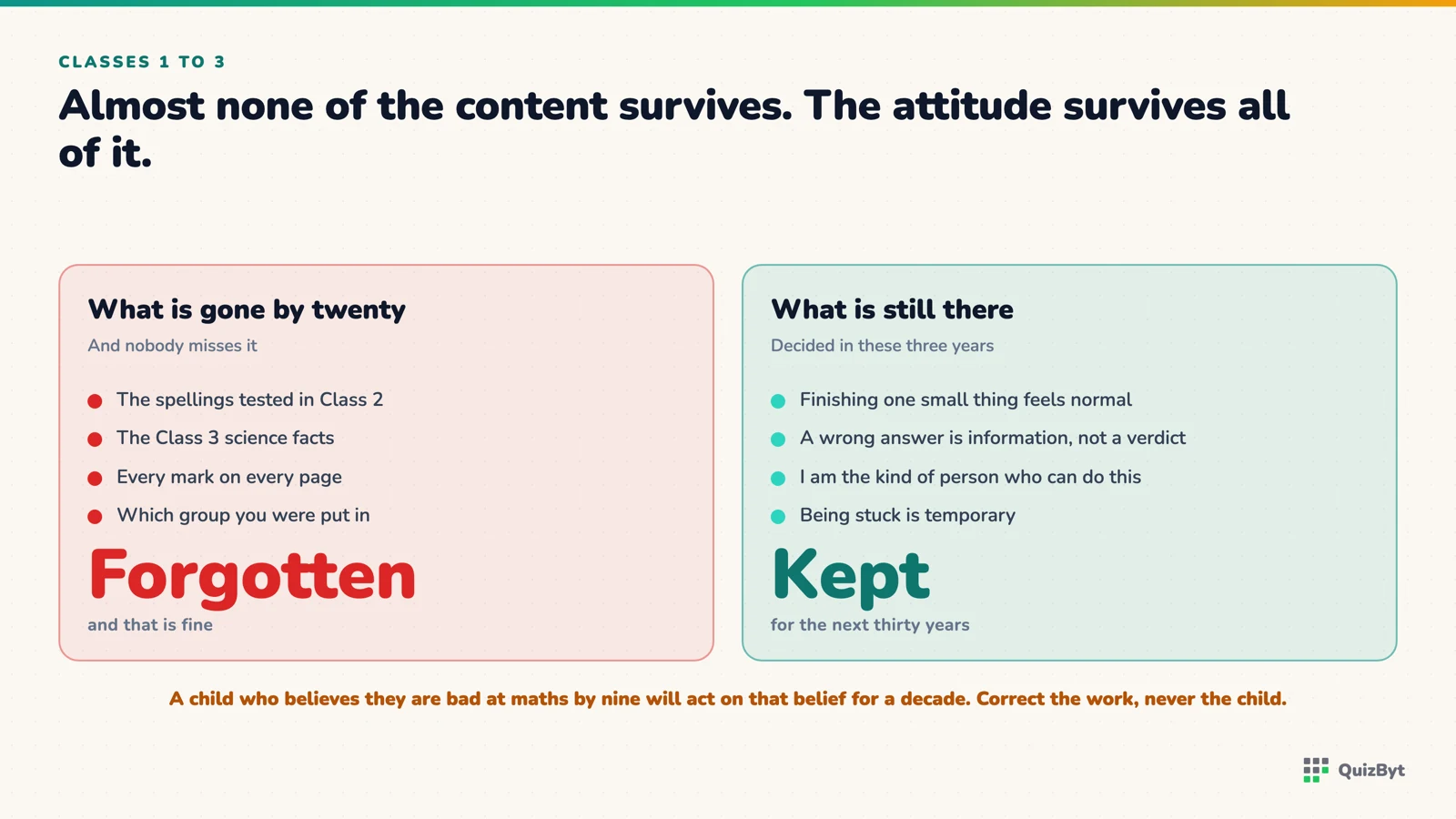
Ask an adult what they learned in Class 2 and you will get almost nothing. Ask them whether they were "good at maths" as a child and you will get an immediate, confident answer, and often it is still shaping what they do at forty.
That is the real curriculum of Classes 1 to 3. The content is replaceable. The self-assessment is not.
The listening–reading gap
A six- or seven-year-old can follow spoken ideas far more complex than anything they can read. Put a science concept in a paragraph and you are testing decoding; say it aloud with a picture and you are teaching science.
This is not a reason to delay reading. It is a reason not to let reading fluency become the bottleneck on everything else. The full argument, and what to do about it, is in learning by ear and eye and read-aloud quizzes.
QuizByt's quizzes for the youngest classes carry a listen button on every question for exactly this reason, a child who cannot yet read "Is 10 even or odd?" can still answer it.
Finish one small thing
The transferable habit of this stage is completion. One lesson read to the end. One quiz finished. One worksheet marked together. Not three started.
It sounds trivially small and it is the foundation of everything later: a Class 9 student who revises in unfinished fragments is running the habit they built at seven.
Correct the work, not the child
At this age the distinction between "this sum is wrong" and "you are bad at sums" does not exist yet. Both land the same way.
Practically: find something specific that was done well before anything else, then fix one thing. "This row of sevens is really neat. Let's look at this one together" does more than five crossings-out, and it does not cost a decade of maths avoidance.
What to actually use
- Short spoken lessons on one idea, with a picture.
- Read-aloud quizzes so the reading level does not gate the subject.
- Printable worksheets, marked together, writing by hand is still how exams work for another decade.
- A finish line every session, however small.
A realistic daily shape for this age is in five-minute lessons with a Class 2 child. If your child is younger, the stage before it is covered across the Kindergarten plan and the playground. If they are heading into Class 4, the ground shifts. See when marks start to mean something.
Questions parents ask
My child can read but hates reading to learn. Is that normal?
Very. Decoding text and learning from text are different skills, and the second arrives later. Read-aloud lessons let the learning continue while reading fluency catches up.
How much should a Class 2 child study at home?
Ten to fifteen minutes on a school day is plenty, in one or two short pieces. Consistency matters far more than duration at this age.
Should I correct every mistake?
No. Pick one thing, and only after pointing out something specific that was done well. A page returned covered in corrections teaches that writing is where they fail.
Does it matter if they are behind in Class 2?
Much less than people fear, academically. What matters is whether they still believe effort changes the outcome.
Responses
Sign in to join the conversation. Responses are open to people with a QuizByt account, which is how we keep this a place you would let your child read.
Loading responses…
Lessons that talk, quizzes that mark themselves, games that make kids think
QuizByt is matched to your child's class. Classes 1–10 and Cambridge O Level. Every subject opens with a free lesson, quiz and worksheet, no account needed.
 The Twenty-Minute Daily Habit That Moves a GradeNot three hours on Sunday. Twenty minutes a day, structured a particular way, across one term, and the reason it works is the gap between the sessions, not the minutes inside them.Read the article →
 Classes 4 to 8: When Marks Start to Mean SomethingThis is where most students quietly pick up the study habit that limits them for the next eight years, and where it is easiest to replace.Read the article →
 Forces for Class 1 to 3: Push, Pull, Gravity and FrictionA push or a pull. That is a force, and a six-year-old can feel one. The trouble starts when the words arrive before the feeling. Three lessons that keep the order right, from opening a door to why a ball rolls to a stop.Read the article →