
Remote and Home Schooling That Students Actually Finish
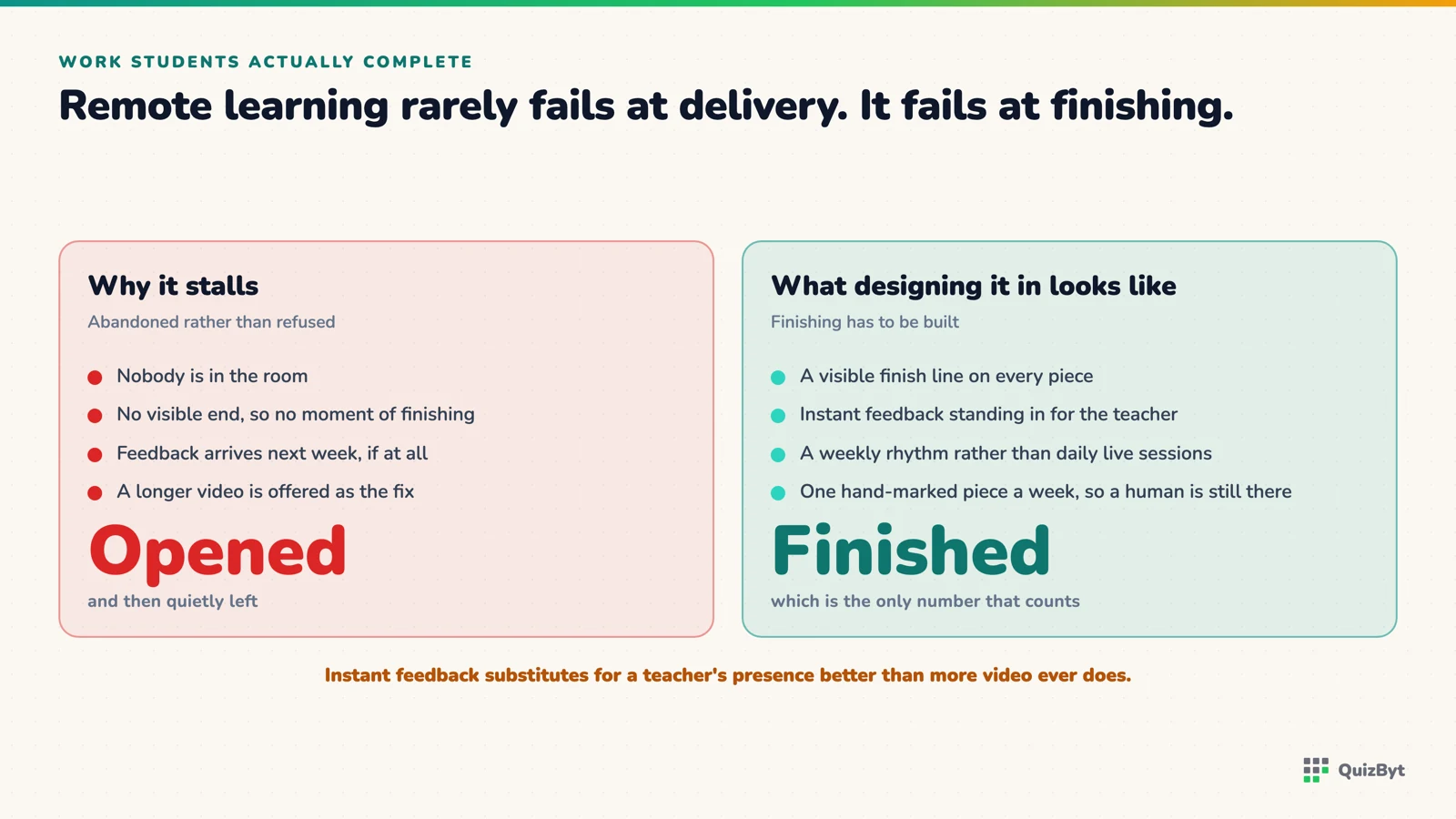
The hard part of remote learning was never delivering the material. It was that nobody was in the room, and self-paced work only works when finishing is designed in.
The short version
- Remote learning rarely fails at delivering material; it fails at completion, because nobody is in the room.
- Self-paced work needs a visible finish line, or it is abandoned rather than refused.
- Instant feedback substitutes for the teacher's presence better than longer video does.
- A weekly rhythm with one hand-marked piece keeps a human in the loop without demanding daily live sessions.
When schooling moved home at scale, the thing most schools solved was delivery: get the material to the student. The thing that stayed broken was completion.
The reason is not mysterious. A classroom supplies structure, a finish line and someone noticing, all for free, invisibly. Remove the room and those three have to be rebuilt by hand, and most remote programmes rebuilt only the first.
Design the finish line as well as the content
A student abandons remote work far more often than they refuse it. The difference matters: refusal is a motivation problem, abandonment is usually a design problem.
What prevents it:
- A visible, finite length. "Part 3 of 10" tells a student whether they can finish now. An unbounded page tells them nothing, so they stop at an arbitrary point and do not return.
- Session-sized units. One topic, one quiz, completable in a sitting.
- A real ending. A score, a mark, a completion. Something that says this is done.
Feedback replaces presence better than video does
The instinct is to replace the teacher with more video. It rarely works, because what the teacher was mainly providing was not exposition. It was immediate correction.
A student working alone who gets a quiz marked instantly, with the reason for each answer, is being corrected at the moment the reasoning is still in their head. The same student watching another twenty minutes of video is not.
This is the same argument as practice testing, and it matters more at home because there is nobody to ask.
Keep a human in the loop weekly, not daily
Daily live sessions exhaust everyone and mostly deliver what a well-built lesson could. A workable rhythm:
- Self-paced lessons and quizzes through the week, marked instantly.
- One piece of written work, done on paper, uploaded and marked by a teacher by hand.
- One short live session for questions arising from the two above, which now has an agenda instead of being a lecture.
The hand-marked piece is what stops the week becoming entirely machine-graded, and it is where a teacher sees method rather than answers.
Track topics, not hours
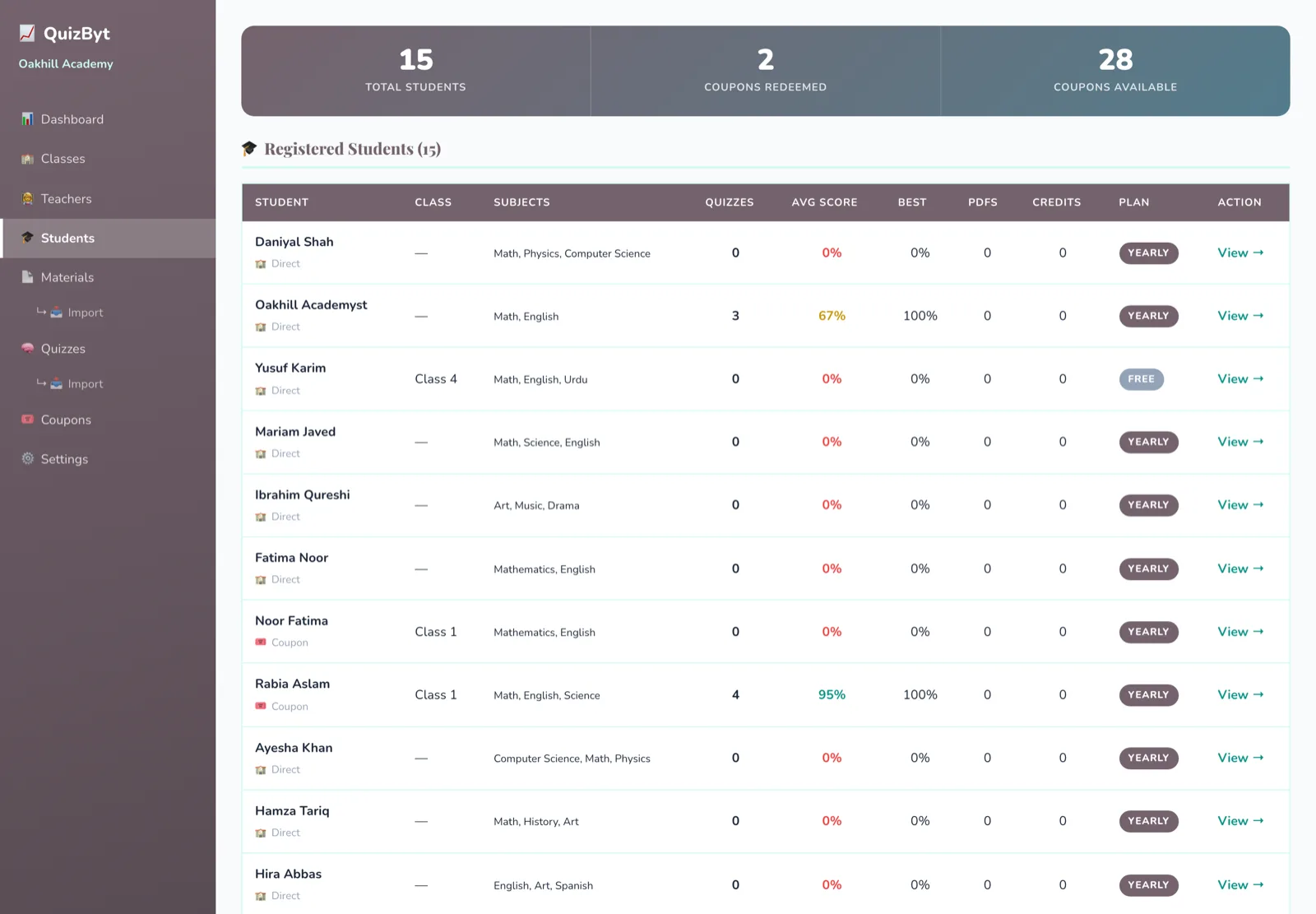
Home-schooling records built on hours look reassuring and hide gaps. A list of topics with a status shows exactly what has not been touched, which is the only thing a parent or teacher can act on. QuizByt keeps per-subject and per-topic results for this reason, and a parent can opt into a monthly summary. See what the monthly report tells you.
Related: why students scroll.
Questions parents ask
Why do students not finish remote work?
Usually not refusal, abandonment. Work with no visible end, no feedback and no consequence gets started and dropped. Making the finish line visible fixes more than adding supervision.
Are live online classes necessary?
Useful but not sufficient, and expensive in everyone's time. A weekly live session for questions plus well-structured self-paced work usually beats daily lectures over video.
How do home-schooling parents track coverage?
By topic rather than by hours. A list of topics with a status is the only record that shows gaps; hours logged shows effort and hides holes.
What about students who fall behind unnoticed?
Per-topic results surface this early. A weekly glance at which topics are unattempted catches drift long before a term-end test would.
Responses
Sign in to join the conversation. Responses are open to people with a QuizByt account, which is how we keep this a place you would let your child read.
Loading responses…
Lessons that talk, quizzes that mark themselves, games that make kids think
QuizByt is matched to your child's class. Classes 1–10 and Cambridge O Level. Every subject opens with a free lesson, quiz and worksheet, no account needed.
 Student Reports That Come From Real WorkA report assembled from assignments a student actually did says something. A report assembled from one end-of-term test mostly measures one afternoon.Read the article →
 Build Your Own Question Bank, Import Ours, or Draft With AIThree routes to a school question bank, and they are not alternatives. Most schools end up using all three, for different parts of the syllabus.Read the article →
 One Chapter, Three Boards: What Changes and What Does NotTake quadratic equations across Cambridge IGCSE, Oxford AQA and the Federal Board matric syllabus. The content list looks almost identical. The teaching, the depth and the examination are not. A worked comparison.Read the article →