
Screen Tracing vs Pencil on Paper: What the Brain Research Actually Shows
A finger on glass and a pencil on paper are not the same activity. The research is clearer than most app marketing admits, and it points to using both, in a particular order.
The short version
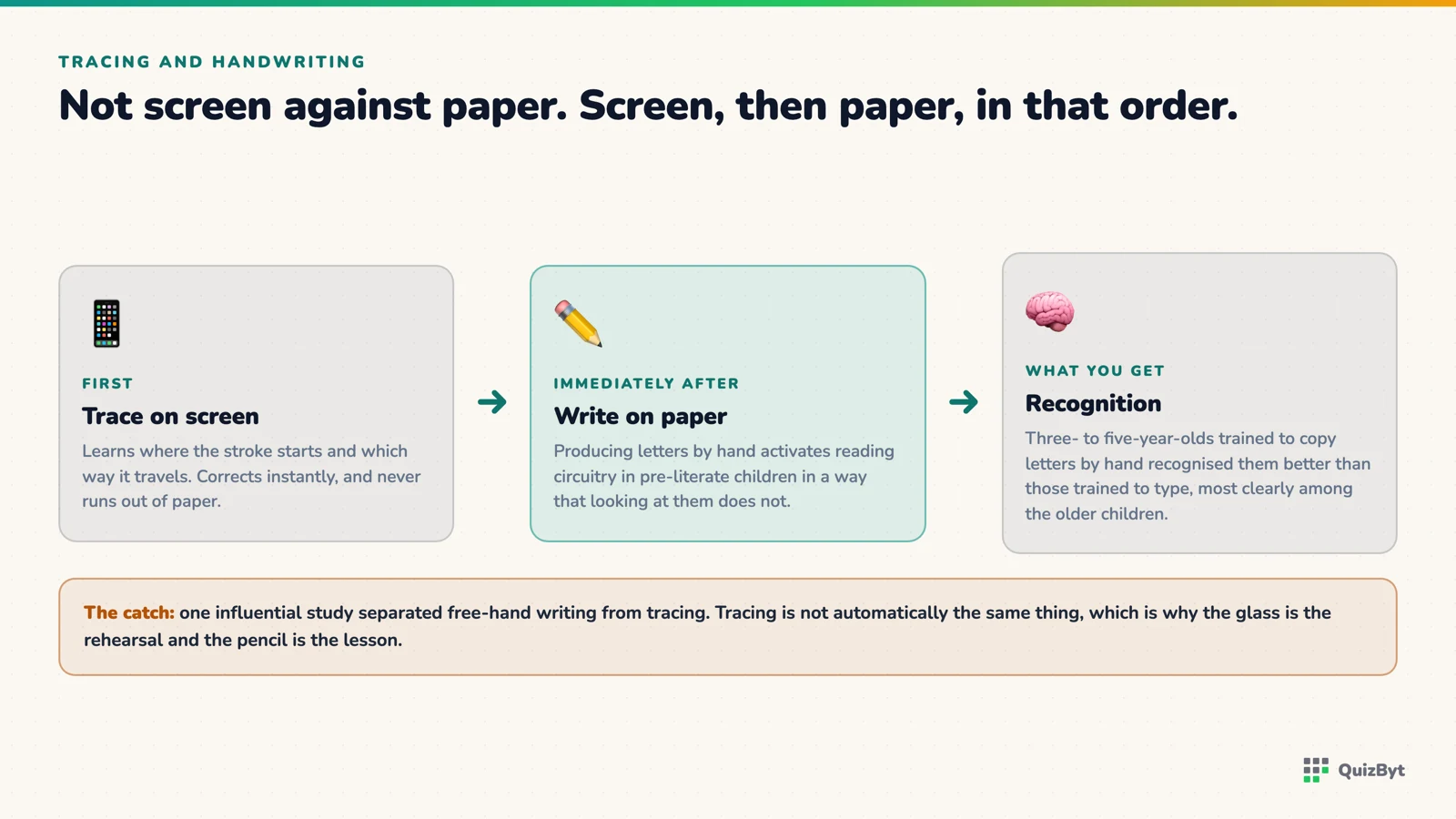
- Brain imaging work found that producing letters by hand activates reading circuitry in pre-literate children in a way that passive viewing does not.
- One influential study distinguished free-hand writing from tracing, tracing is not automatically equivalent to writing.
- In one small study, three- to five-year-olds trained to copy letters by hand recognised them better than those trained to type. Most clearly among the older children.
- The practical answer is sequence, not sides: screen first to learn the path, paper immediately after to build the motor memory.
Every tracing app implies the same promise: your child drags a finger along a dotted letter and learns to write. It is a reasonable-sounding claim, and the research on it is more interesting (and more specific) than either the app makers or their critics usually let on.
What the studies found
The most-cited work here comes from Karin James and colleagues at Indiana University, who scanned pre-literate children's brains while they looked at letters, after different kinds of practice. Children who had produced letters themselves showed activation in regions associated with adult reading; children who had only observed the same letters did not show the same pattern. You can read the study on active self-production versus passive observation directly.
The detail that matters for our question is that this line of work has generally distinguished free-hand writing from tracing and from typing, and did not treat them as equivalent. Tracing a pre-drawn shape is a different motor task from generating the shape yourself, and the summaries of this research that circulate online tend to flatten that distinction in whichever direction suits the writer.
Separately, Longcamp, Zerbato-Poudou and Velay (2005) trained thirty-eight children aged three to five to copy letters either by hand or by typing. After three weeks, the older children who had written by hand recognised letters better than those who had typed. It is a small study and the effect was clearest in the older group, which matters before it gets quoted as settled fact.
So is screen tracing useless?
No, but it is useful for different things than paper, and knowing which is how you get value from both.
What a screen does better than paper:
- It shows the path. Arrows, a moving dot, a numbered stroke order. A worksheet shows a destination; a screen can show the journey.
- It gives instant, patient feedback. It will say "let's try that one again" for the ninth time in the same tone as the first. No parent manages that.
- It removes the grip problem. A three-year-old who cannot yet hold a pencil can still learn that "c" travels anticlockwise. The idea and the motor skill can be learned separately and combined later.
- It is repeatable at no cost. Infinite attempts, no paper, no sharpening, no mess.
What paper does that a screen cannot:
- Resistance. A pencil pushes back. That feedback through the fingers is a large part of what builds the motor model.
- Grip and pressure. Both are skills, both need practice, and glass teaches neither.
- Size control. Staying inside a line on paper is genuinely harder than on a screen that snaps to the path.
- It is what school will ask for. Exams are still written by hand in most of the world.
The order that works
Not one or the other. This sequence, in one sitting of about ten minutes:
- Screen first, twice. The child traces the letter on a tablet or phone with the arrows showing stroke order. They are learning where it starts and which way it goes.
- Say it while doing it. "Down, and around." Naming the movement is how it becomes retrievable later.
- Paper immediately after. The same letter, same form, with a pencil. Four or five attempts, no more.
- Circle the best one. Not the mistakes. The best one. Then stop.
The screen front-loads the knowledge; the pencil converts it into a motor habit. Doing the pencil part on the same day matters more than doing it for long.
Before the pencil at all
If your child physically cannot hold a pencil yet, letter practice is not the priority, hand strength is. All of these build it and none of them look like schoolwork:
- Play dough: squeezing, rolling, pinching.
- Tearing paper into strips.
- Threading beads or pasta onto string.
- Picking up small objects with tongs or a peg.
- Spray bottles: genuinely excellent for the exact muscles a pencil grip uses.
- Drawing in a tray of sand, salt or flour with one finger.
A child with weak hands who is pushed onto a pencil early usually develops a fist grip that is far harder to undo than it would have been to avoid.
How we build it
QuizByt's letter tracing is designed to be the first half of that sequence, not a replacement for the second. The letters are drawn from stroke data rather than a font, so the shapes are the ones schools teach. See why the "a" in most apps is wrong, with arrows for direction, a "Done" button so the child decides when a stroke is finished rather than the app moving on for them, and a gentle retry when a stroke wanders too far outside the line.
And then every letter and number has a matching printable worksheet generated from the identical stroke data, so the letter on the page is the letter on the screen. The app is meant to send you to the printer, not to replace it.
Questions parents ask
Does tracing letters on a tablet teach handwriting?
It teaches the path and the stroke order well, and it gives instant feedback a parent cannot. What it does not reliably give is the motor memory that comes from controlling a pencil, so it works best as the step before paper rather than instead of it.
Is handwriting better than typing for young children?
For learning letters, the research points that way. In a 2005 study of thirty-eight three- to five-year-olds, the older children trained to copy letters by hand recognised them better after three weeks than those trained to type the same letters.
How much handwriting practice does a four-year-old need?
Ten minutes is a lot at that age. Short and daily beats long and weekly, fine motor control is built by repetition, and a tired hand practises badly.
What about children who cannot hold a pencil yet?
Build the hand first: play dough, tearing paper, threading beads, tongs, spray bottles. Finger tracing on screen or in sand is useful at this stage because it removes the grip problem.
Responses
Sign in to join the conversation. Responses are open to people with a QuizByt account, which is how we keep this a place you would let your child read.
Loading responses…
Lessons that talk, quizzes that mark themselves, games that make kids think
QuizByt is matched to your child's class. Classes 1–10 and Cambridge O Level. Every subject opens with a free lesson, quiz and worksheet, no account needed.
 Screen Time Under Six: What the Research Actually SaysThe honest summary is not "screens are bad" or "screens are fine". It is that almost everything depends on what is on the screen and whether an adult is sitting there, and the size of that second effect is startling.Read the article →
 Letter Formation: Why the "a" in Most Learning Apps Is the Wrong ShapeAlmost every app shows children a two-storey "a", the one you are reading now. Almost no school teaches children to write it. Here is why that mismatch matters and what to look for instead.Read the article →
 A Migration Plan From Google Classroom to QuizByt, in Five StepsDo not switch everything on a Monday. Move the test, then the practice, then the lessons, keep Classroom for announcements, and decide at the end of term whether you still open it.Read the article →