
A School's First Month With AI-Built Content
Week by week: what to upload first, who reviews, what usually goes wrong in week two, and what you should be able to see by the end of the month. A plan rather than a promise.

The short version
- Start with one department and one chapter each, not with the whole school. The first generated quizzes teach your teachers what to look for.
- Week two is where it stalls, usually because review has no owner and no time in the timetable.
- By the end of the month you should be able to name a topic a class is weak on and say what you did about it.
- A school that skips review saves more hours in month one and has nothing defensible by month three.
Schools that get value from this in the first term do roughly the same things in the same order. Schools that stall do a recognisable thing in week two. So here is the plan, with the stall included.
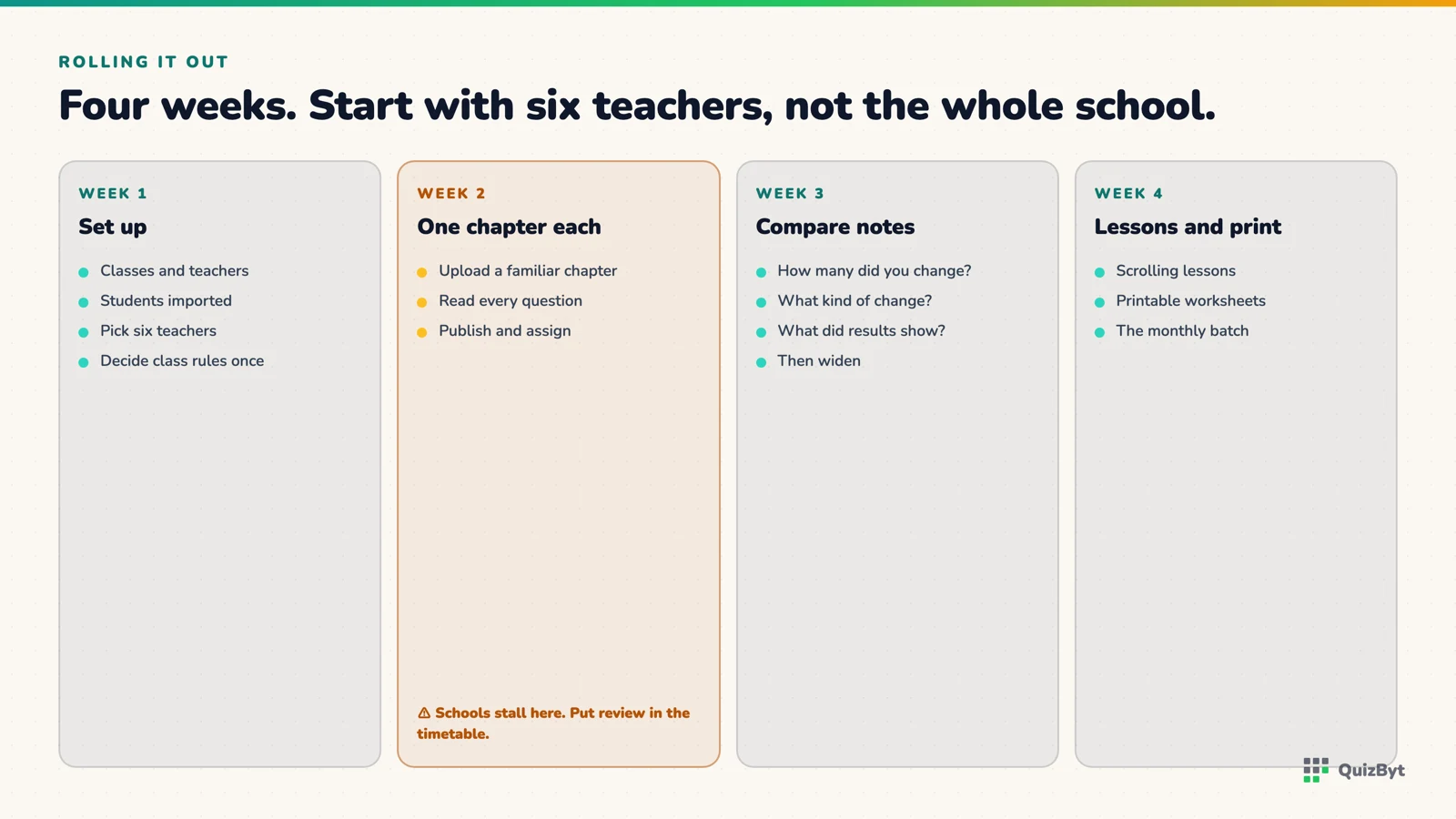
Week 1: set up, and pick six people
The administrative setup is a day: classes, teachers, branches, students imported from a spreadsheet, onboarding codes issued. Step by step, it is here.
The decision that matters this week is who starts. Not everyone. Three to six teachers in one department, each teaching a different class. Enough that they can compare notes in the staff room, few enough that one person can help all of them.
Decide the class rules now rather than later: which classes allow retries, which allow hints and read-aloud, which are full-screen for tests. Assignments inherit these, so setting them once means never thinking about them again.
Week 2: one chapter each, and the stall
Each of the six uploads one chapter. Not a new one: the chapter they have taught most often, because familiar material makes a weak question obvious. Generate a quiz. Read every question. Change what needs changing. Publish. Assign to one class.
This is also where schools stall, and the reason is always the same. Review has no owner and no time. The uploads happen, the drafts appear, and nothing is published for nine days because everyone assumes someone else is reading them.
The fix is a calendar entry. Thirty minutes, one named person, same slot each week. It is not a big commitment and nothing moves without it. A department that treats review as something to fit in between lessons produces a queue of drafts and no content.
Week 3: compare notes, then widen
Get the six together for twenty minutes. Three questions.
- How many questions did you change out of twenty? Expect three or four. Someone reporting zero has not read properly. Someone reporting twelve had a vague chapter, and that is useful information about the chapter.
- What kind of change? Wrong keys, ambiguity, difficulty, too much recall. The patterns are in five failure modes and naming them makes the next review faster.
- What did the results tell you? This is the one that matters. If someone can name a topic their class is weak on, the system is working.
Then widen: a second department, or the same six moving to lessons and worksheets as well as quizzes.
Week 4: lessons and the printable side
Quizzes first, because the payoff is immediate. Lessons and worksheets second, because they change how a class is taught rather than how it is assessed.
A generated lesson is a scrolling sequence a student can work through alone, which makes it useful for homework, for catch-up after absence, and for the student who needs the explanation a third time without asking for it. The generated worksheet is for the students and the families who work better on paper, and plenty do.
This is also the week to let a teacher or two try the monthly quizzes the system generates for every topic. They arrive in a review queue at the start of each month, and a department can publish the ones relevant to its term and leave the rest.
What you should be able to say at the end of the month
Not "we are using AI". These four things.
- Nobody marked a quiz by hand. Straightforward, measurable, true from week two.
- Every published item was read by a person first. If this is not true, stop and fix it before going further.
- At least one teacher changed a lesson because of what a result showed. This is the one that indicates the loop is closed.
- You know your change rate. How many drafted questions get rewritten. It tells you about your chapters and about your reviewers.
The failure mode to avoid
A school that skips review saves more hours in month one. By month three it has a library of content nobody has checked, a teacher who found a wrong answer key the hard way, and no way to tell parents who approved what their children are studying.
The thirty minutes a week is the whole deal. Everything else the system does is in service of making those thirty minutes enough to cover work that used to take a weekend. Who does the checking, and what they earn for it, is the article to read next.
Questions parents ask
How many teachers should start?
Three to six, in one department, all teaching different classes. Enough to compare notes, small enough that someone can help each of them.
What should they upload first?
The chapter they have taught most often. Familiar material makes a weak generated question obvious.
What if teachers resist?
Usually it is not resistance to AI, it is resistance to another system. Give one teacher a quiz that marks itself for four classes and the argument tends to resolve itself.
When does it pay for itself?
Marking time goes on week one. The part that matters, which is faster intervention, shows up in the second half of the term.
Responses
Sign in to join the conversation. Responses are open to people with a QuizByt account, which is how we keep this a place you would let your child read.
Loading responses…
Lessons that talk, quizzes that mark themselves, games that make kids think
QuizByt is matched to your child's class. Classes 1–10 and Cambridge O Level. Every subject opens with a free lesson, quiz and worksheet, no account needed.
 How We Use AI to Build a Quiz: The Whole PipelineA quiz on QuizByt passes through six stages before a child sees it, and a language model is only in charge of one of them. Here is each stage, what runs it, and what would happen if you removed it.Read the article →
 When the AI Gets It Wrong: Five Failure Modes We Plan ForGenerated questions fail in patterns, and the patterns repeat. Here are the five we see most, what each one looks like on the page, and what catches it before a child does.Read the article →
 Two Children, One Plan: How Family Accounts WorkSeparate dashboards, separate progress, separate PINs, and the second and third child at half price. What that means in practice for a mixed-age household.Read the article →