
How We Use AI to Build a Quiz: The Whole Pipeline
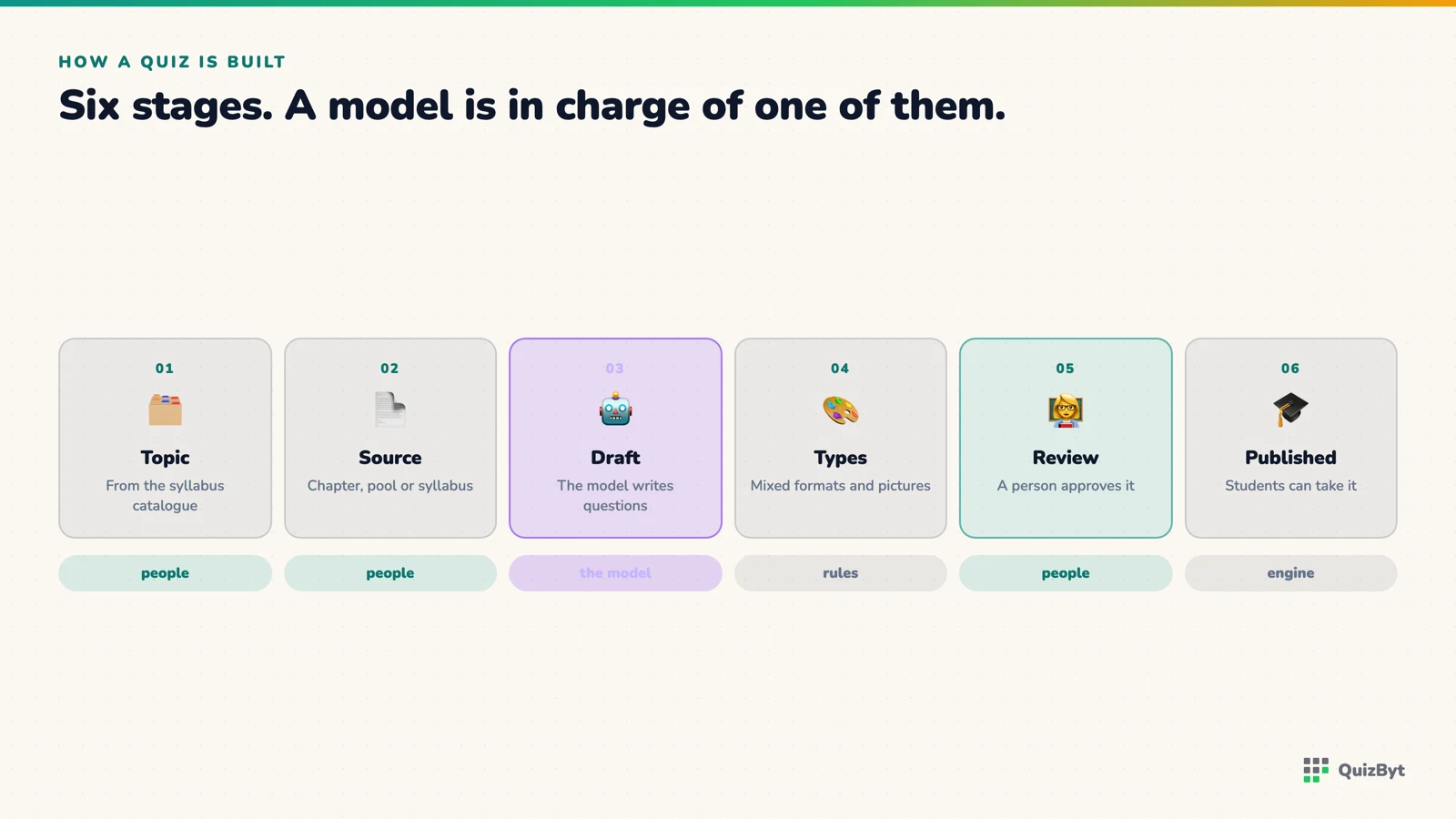
A quiz on QuizByt passes through six stages before a child sees it, and a language model is only in charge of one of them. Here is each stage, what runs it, and what would happen if you removed it.

The short version
- A language model writes the first draft of the questions. It does not choose the topic, set the difficulty, decide the question types or publish anything.
- Every generated quiz is created with the status pending_review, and every student-facing query filters for approved, so an unreviewed quiz is invisible by construction rather than by policy.
- The topic comes from a catalogue built from published syllabuses, so a drafted question is always attached to a named topic for a named class.
- The last stage is a person. Two teachers approve a teacher-written quiz; one named teacher approves a quiz the admin hands them.
"We use AI" is a sentence that hides more than it explains. On QuizByt a quiz passes through six stages before a child answers the first question, and a language model is responsible for exactly one of them. This article walks the whole thing, in order, so you can see where the machine helps and where it would do damage if it were left alone.
Stage 1: the topic, from a syllabus
Nothing is generated against "Class 5 Maths". It is generated against a named topic inside Class 5 Maths, and the list of topics is a catalogue in the code rather than something a model invents each time. The lists were assembled from published frameworks: Cambridge Primary Mathematics 0096, English 0058 and Science 0097 for the early classes, Cambridge Lower Secondary 0862 for Classes 7 and 8, a national secondary-board syllabus for Classes 9 and 10, and Cambridge O Level 4024 with IGCSE 0580 for O Level.
This sounds like a small detail and it is the foundation. A model asked for "five Class 5 maths questions" will cheerfully produce five questions scattered across five chapters, which is useless for a teacher who taught one of them yesterday. A model asked for "five questions on Prime and Composite Numbers for Class 5" produces something a teacher can set on Tuesday. How those lists were compared across boards is its own article: agentic AI and the syllabus problem.
Stage 2: the source material
Where the questions come from depends on which path triggered the build.
- A school's own PDF. A teacher uploads a chapter, and the questions are drawn from that chapter and nothing else. This is the path described in upload a PDF, get a lesson, a quiz and a worksheet.
- The existing question pool. For the monthly batch, questions already written and approved for that topic are drawn first, and the model is only asked for what is missing. A pool question has already been through review once.
- Neither. A topic with no pool and no upload is written from the syllabus description alone. This is the weakest input and it is the one most likely to produce something a reviewer rejects.
Stage 3: the draft
Now the model runs. It is given the class, the subject, the topic, the difficulty, the number of questions, and a schema it must return. The schema is not a suggestion: the response is parsed, and anything that does not fit the shape is dropped rather than guessed at.
The prompt also carries the rules a real classroom needs. Age-appropriate language for the class in question. One correct option out of four. A spread of sub-skills inside the topic rather than four questions on the same line of the chapter. For the younger classes, a requirement to mix question types rather than produce twenty multiple-choice questions in a row, because a seven-year-old answering twenty identical-looking questions stops reading them.
Stage 4: types and pictures
A question on QuizByt is not always four options and a radio button. It can be a set of tiles tapped into the right order, several blanks inside one sentence, items sorted into groups, or a set of pictures where the child taps the right one. The model is told which of these it may produce and in what shape, and the shapes are validated on the way in.
Pictures work through a small token language. Writing {pic:blocks:264} in a question draws base-ten blocks for 264; {pic:count:apple,7} draws seven apples; {pic:line:340,350,1,347} draws a number line with 347 marked. The same token renders as a drawn picture on screen and as a printable equivalent in a PDF worksheet, so one question carries its illustration into both without anyone drawing anything twice.
This is a constraint on the model and it is what keeps generated content consistent with hand-written content. A model that could emit arbitrary HTML would eventually emit something the player cannot render.
Stage 5: review
The quiz is written to the database with the status pending_review. Every query that lists quizzes for a student filters on approved. That means an unreviewed quiz is invisible because of how the data is queried, not because of a rule someone remembered to apply. Those are very different levels of safety.
From there it reaches a person in one of three ways: an administrator publishes it from the review desk, an administrator assigns it to a named teacher whose single approval publishes it, or, for a quiz written by a teacher, two different teachers approve it. The reasoning behind that structure is in the teacher portal: who checks the machine.
Stage 6: publication, and what happens afterwards
Approved quizzes appear for students in their class and subject, surface on the dashboard when they match a student's chosen topics, and become searchable. Each one carries its topic, so a result is recorded against that topic rather than against the subject as a whole.
After publication there is one more signal. Students rate how hard a piece of content was to follow, from 1 to 5. The average is ignored until ten students have voted, and anything averaging 2.0 or below goes back for review. A question that reads badly to thirty children is a fault in the question, whatever the adults thought of it.
Remove any stage and watch what breaks
Take out the syllabus catalogue and you get content that is technically correct and pedagogically random. Take out the type and picture rules and you get twenty identical multiple-choice questions that a Class 2 child will not finish. Take out the review and you publish wrong answer keys to real children, which is the one failure that is unforgivable. Take out the model and you are back to a teacher writing twenty questions by hand on a Wednesday evening.
All six stages, or none of it works. The model is the fastest part and the least trustworthy part, and the architecture around it exists because both of those are true at once.
Questions parents ask
Which model writes the questions?
Claude, through the Anthropic API, with the key held in site settings rather than in code. The model is one component of the pipeline, not the pipeline.
Can a student ever see a question no person has read?
No. Generated quizzes are saved with the status pending_review, and the queries that list quizzes for students filter on approved. Publishing is an action a person takes.
Does the AI set the difficulty?
No. The level is passed in by the teacher or by the monthly run, and the engine stores it as easy, medium or skilled. The model writes to the level it is given.
What happens to a draft nobody approves?
It stays in the review queue. Nothing publishes itself after a timeout, because a queue that empties itself is not a review.
Responses
Sign in to join the conversation. Responses are open to people with a QuizByt account, which is how we keep this a place you would let your child read.
Loading responses…
Lessons that talk, quizzes that mark themselves, games that make kids think
QuizByt is matched to your child's class. Classes 1–10 and Cambridge O Level. Every subject opens with a free lesson, quiz and worksheet, no account needed.
 Place Value for Class 1 to 3: Digits, Tens and Hundreds Without TearsThe digit 4 means four things in 4, forty things in 40 and four hundred things in 400. A child who really understands that can add, subtract, round and compare. A child who does not is memorising tricks.Read the article →
 A School's First Month With AI-Built ContentWeek by week: what to upload first, who reviews, what usually goes wrong in week two, and what you should be able to see by the end of the month. A plan rather than a promise.Read the article →
 Screen Rules That Survive a TeenagerRules that depend on constant enforcement fail, because enforcement runs out. Rules that are predictable, negotiated once, and enforced by the device survive.Read the article →