
Two Children, One Plan: How Family Accounts Work
Separate dashboards, separate progress, separate PINs, and the second and third child at half price. What that means in practice for a mixed-age household.

The short version
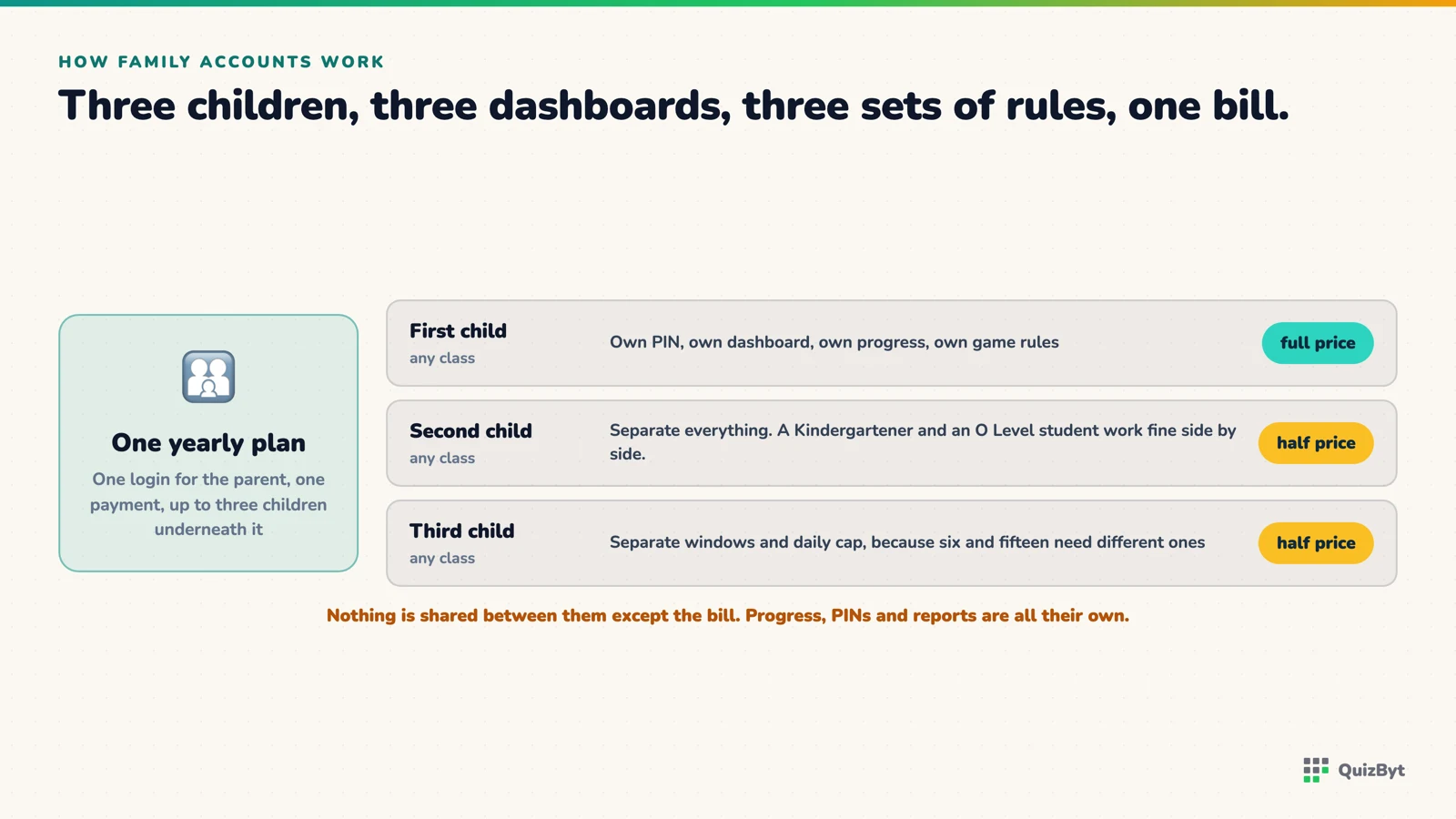
- A yearly plan covers up to three children, each with their own PIN, dashboard and progress.
- Second and third children are half price.
- Children of very different ages work fine together, one can be in the Kindergarten playground while another is on O Level material.
- Each child's game rules and reporting are set separately, because a six-year-old and a fifteen-year-old need different ones.
Households with more than one school-age child face the same arithmetic on every subscription: pay twice, or share one login and lose all the progress tracking that made it worth paying for.
Family accounts exist to avoid choosing.
How it is structured
One yearly plan covers up to three children. Each child has:
- Their own PIN, entered when they start.
- Their own class and subjects.
- Their own dashboard: quizzes, scores, lessons, credits, games.
- Their own rules: game schedule, daily cap and reporting set per child.
After signing in, the question is who is learning today, and each child goes to their own space. Second and third children are half price.
Very different ages are fine
This is the case people assume will be awkward and it is the one it handles best. A five-year-old can be in the Kindergarten playground tracing letters while a fifteen-year-old works through O Level chemistry on the same plan. They share nothing except the payment.
It also means the controls can differ appropriately. A six-year-old might have games available for thirty minutes after school; a fifteen-year-old might have them switched to an evening window with a longer cap, or off during exam weeks. Those are set per child, which matters because a single household rule applied to both ages is wrong for at least one of them.
Why separate progress matters more than it sounds
Two children sharing one profile produces data that describes neither. Averages merge, the weak-topic list becomes meaningless, and the monthly report describes a composite child who does not exist.
Since the whole value of tracking is locating a specific gap in a specific child. See which subject is my child actually weak in, merged profiles remove the thing you were paying for.
Setting it up
Add children from the family area of the dashboard, set each one's class and subjects, and set a PIN per child. The game rules and monthly report are configured separately for each, in the same sitting.
Ten minutes, once. After that see set it once and read the report.
Questions parents ask
How many children can share one plan?
Up to three on a yearly plan, each with a separate profile, PIN and progress record.
Does the second child cost full price?
No, second and third children are half price.
Can children of different ages and classes share an account?
Yes. Each child has their own class and subjects, so one can be in Kindergarten while another is preparing for O Level without interfering with each other.
Can one child see another's results?
No. Each profile is entered with its own PIN and has its own dashboard, so progress is not shared between siblings.
Responses
Sign in to join the conversation. Responses are open to people with a QuizByt account, which is how we keep this a place you would let your child read.
Loading responses…
Lessons that talk, quizzes that mark themselves, games that make kids think
QuizByt is matched to your child's class. Classes 1–10 and Cambridge O Level. Every subject opens with a free lesson, quiz and worksheet, no account needed.
 Screen Rules That Survive a TeenagerRules that depend on constant enforcement fail, because enforcement runs out. Rules that are predictable, negotiated once, and enforced by the device survive.Read the article →
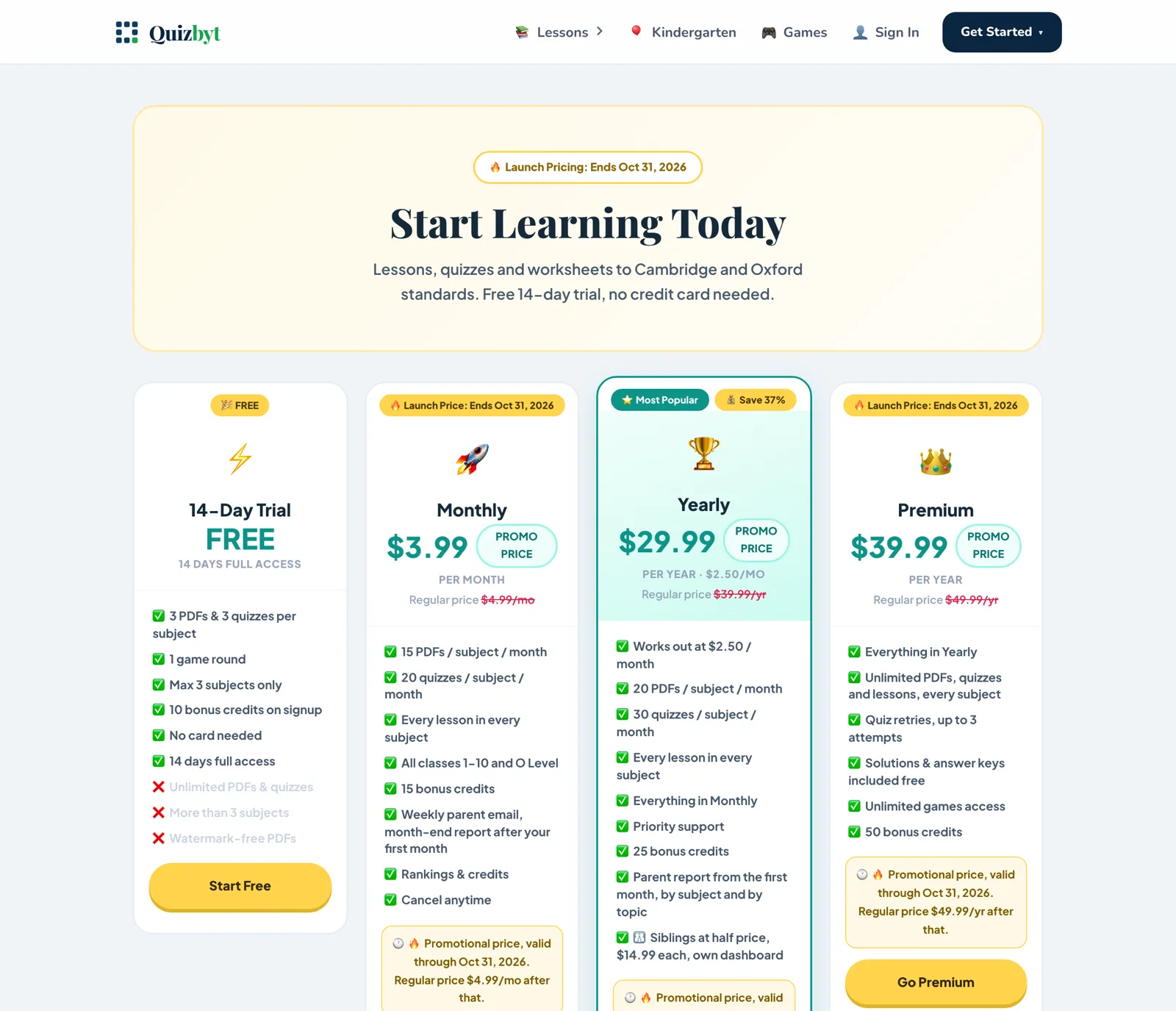 What a Study Platform Costs, and What You Get for ItPlain numbers, no marketing arithmetic: what each plan costs, what it actually includes, and the honest case for when the free trial is enough.Read the article →
 A School's First Month With AI-Built ContentWeek by week: what to upload first, who reviews, what usually goes wrong in week two, and what you should be able to see by the end of the month. A plan rather than a promise.Read the article →