
Practice Testing: Why a Quiz Beats Reading the Chapter Again
Of ten common study techniques reviewed across hundreds of studies, only two were rated high utility. Re-reading and highlighting were not among them. Here is what was, and why.
The short version
- Across a large review of study techniques, practice testing and distributed practice were the only two rated high utility.
- Re-reading feels effective because fluency is mistaken for knowledge, the page gets easier to read, not easier to recall.
- Retrieving an answer from memory strengthens it more than reviewing the same material does.
- A quiz you score badly on has taught you more than a chapter you read comfortably.
Here is a study session that feels excellent and mostly is not: open the chapter, read it carefully, highlight the important parts, read the highlighted parts again, close the book feeling prepared.
Now one that feels much worse and works far better: close the book, try to answer ten questions on the chapter, get four of them wrong, and read the explanations for those four.
What the evidence actually says
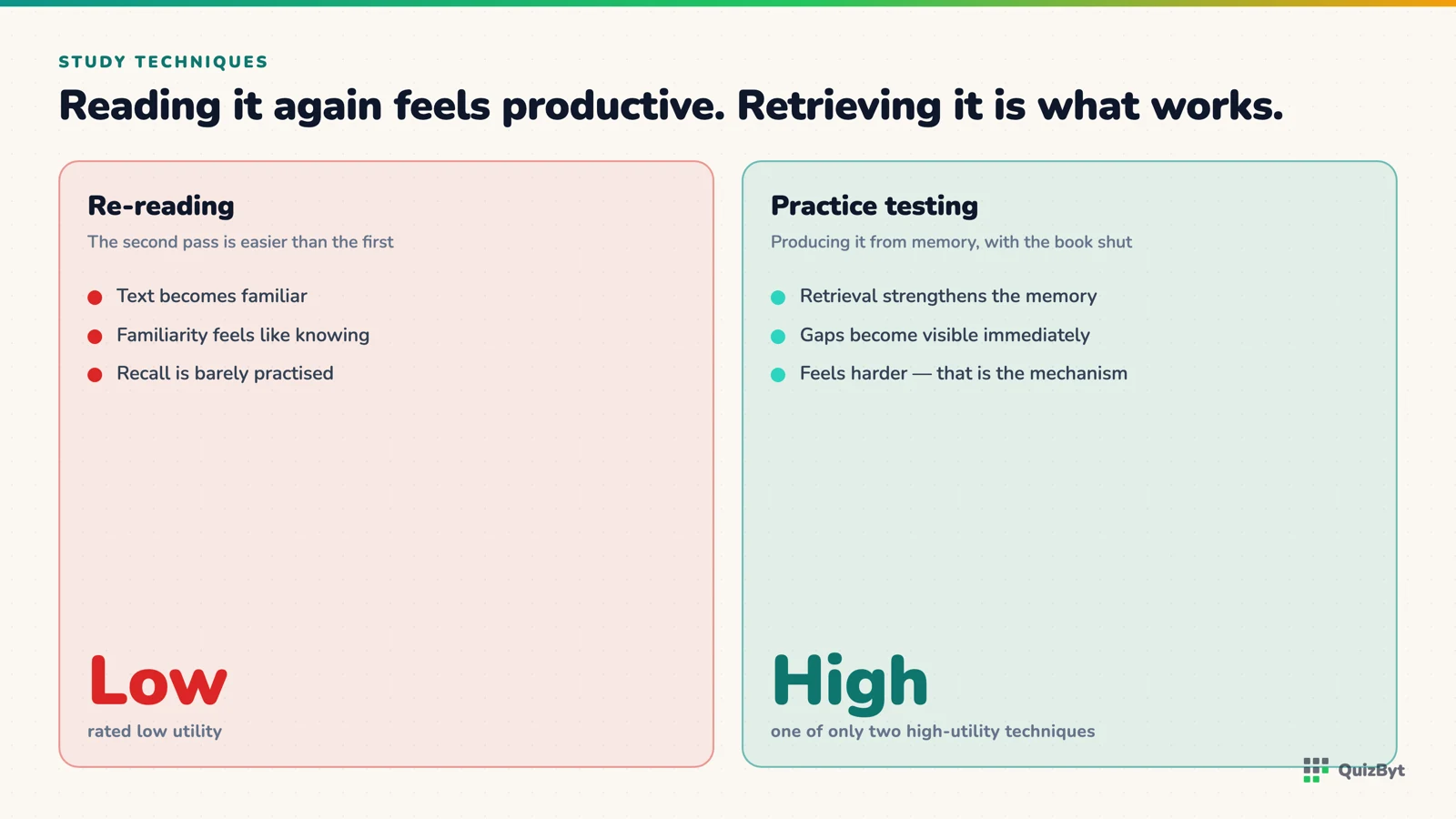
A well-known review assessed ten study techniques students commonly use and rated each for utility. Two came out as high utility: practice testing and distributed practice, spreading study over time. Highlighting, re-reading and summarising were rated low.
The finding has held up. A set of meta-analyses across nine introductory STEM courses looked again at spaced retrieval practice and found real, if sometimes modest, benefits in real classrooms rather than laboratories, and a 2025 meta-analytic review focused on mathematics found a robust small-to-medium effect for spaced over massed practice.
A caveat: the effects are reliable, not miraculous, and they vary by subject. One study found retrieval practice did not clearly help with mathematical word-problem solving. The technique is a strong default, not a universal law.
Why the wrong method feels right
Re-reading produces fluency. The second pass is smoother than the first, and the brain treats that smoothness as evidence of knowing. It is not. Fluency measures how easy the text is to read, and the exam measures whether you can produce the content without the text in front of you. Those are different skills, and only one of them is being practised.
Retrieval feels bad for the same reason it works. Struggling to recall something is the effortful part, and the effort is the mechanism.
How to actually do it
- Read the lesson once. Once. Not three times.
- Close it and take the quiz. Before you feel ready, attempting questions early and then reading the explanation beats the reverse.
- Read only what you got wrong. The questions you answered correctly need nothing.
- Come back in two days, not two hours. The gap is doing the work.
- Retake the quiz. A second attempt after a gap is worth more than a second attempt immediately.
How this is built into QuizByt
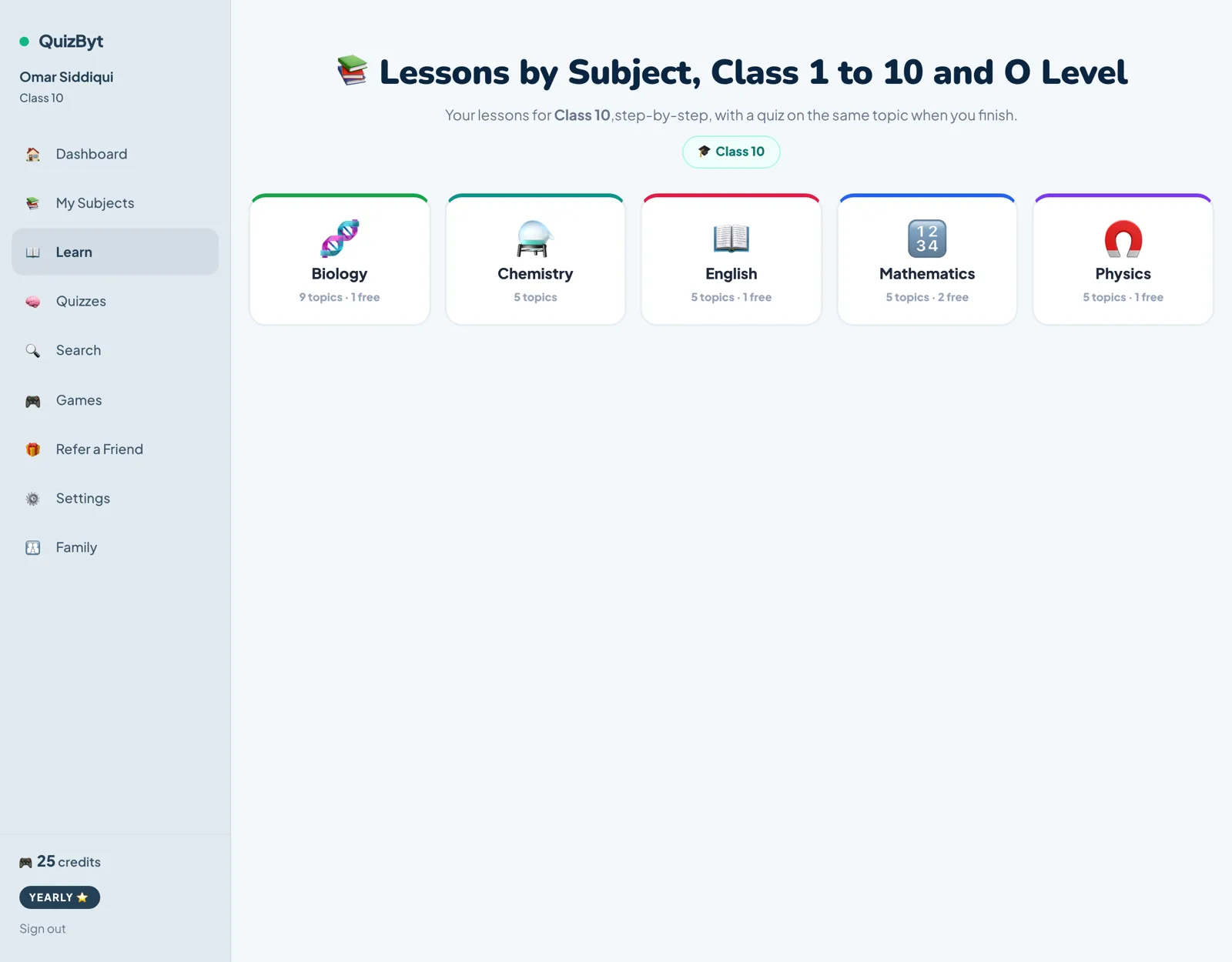
Every lesson topic finishes with a quiz on that same topic, which is the shape this evidence recommends: read once, retrieve immediately. Quizzes are about six multiple-choice questions on one topic at one of three difficulty levels, so a session is short enough to repeat rather than an event to prepare for.
Answers are never shown mid-quiz. You answer, press Next, and see every correct answer with the reason once you finish. Score 80% or more and the answer review opens even if you still have a retry in hand, because at that point you have demonstrated the understanding the hold was protecting. Below 80% the answers stay closed until your last attempt, and the lesson behind the topic is offered instead. The second try is meant to be earned by revising, not by copying the corrections.
Paid plans include retries (two on monthly and yearly, three on Premium) which exist so that a second attempt after a gap is possible.
Start with any subject at the subject list, or read the twenty-minute daily habit for how to fit this into a real week.
Questions parents ask
What is retrieval practice?
Trying to recall information from memory without looking at it, answering a question, doing a past paper, explaining a topic out loud. The act of retrieving is what strengthens the memory, not the act of reviewing.
Why does re-reading not work well?
Because the second read is easier than the first, and the brain reads that ease as understanding. It is a fluency illusion: the text becomes familiar while recall does not improve much.
How often should I test myself?
Little and often. Spacing the same total study time across several days consistently beats concentrating it in one session.
Should I test myself even before I have learned the material?
Yes, surprisingly. Attempting questions before you feel ready, then reading the explanation, tends to outperform reading first and testing last.
Responses
Sign in to join the conversation. Responses are open to people with a QuizByt account, which is how we keep this a place you would let your child read.
Loading responses…
Lessons that talk, quizzes that mark themselves, games that make kids think
QuizByt is matched to your child's class. Classes 1–10 and Cambridge O Level. Every subject opens with a free lesson, quiz and worksheet, no account needed.
 Letter Names or Letter Sounds: Which Should a Child Learn First?A child who knows that letter is called "em" still cannot read "mat". A child who knows it says /m/ can. The distinction sounds academic until you watch a five-year-old get stuck on it.Read the article →
 Kindergarten to A Level: The Whole Road, MappedEleven or more years of school, and the thing that has to change at each stage is not how hard a student works but what "studying" actually means. Here is the whole progression in one place.Read the article →
 How to Choose an Online Quiz System for Your School: Twelve Questions to AskEvery vendor demo shows a quiz being taken. Almost none shows what happens the next morning. Twelve questions that separate a quiz system a school will still be using in a year from one it will quietly abandon.Read the article →