
Letter Names or Letter Sounds: Which Should a Child Learn First?
A child who knows that letter is called "em" still cannot read "mat". A child who knows it says /m/ can. The distinction sounds academic until you watch a five-year-old get stuck on it.
The short version
- Letter names and letter sounds are two different pieces of knowledge, and only the sounds let a child blend a word.
- Most phonics programmes teach the sound first or both together, with the sound doing the reading work.
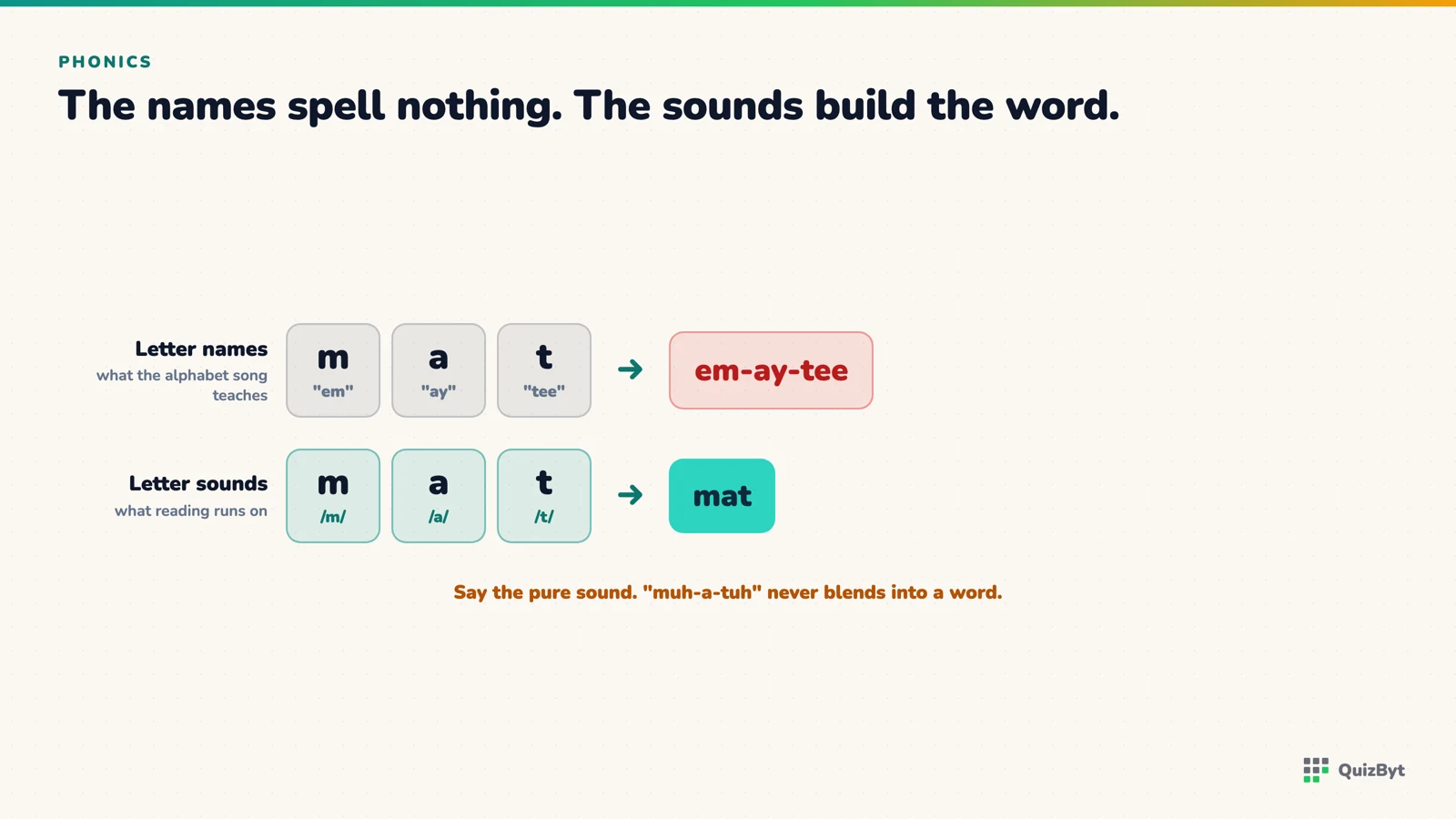
- Say the pure sound (/m/, not "muh") because added vowels turn "mat" into "muh-a-tuh".
- Start with letters that appear in lots of short words, not with A B C in order.
Most children learn the alphabet song before they learn anything else about letters. It is charming, it is useful, and it teaches something slightly different from what people assume.
The song teaches names. Reading needs sounds. They are not the same knowledge, and the gap between them is where a lot of early reading frustration lives.
The difference, concretely
Take the word mat.
A child who knows letter names reads it as "em (ay) tee". Which is not a word, sounds nothing like "mat", and leads nowhere. Many children at this point conclude that reading is an arbitrary code they are failing at.
A child who knows letter sounds reads /m/ (/a/) /t/, which, said quickly, is "mat". The word falls out of the letters. That moment (when a child blends three sounds and hears a real word come out of their own mouth) is the single biggest moment in learning to read, and it is only available to a child who has the sounds.
So which first?
Most structured phonics approaches lead with the sound, or teach name and sound together while using the sound for all the actual reading work. Very few teach names first and sounds later.
That said, names are not useless. They are how you talk about letters ("this one is called tee, and it says /t/") and children pick them up from the alphabet song regardless. The practical position is simple:
- Teach the sound as the letter's job.
- Teach the name as the letter's label.
- When reading a word, always use sounds.
Children handle this pairing without much difficulty. What confuses them is being asked to read with names.
Say the pure sound
This is the technical point that matters most and is easiest to get wrong.
The sound of "m" is /m/, a hum, held, with no vowel. Not "muh". The sound of "t" is a clean /t/, not "tuh". The sound of "s" is a hiss, not "suh".
Those extra vowel sounds are called schwa, and they wreck blending. "Muh-a-tuh" does not turn into "mat" no matter how fast you say it, and the child hears that it does not. They will reasonably conclude that blending does not work.
Some letters make this genuinely hard, b, d, g, k and p are difficult to say without a trailing vowel. Make it as short and clipped as you can. It only has to be close enough that blending produces a recognisable word.
Not in alphabetical order
A B C is an ordering convention, not a teaching sequence. Taught in order, a child needs to reach the letter D before they can read a single word.
Most phonics schemes instead start with a small set chosen because it makes many words quickly. A common first group is s, a, t, p, i, n: from which a child can immediately build sat, tap, pin, nip, tin, pat, sit, pit, tan and more.
Reading actual words within the first week is a much stronger motivator than reaching the letter G.
Lowercase first
Look at any page of a book. It is overwhelmingly lowercase. Capitals are for names and sentence starts: good to know, but a small minority of what a child will encounter.
Teach lowercase as the default. Introduce the capital alongside it as "the big one", especially where the two look completely different: a/A, g/G, r/R, e/E.
This is why our letter tracing presents the capital and the lowercase form together on the same sheet, and why the lowercase letters are drawn in the single-storey handwriting forms schools teach rather than the printing forms most fonts supply. See why that distinction matters.
Sounds and writing are different jobs
One last thing worth separating. Knowing what a letter says and being able to write it are independent skills on independent timetables.
A three-year-old can know that "s" says /s/ long before their hand can produce an "s". Do not hold back the phonics because the handwriting is not ready, and do not assume neat handwriting means the sounds are secure. Run them in parallel, the weekly plan treats them as separate days for exactly that reason.
Questions parents ask
Should I teach letter names or sounds first?
Most phonics approaches lead with the sound, or teach both together while using the sound for reading. The sound is what lets a child blend letters into a word; the name is a label for talking about letters.
What does it mean to say a pure letter sound?
Saying /m/ or /s/ without a vowel attached. "Muh" and "suh" are the common habit, and they make blending much harder: "muh-a-tuh" does not sound like "mat".
Which letters should a child learn first?
Usually a set that makes many short words quickly (s, a, t, p, i, n is a common starting group) rather than alphabetical order.
Should a child learn capitals or lowercase first?
Lowercase, because that is what almost all text is written in. Capitals matter, but they are the minority of what a child will meet on a page.
Responses
Sign in to join the conversation. Responses are open to people with a QuizByt account, which is how we keep this a place you would let your child read.
Loading responses…
Lessons that talk, quizzes that mark themselves, games that make kids think
QuizByt is matched to your child's class. Classes 1–10 and Cambridge O Level. Every subject opens with a free lesson, quiz and worksheet, no account needed.
 Printable Tracing Worksheets: How to Use Them So They Actually WorkA worksheet is a tool, not a lesson. Handed over with a pencil it teaches very little; used for four minutes in the right way it is the most valuable part of the day.Read the article →
 Practice Testing: Why a Quiz Beats Reading the Chapter AgainOf ten common study techniques reviewed across hundreds of studies, only two were rated high utility. Re-reading and highlighting were not among them. Here is what was, and why.Read the article →
 What to Look For in a Learning App for a Five-Year-OldMost apps for this age are built to be opened again, not to teach. The difference is visible in about two minutes if you know where to look. Seven things to check, and the reason behind each one.Read the article →