
Student Reports That Come From Real Work
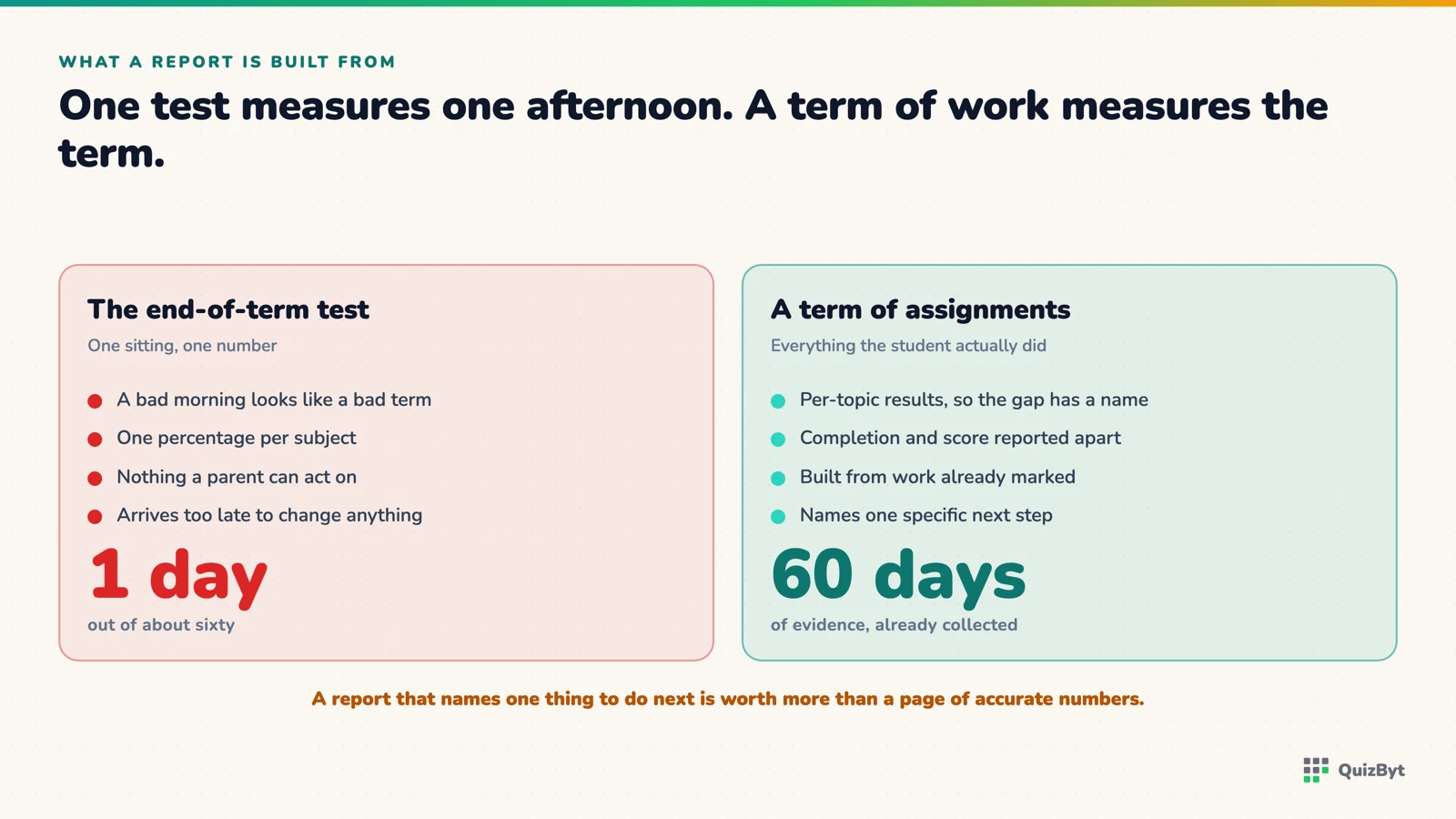
A report assembled from assignments a student actually did says something. A report assembled from one end-of-term test mostly measures one afternoon.
The short version
- One end-of-term test measures a single afternoon; a term of assignments measures the term.
- Per-topic results tell a parent something actionable in a way a subject percentage never does.
- Completion and score are different signals and should be reported separately.
- A report that names one specific next step is worth more than a page of accurate numbers.
The traditional report is built from a test sat in one room on one afternoon. It is treated as a measurement of a term. It is mostly a measurement of that afternoon. How the student slept, whether the topics they revised happened to come up, whether they were anxious.
A term of assignments is a far better instrument, and most schools now have that data without using it.
Report per topic, not per subject
"Science: 68%" is unusable. A parent cannot act on it and neither can the student.
"Science: 68% overall, strong on forces and energy, 2 out of 6 on electric circuits across three attempts" is a plan. It names the problem, shows it is not a one-off, and points at the next hour of work.
This is why QuizByt's quizzes are topic-sized rather than subject-sized, a score on six questions about one topic is diagnostic, and a score on a whole subject is an average that hides the thing you needed to see.
Separate completion from score
Two students both average 65%. One completed every assignment; the other completed a third and scored well on those. Same number, completely different conversations.
Report both. Completion is a measure of habit and often the easier thing to fix; score is a measure of understanding. Collapsing them into one figure destroys the distinction exactly when a parent needs it.
Include the work only a teacher marked
If the report is built solely from auto-marked quizzes it describes recall and ignores method, which is most of what the exam will award. Because hand-marked uploads carry a score and a maximum in the same assignment record, they belong in the report alongside the quizzes. That is the difference between a complete picture and a convenient one. See hand-marked assignments.
End with one next step
The most common failure of a good report is that it stops at accuracy. A parent reading three pages of correct numbers still asks "so what do we do?"
One specific recommendation (the topic to work on, the difficulty level to move to, the habit to change) is worth more than another page of data. This is the principle behind the parent report QuizByt sends: it names the weakest subject and says what to do about it, rather than rendering a dashboard into an email. What it contains is here.
Related: assignments and results in one place.
Questions parents ask
Why not just use end-of-term exams for reports?
Because a single test conflates knowledge with how one afternoon went. Assignment data across a term separates a bad day from a real gap.
What should a parent report actually contain?
The subject picture, the weakest topic named specifically, whether effort and completion are steady, and one concrete next step. Numbers without a recommendation are just numbers.
Is completion as important as score?
It is a different signal and often more actionable. A student completing everything at 60% needs different help from one completing half at 90%.
How do hand-marked assignments fit in?
They carry a score out of a maximum the teacher sets, so they sit alongside auto-marked quizzes in the same history rather than in a separate mark book.
Responses
Sign in to join the conversation. Responses are open to people with a QuizByt account, which is how we keep this a place you would let your child read.
Loading responses…
Lessons that talk, quizzes that mark themselves, games that make kids think
QuizByt is matched to your child's class. Classes 1–10 and Cambridge O Level. Every subject opens with a free lesson, quiz and worksheet, no account needed.
 Games on a Schedule, Not a Nightly ArgumentThe fight is rarely about games. It is about the fact that the rule is renegotiated every single evening. A rule that is set once and enforced by the device ends the negotiation.Read the article →
 Remote and Home Schooling That Students Actually FinishThe hard part of remote learning was never delivering the material. It was that nobody was in the room, and self-paced work only works when finishing is designed in.Read the article →
 One Chapter, Three Boards: What Changes and What Does NotTake quadratic equations across Cambridge IGCSE, Oxford AQA and a national board's secondary syllabus. The content list looks almost identical. The teaching, the depth and the examination are not. A worked comparison.Read the article →