
Screen Rules That Survive a Teenager
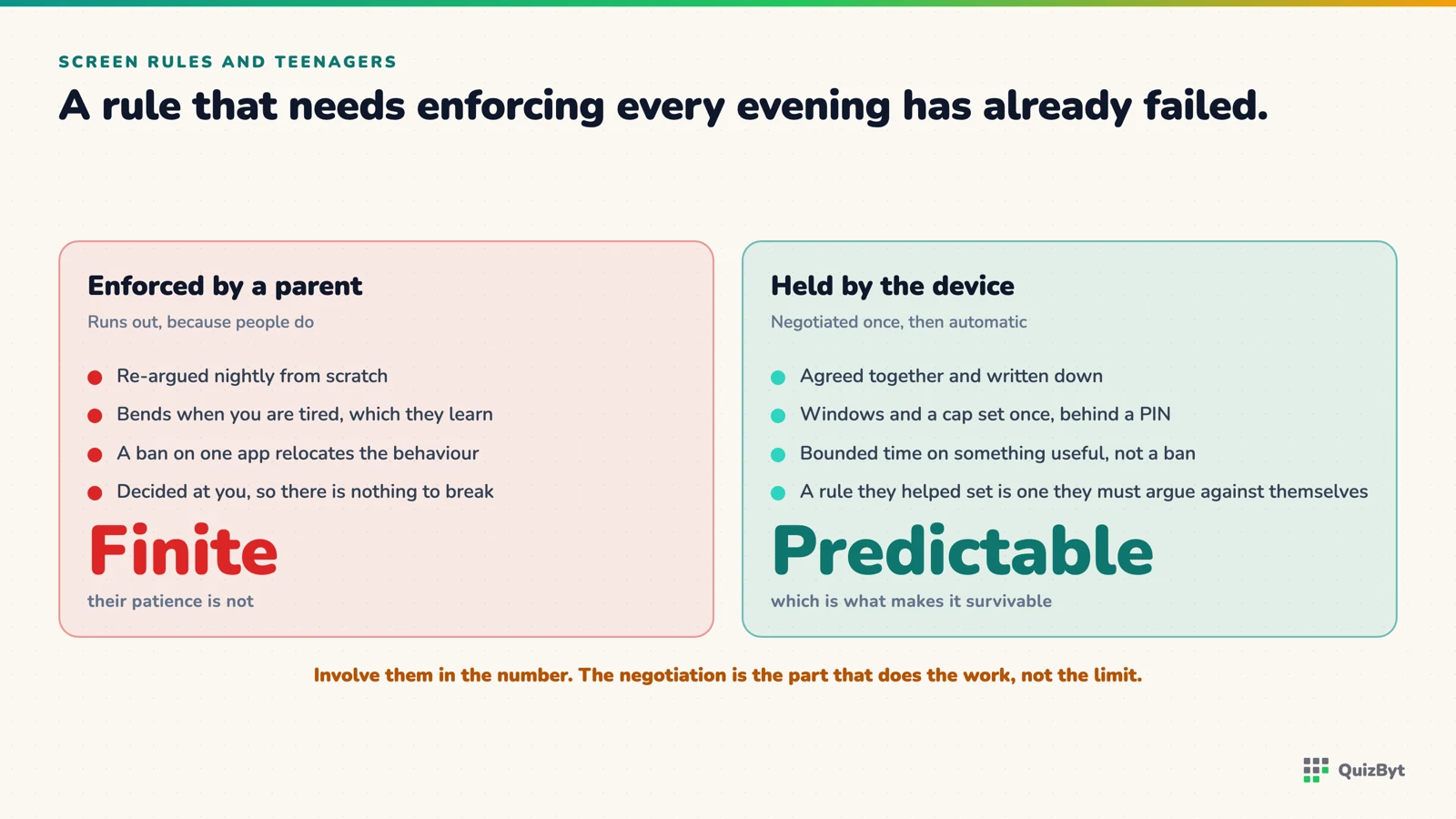
Rules that depend on constant enforcement fail, because enforcement runs out. Rules that are predictable, negotiated once, and enforced by the device survive.

The short version
- A rule requiring enforcement every evening will fail, because the parent's capacity to enforce is finite and the teenager's is not.
- Negotiate once, write it down, and let the device hold the boundary.
- Bans on a single platform mostly relocate the behaviour; bounded time on a useful platform is more achievable.
- Involve the teenager in setting the limit, a rule they helped set is one they have to argue against themselves to break.
Every parent of a teenager has run the same experiment. A rule is announced, enforced for a fortnight, eroded over a month by daily negotiation, and quietly abandoned.
The failure is structural, not personal. A rule that requires an adult to enforce it every evening depends on that adult's willpower every evening, and willpower is finite in a way that a fifteen-year-old's persistence is not.
Move the boundary off the parent
The rules that survive are the ones nobody has to enforce in the moment. A game window that opens at six and closes at seven is not a decision anybody makes at 6:55. It is simply how the evening goes.
QuizByt's controls are built for that: games on or off, a weekly schedule of windows, and a daily cap in minutes, all behind a parent PIN. Once it is set, the argument has nowhere to happen. The details are in games on a schedule.
Negotiate once, properly
Have the conversation as a genuine negotiation, once, and write the outcome down. Ask them to propose the schedule. Push back where you need to, agree something, and enter it.
The reason this works is not that they will like the limit. It is that they will have to argue against their own proposal to break it, which is a much harder position than arguing against yours.
Then hold it for a term. Renegotiating monthly re-teaches that the rule is negotiable, which was the original problem.
The limits of any one platform
No app controls a household. A teenager with a phone, a laptop and friends has options, and pretending otherwise damages your credibility on the rules that matter.
What per-platform controls actually buy you is narrower and still worth having: one fewer nightly negotiation, and a working demonstration that limits can be predictable and survivable rather than arbitrary. That demonstration transfers.
Exam periods: change it, do not suspend it
Removing all games during exams is the most common approach and one of the least effective. It removes the main recovery activity at the most stressful time, and it has no defined end, which teenagers read as indefinite.
Better: a reduced, specific schedule for those weeks, with a stated date when it returns to normal. Defined and temporary is accepted. Open-ended is fought.
Questions parents ask
Should I ban games entirely?
Rarely effective on its own. Total bans relocate the activity to devices and places you have no visibility of, and cost the goodwill you need for the rules that matter more.
My teenager just uses another device. What now?
No single platform can control a household. What per-platform rules give you is one fewer nightly negotiation and a working example of a limit that is predictable rather than arbitrary.
Is it worth involving them in setting the rule?
Yes, and it is the highest-return five minutes available. Adolescents respond much better to a rule they helped construct than to one imposed, even when the rule is identical.
What about exam periods?
Change the schedule for those weeks rather than suspending all games, and say when it returns to normal. A defined, temporary change is accepted far better than an open-ended removal.
Responses
Sign in to join the conversation. Responses are open to people with a QuizByt account, which is how we keep this a place you would let your child read.
Loading responses…
Lessons that talk, quizzes that mark themselves, games that make kids think
QuizByt is matched to your child's class. Classes 1–10 and Cambridge O Level. Every subject opens with a free lesson, quiz and worksheet, no account needed.
 One Platform Instead of Six AppsA quiz app, a worksheet site, a video channel, a games app and a spreadsheet of scores. The problem is not any one of them. It is that nothing connects.Read the article →
 Two Children, One Plan: How Family Accounts WorkSeparate dashboards, separate progress, separate PINs, and the second and third child at half price. What that means in practice for a mixed-age household.Read the article →
 Place Value for Class 1 to 3: Digits, Tens and Hundreds Without TearsThe digit 4 means four things in 4, forty things in 40 and four hundred things in 400. A child who really understands that can add, subtract, round and compare. A child who does not is memorising tricks.Read the article →