
One Platform Instead of Six Apps
A quiz app, a worksheet site, a video channel, a games app and a spreadsheet of scores. The problem is not any one of them. It is that nothing connects.
The short version
- Separate tools each work while producing no combined picture of whether a child is improving.
- The value of one platform is not features but continuity: lessons, quizzes, worksheets and reporting describing the same child.
- Fewer subscriptions is a side benefit; the real one is that the weak topic becomes visible.
- A single platform is not automatically better. It is better when the pieces genuinely reference each other.
A typical arrangement: a quiz app, a worksheet site, a video channel for explanations, a games app as a reward, and a mental note about how it is going.
Each one works. The arrangement does not, and the reason is not quality. It is that nothing references anything else.
What is actually lost
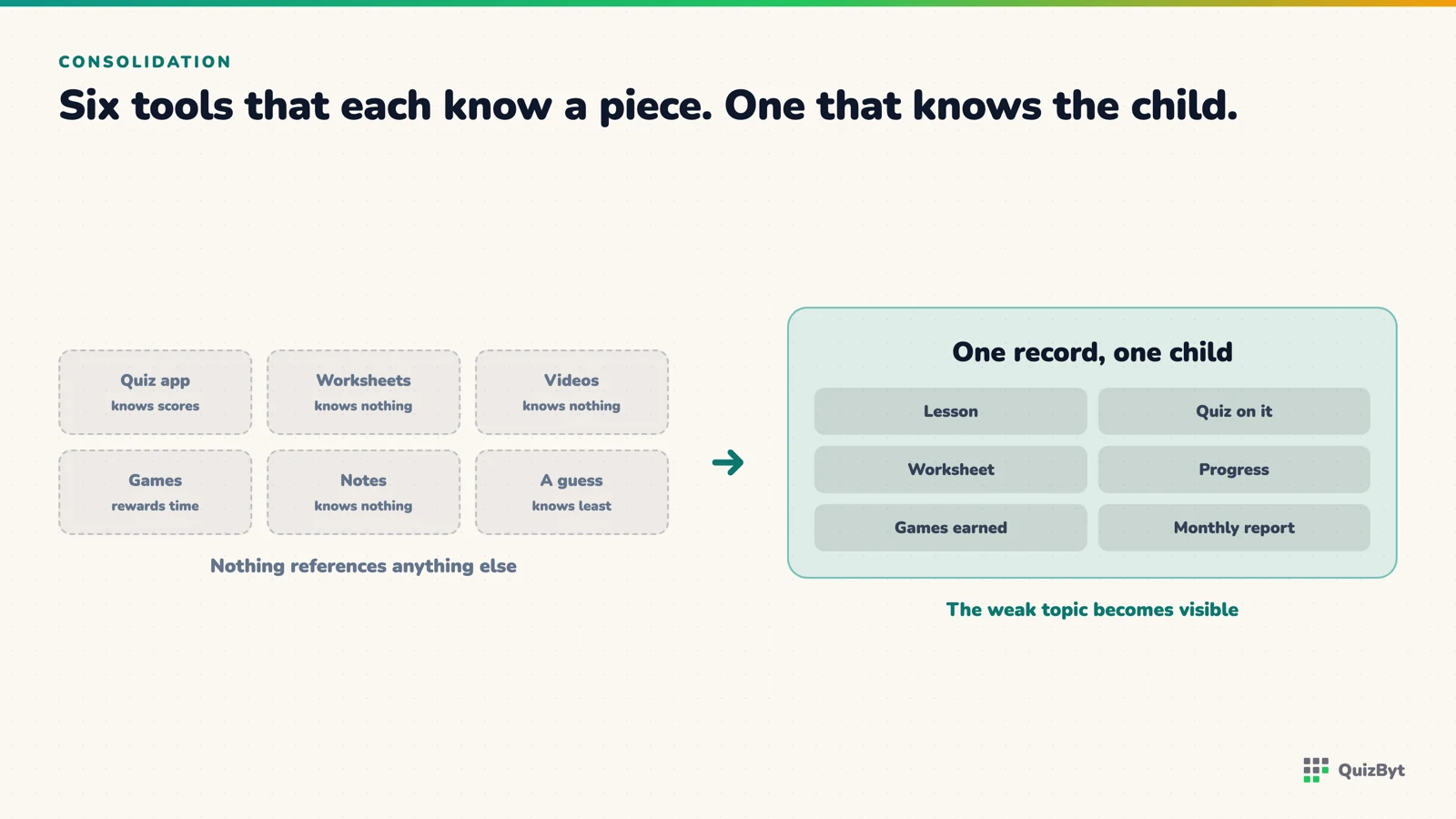
The quiz app knows your child scored badly on electric circuits. The worksheet site does not, so it offers no worksheet on it. The video channel does not, so nothing is recommended. The games app rewards time rather than progress. And no one thing can tell you whether this month was better than last.
The missing product is not a feature. It is continuity, the same topic tracked from the lesson, through the quiz, onto paper, into a report.
What one platform changes
- The lesson and its quiz are the same topic. Read once, retrieve immediately, the sequence the evidence supports.
- The worksheet matches the topic, so the paper practice reinforces the same thing rather than something adjacent.
- Progress is per topic across all of it, which is what makes a weak area visible rather than merely felt.
- Games connect to the work (credits earned by scoring 50% or better) instead of being a separate negotiation.
- The report describes one child, not four partial views.
What it does not change
Worth being straight about this, because consolidation is oversold. One platform does not make a child study. It does not replace a teacher who explains something the right way. It does not fix a two-year foundation gap quickly.
And one platform is only better if the pieces genuinely reference each other. A single app bundling five unconnected sections has the same disconnection problem in one login, and should not be preferred simply because the bill is consolidated.
The practical test
Ask of any platform: if my child scores badly on one topic, what happens next? A good answer names the lesson behind that topic, the worksheet for it, the retry policy, and where it shows up in the report. A vague answer means the sections are not connected and you are back to assembling it yourself.
QuizByt's arrangement is 405 lesson topics, a quiz on each, a printable worksheet for each, per-subject and per-topic progress, credit-gated games, parental controls, and an opt-in monthly report, covering Kindergarten through Class 10 and O Level.
Related: what it costs, why children's digital engagement matters, and the community's job in raising digital learners.
Questions parents ask
Is one platform really better than picking the best app for each thing?
Only if the pieces connect. Best-of-breed tools that share no data leave you assembling the picture manually, which is the work that never gets done.
What should be in one place?
Lessons, the quizzes for those lessons, printable worksheets for the same topics, and the record of what was done. Those four referencing each other is what produces a usable picture.
Does consolidating save money?
Usually somewhat, but that is the smaller benefit. The larger one is that a weak topic becomes visible instead of being spread across four tools that each saw part of it.
What if my child likes a specific app?
Keep it. Consolidation is about the core study loop, not about removing everything a child enjoys.
Responses
Sign in to join the conversation. Responses are open to people with a QuizByt account, which is how we keep this a place you would let your child read.
Loading responses…
Lessons that talk, quizzes that mark themselves, games that make kids think
QuizByt is matched to your child's class. Classes 1–10 and Cambridge O Level. Every subject opens with a free lesson, quiz and worksheet, no account needed.
 A Parent's Guide to the Kindergarten-to-A-Level JourneyWhat your job is at each stage, and (more usefully) what it stops being. The commonest mistake is running stage two parenting during stage five.Read the article →
 Screen Rules That Survive a TeenagerRules that depend on constant enforcement fail, because enforcement runs out. Rules that are predictable, negotiated once, and enforced by the device survive.Read the article →
 Place Value for Class 1 to 3: Digits, Tens and Hundreds Without TearsThe digit 4 means four things in 4, forty things in 40 and four hundred things in 400. A child who really understands that can add, subtract, round and compare. A child who does not is memorising tricks.Read the article →