
Should You Trust AI-Written Quizzes in a Classroom?
Generative models still get things confidently wrong, and a wrong answer marked correct teaches the mistake. The answer is not to ban AI from question writing. It is to never let it publish unreviewed.
The short version
- Generative models still produce confident factual errors, and rates rise sharply on niche or recent topics.
- A wrong answer key is worse than no question, because it teaches the mistake and is backed by the authority of the platform.
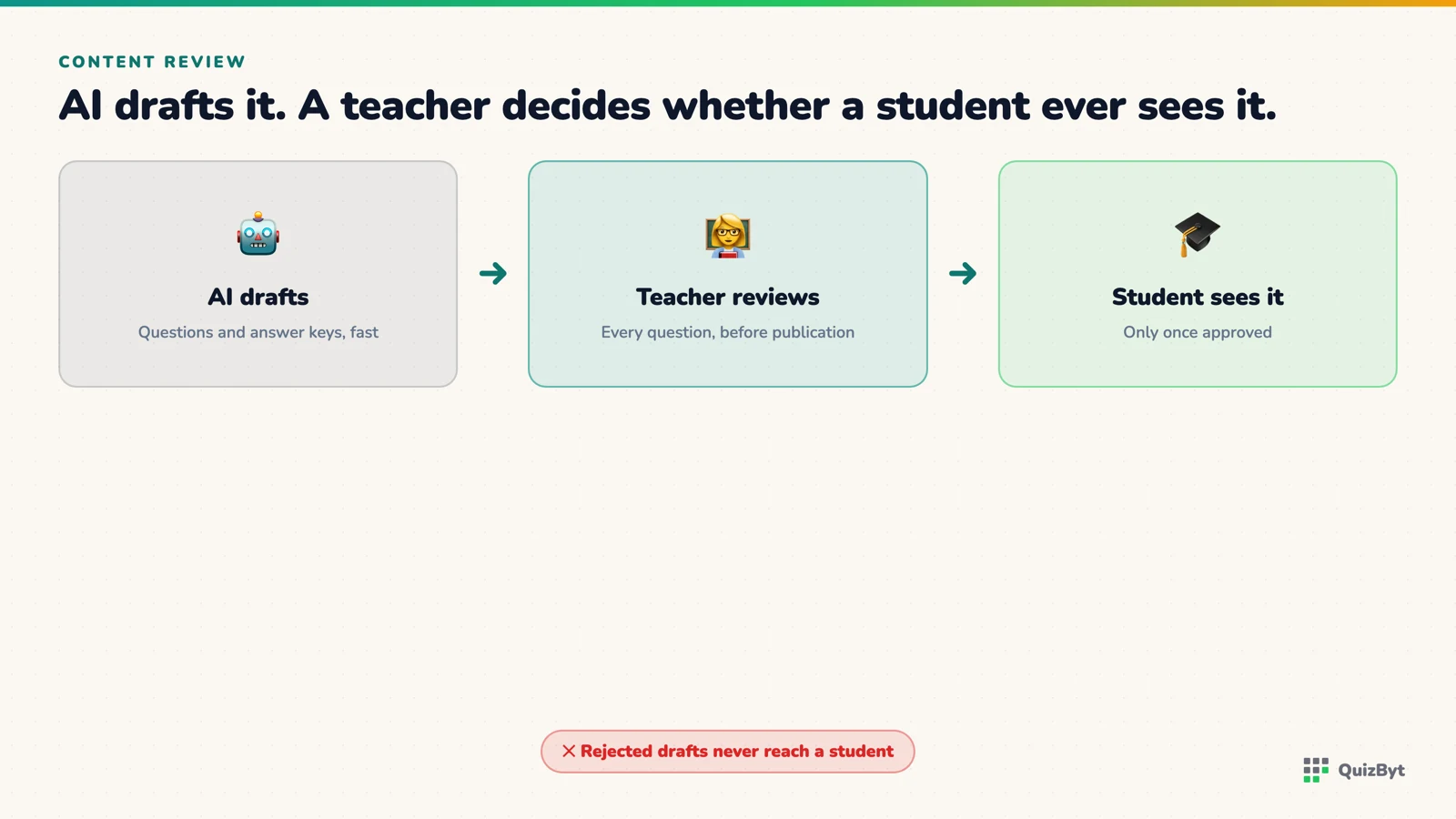
- The workable model is AI drafts, a qualified human approves, and nothing reaches a student in between.
- Ask any edtech vendor one question: who checks it before a child sees it, and what happens when they reject it?
There is a specific failure to be clear about, because it is not the one people usually worry about. It is not that AI writes a bad question, a bad question is obvious and gets skipped. It is that AI writes a good question with a wrong answer key.
A student answers correctly, is marked wrong, reads the "correct" explanation, and updates their understanding to match the error. They have been taught something false by a system they had no reason to doubt.
How often does this happen?
Often enough to design around. Reviews of generative AI in education report that current models still produce confident factual errors, with rates rising sharply on niche or recent topics, and a national syllabus is full of exactly the specific, locally-defined material that models handle worst.
The research literature has been catching up on this: work on hallucinations as a threat to scholarly integrity argues for supervised verification rather than trust, and a review of generative AI in computer science education concludes that a hybrid approach (AI efficiency plus human expertise) is what is needed for accuracy. MIT Sloan's teaching group reaches the same practical conclusion in its guidance on hallucinations and bias.
None of this says do not use AI. It says do not let it be the last step.
Why "a teacher spot-checks it" is not enough
Spot-checking finds the questions that look wrong. The dangerous ones look right. If a sample of ten is checked from a batch of two hundred, the errors that survive are the plausible ones, the category that does the damage.
Review has to be per-question and before publication, or it is theatre.
What we actually do
QuizByt's catalogue is either written by teachers directly or drafted with AI and reviewed by a teacher before publication. The review is not advisory: an unapproved quiz is not visible to students, because every student-facing query filters to approved content.
For teacher-authored content there is a second layer. In the Teacher Hub, a quiz needs two independent peer approvals from other teachers before it publishes, and a single rejection sends it back to the author. Content touching sensitive material is routed to an admin queue instead and never enters peer review at all.
Schools writing their own questions get the AI builder too. It drafts, the teacher edits and approves, and the school owns the result.
The question to ask any vendor
Not "do you use AI?", nearly everyone does now, and the answer tells you nothing. Ask:
- Who reviews content before a student sees it, and what are they qualified in?
- Is review before or after publication?
- What share of drafted questions gets rejected or rewritten?
That last one is the tell. A vendor reviewing seriously knows the number and it is not tiny. A vendor who has never measured it is describing an intention rather than a process.
More on the teacher side of this: building a question bank, and how the Teacher Hub review queue works. The wider question of what AI does to a student's own thinking is in AI gives answers. Who trains the mind?
Questions parents ask
Is it safe to use AI to write quiz questions?
To draft them, yes. It is fast and it removes blank-page work. To publish them unchecked, no. The failure mode is a plausible question with a wrong answer key, which is very hard for a student to detect.
How often does AI get factual questions wrong?
It varies a lot by topic and model. Reviews report meaningful error rates on factual and citation tasks, rising sharply on niche or recent material, which is exactly where a syllabus often sits.
What should schools ask an edtech vendor about AI content?
Who reviews it, what their qualification is, whether review happens before or after publication, and what proportion gets rejected. A vendor who cannot answer the last one probably is not reviewing much.
Does QuizByt use AI to write quizzes?
Some content is drafted with AI and some is written by teachers directly. Either way it is reviewed by a real teacher before publication. Nothing reaches a student unapproved.
Responses
Sign in to join the conversation. Responses are open to people with a QuizByt account, which is how we keep this a place you would let your child read.
Loading responses…
Lessons that talk, quizzes that mark themselves, games that make kids think
QuizByt is matched to your child's class. Classes 1–10 and Cambridge O Level. Every subject opens with a free lesson, quiz and worksheet, no account needed.
 From Paper to Tablet Without Losing the LearningMost school digitisation projects move the paper onto a screen and call it transformation. Here is what actually has to change, and the parts of paper worth keeping.Read the article →
 How to Move Up One Grade in a Single TermNot by working twice as hard. By spending the same hours on the topics that are actually costing marks, which most students never identify.Read the article →
 Five-Minute Lessons: A Realistic Study Day for a Class 2 ChildForget the hour-long study session. Here is a day of interactive learning for a seven-year-old that actually fits a real family, and why short beats long at this age.Read the article →