
How to Move Up One Grade in a Single Term
Not by working twice as hard. By spending the same hours on the topics that are actually costing marks, which most students never identify.
The short version
- Most students revise what they already know, because it is more pleasant, and it returns almost nothing.
- An hour on a weak topic is worth several hours on a strong one, so the audit comes before the effort.
- Measure topics closed, not hours studied; hours reward sitting still.
- One term of spaced, targeted work moves grades more reliably than a month of panic before the exam.
The usual plan for improving a grade is "work harder". It fails often enough to be worth examining why: extra hours get spent on whatever the student is most comfortable revising, and comfort correlates almost perfectly with already knowing it.
A term is enough time to move a grade. It requires spending the hours somewhere else.
Week 1: audit, do not study
Spend the first week finding out where you actually are.
- List every topic in the subject. Topics, not chapters.
- Rate each: solid / shaky / lost.
- Take a short quiz on three you rated solid.
That last step is the one people skip, and it is the one that produces the real list. Re-reading inflates confidence, so the "solid" pile is where the hidden losses live.
Weeks 2–9: work only the weak list
Two topics a week. For each: read the lesson once, take the quiz, read only the wrong answers, and re-test the same topic the following week after a gap.
This is the twenty-minute structure, pointed at a specific list rather than at the syllabus in general. Strong topics get one maintenance pass and nothing more. They are not where the marks are.
QuizByt is shaped for this: quizzes are topic-sized at three difficulty levels, and each topic has a lesson behind it and a printable worksheet beside it, so the whole cycle is in one place.
Weeks 10–12: assemble
Now the paper-level skills: full past papers under timing, marked against the mark scheme. If you are on O Level this is also when command words and answer structure earn their marks.
Measure topics closed, not hours studied
"I studied three hours" is a measure of sitting. "I closed four topics this week" is a measure of progress, and it is the only one that predicts the grade.
Keep the rated topic list visible and change ratings only after a test, never after a read. A list that improves because you feel better about it is a list that will disappoint you in an exam.
The honest limits
This works when the problem is unidentified gaps, which it usually is. It works far less well when the foundations from two years earlier are missing, a Class 10 student who never secured Class 8 algebra needs to go back, and a term is a tight budget for that. Going back is still faster than repeatedly failing forwards.
Where you are in the wider journey: Kindergarten to A Level, mapped.
Questions parents ask
Can a grade really move in one term?
Frequently, when the starting problem is unidentified weak topics rather than a general lack of understanding. It moves far less if the foundations two years back are missing, which needs longer.
How do I find my weak topics quickly?
List every topic, rate each one honestly, then test the ones you rated highest. Confidence is where the surprises are, so auditing it is the fastest route to the real list.
Should I drop my strong subjects to focus on weak ones?
Not drop, reduce. Strong subjects need maintenance, which is much less time than improvement. The marginal hour belongs to the weak topic.
What if I have no time at all?
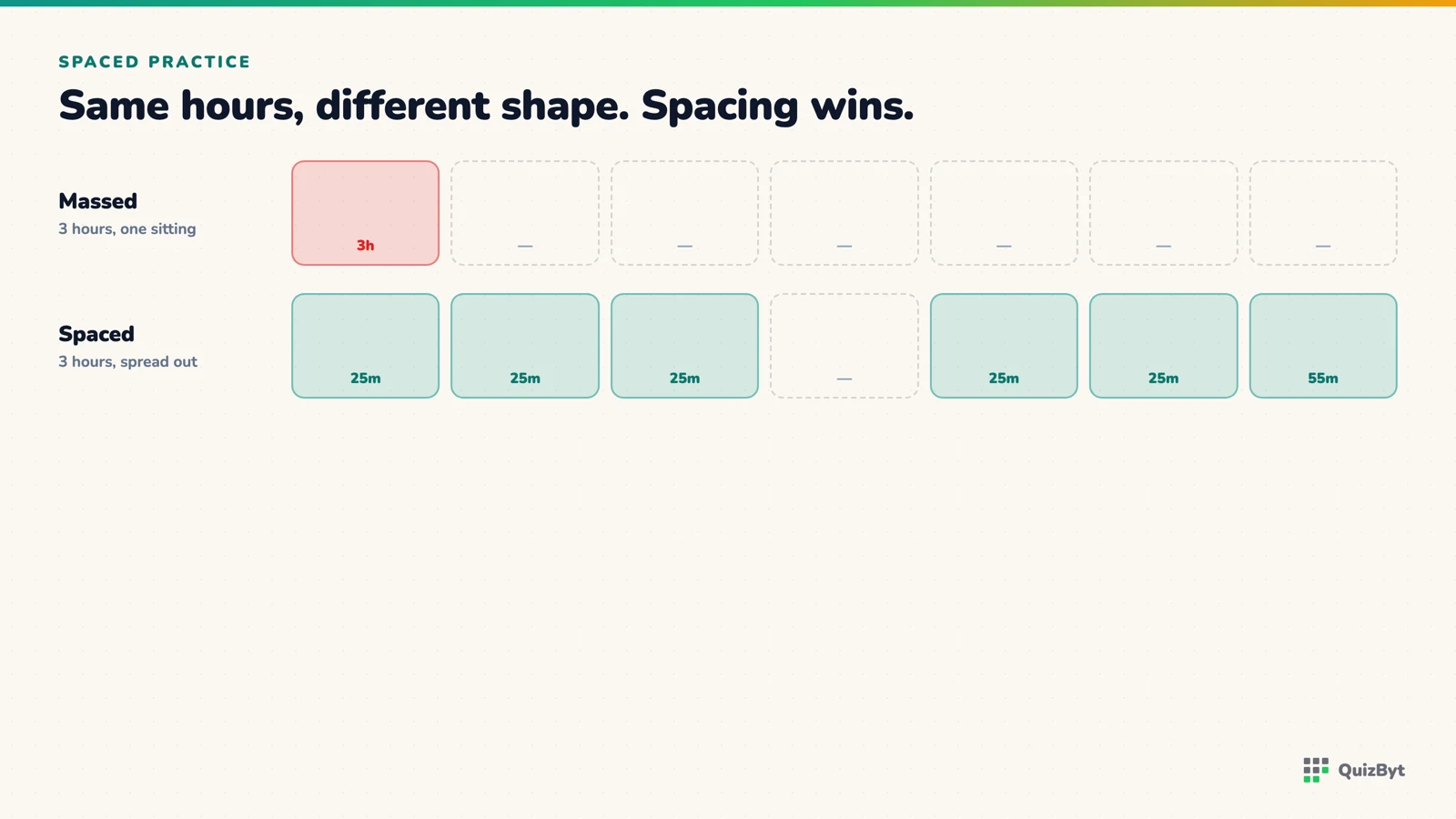
Twenty minutes a day for a term is about twenty hours, spaced, which outperforms the same twenty hours crammed. Lack of time is usually lack of a plan.
Responses
Sign in to join the conversation. Responses are open to people with a QuizByt account, which is how we keep this a place you would let your child read.
Loading responses…
Lessons that talk, quizzes that mark themselves, games that make kids think
QuizByt is matched to your child's class. Classes 1–10 and Cambridge O Level. Every subject opens with a free lesson, quiz and worksheet, no account needed.
 Should You Trust AI-Written Quizzes in a Classroom?Generative models still get things confidently wrong, and a wrong answer marked correct teaches the mistake. The answer is not to ban AI from question writing. It is to never let it publish unreviewed.Read the article →
 What a Falling Quiz Score Is Actually Telling YouA score is a measurement, not a verdict. Read properly, a bad one is the most useful thing that happened all week, and there are only about four things it can mean.Read the article →
 Read-Aloud Quizzes: Why Listening Beats Reading for Early LearnersA quiz a Class 1 child has to read is really two tests at once. A quiz that reads itself aloud tests the one thing you care about: does the child know the answer?Read the article →