
What a Study Platform Costs, and What You Get for It
Plain numbers, no marketing arithmetic: what each plan costs, what it actually includes, and the honest case for when the free trial is enough.
The short version
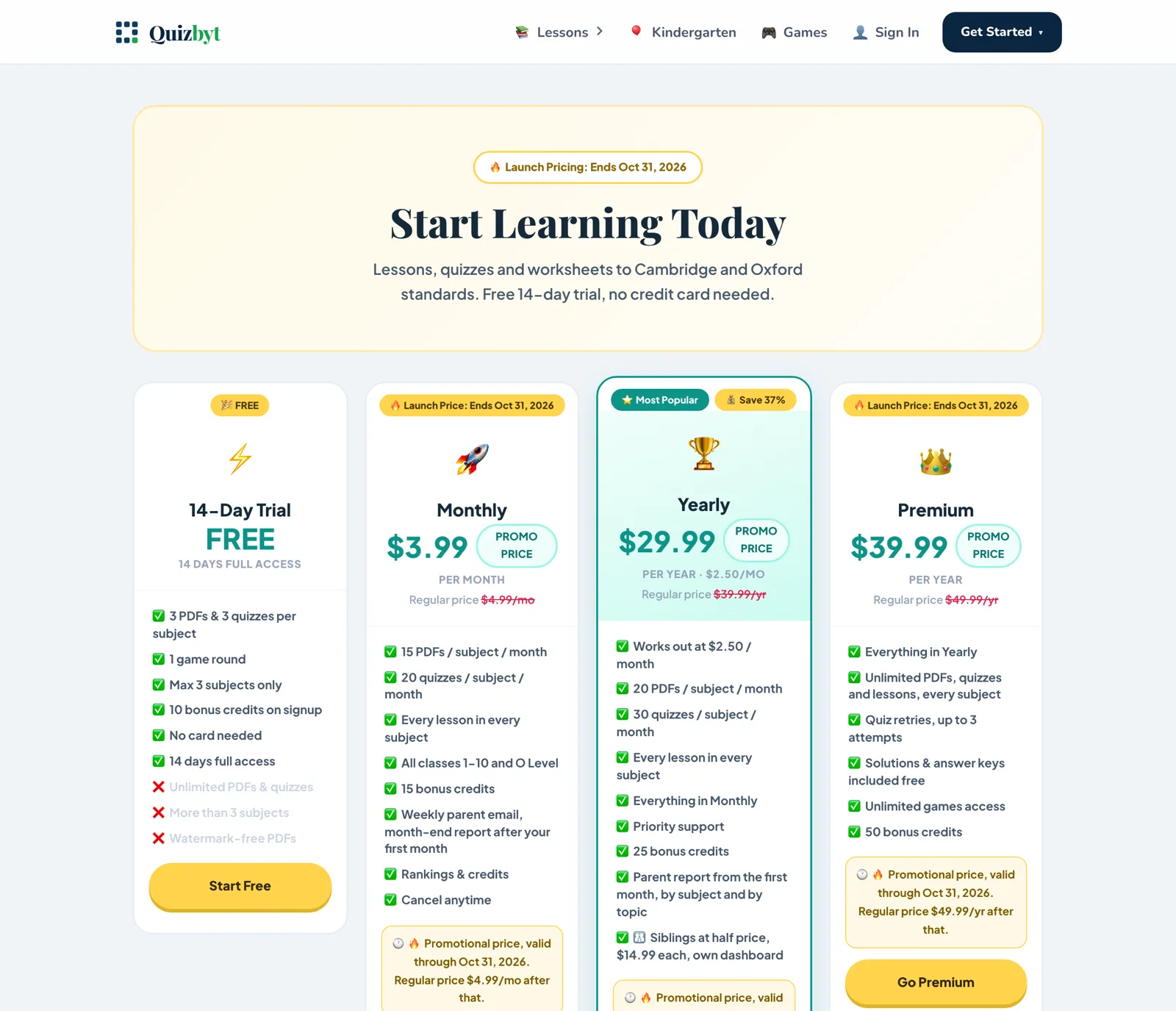
- The 14-day trial needs no card and includes 3 worksheets, 3 quizzes and 3 subjects.
- Monthly is PKR 199 (USD 3.99); yearly is PKR 1,999 (USD 29.99) and is cheaper than ten monthly payments.
- Premium adds answer keys, unlimited worksheets and quizzes, three retries and unlimited games.
- The main practical difference between monthly and yearly is worksheets per month: 15 versus 20.
Educational pricing pages tend to be written to make comparison difficult. Here are the actual numbers.
Free trial: 14 days, no card
Three worksheets, three quizzes, up to three subjects. No payment details required to start.
This is genuinely enough to answer the only question that matters at this stage: does this child engage with this material? If they do not open it during the trial, a subscription will not change that, and you have lost nothing.
Monthly: PKR 199 / USD 3.99
- 15 printable worksheets per month
- 20 quizzes per month
- All subjects for their class
- Two attempts per quiz
Suits a household that wants to stay flexible, or is testing the water past the trial.
Yearly: PKR 1,999 / USD 29.99
- 20 printable worksheets per month
- 30 quizzes per month
- Two attempts per quiz
Cheaper than ten monthly payments, with higher monthly allowances. The honest reason to pick it is that study benefits from continuity, a plan that lapses in March and restarts in June produces exactly the massed-then-nothing pattern that spacing is supposed to prevent.
Premium: PKR 3,999 / USD 39.99 a year
- Unlimited worksheets and quizzes
- Answer keys included with worksheets
- Three attempts per quiz
- Unlimited games without spending credits
The answer keys are the real differentiator for most families: it is what lets a parent mark a worksheet at the kitchen table without waiting for a teacher.
More than one child
Family accounts on the yearly plan cover up to three children, each with their own PIN and separate dashboard, and second and third children are half price. More in how family accounts work.
When you should not subscribe
To put it plainly:
- If your child did not open it during the trial. Paying does not create motivation.
- If you only need two or three topics before an exam, topic bundles are the cheaper answer.
- If nobody at home will look at the report. The platform works best with an adult glancing at it monthly; without that it is a website your child may or may not visit.
One more thing worth weighing before you compare prices: whether you are replacing several separate subscriptions with one. That arithmetic is in one platform instead of six apps.
See the current plans at the pricing page, and start with the free trial.
Questions parents ask
Is there a free trial?
Yes: 14 days, no credit card. It includes 3 worksheets, 3 quizzes and up to 3 subjects, which is enough to judge whether the material suits your child.
What is the difference between monthly and yearly?
Price and allowances. Monthly gives 15 worksheets and 20 quizzes a month; yearly gives 20 worksheets and 30 quizzes a month at PKR 1,999 a year, which works out cheaper than ten monthly payments.
What does Premium add?
Answer keys included with worksheets, unlimited worksheets and quizzes, three quiz retries instead of two, and unlimited games.
What if I only need a few topics?
Topic bundles exist for that. You buy specific topics rather than a subscription, which suits exam-season revision on two or three weak areas.
Responses
Sign in to join the conversation. Responses are open to people with a QuizByt account, which is how we keep this a place you would let your child read.
Loading responses…
Lessons that talk, quizzes that mark themselves, games that make kids think
QuizByt is matched to your child's class. Classes 1–10 and Cambridge O Level. Every subject opens with a free lesson, quiz and worksheet, no account needed.
 Two Children, One Plan: How Family Accounts WorkSeparate dashboards, separate progress, separate PINs, and the second and third child at half price. What that means in practice for a mixed-age household.Read the article →
 Lessons Opened Versus Lessons FinishedThe gap between those two numbers is the clearest early warning a parent gets, and it shows up weeks before scores start to fall.Read the article →
 A School's First Month With AI-Built ContentWeek by week: what to upload first, who reviews, what usually goes wrong in week two, and what you should be able to see by the end of the month. A plan rather than a promise.Read the article →