
Homeschooling With QuizByt: A Day That Runs Itself
The hardest part of homeschooling is not the teaching, it is being the timetable, the marker and the motivator at once. Here is a day where the lesson advances itself, the quiz marks itself and the reward is already agreed.
The short version
- A lesson advances one idea at a time and ends on a quiz about the same topic, so the child moves through it without a parent narrating.
- The quiz marks itself and records the result per topic; the parent's job is to read the dashboard, not to mark.
- Twenty minutes a day is enough, and the credits earned at 50% or better are the reason the child comes back tomorrow.
- Games run inside windows and a daily cap the parent sets once, behind a PIN, so the reward never becomes the argument.
Ask a homeschooling parent what is hard and they rarely say the content. They say the rest of it: being the timetable, the marker, the motivator and the referee, every day, for every subject. This is a day designed so that most of those jobs are done by the platform, and the parent's job is the one that actually needs a parent.
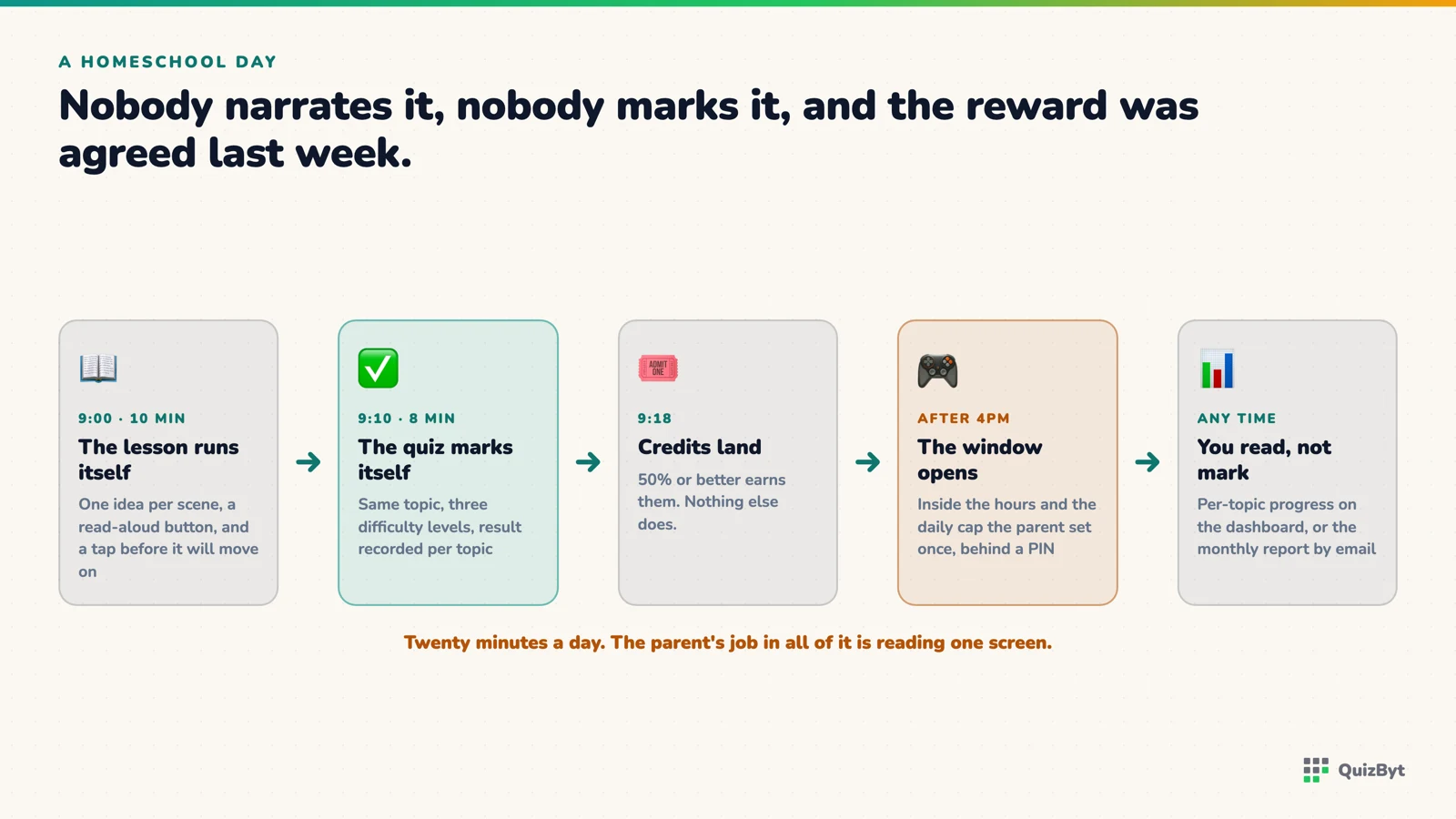
9:00, The lesson advances itself
The child opens today's topic. A lesson on QuizByt does not arrive as a page to be read; it advances one part at a time as the child scrolls (a definition, an example, a common misconception, a summary) and ends on a quiz about that same topic. In Class 1 to 5 many lessons have a read-aloud button on each part. The parent does not narrate it; the format does.
That is not a convenience feature. Presenting one idea at a time and then testing it is close to what the research on effective study techniques keeps finding works, practice testing and spaced, chunked material near the top, re-reading near the bottom.
9:15, The quiz marks itself
The lesson ends on its quiz. The child answers, presses finish, and the result is recorded per topic. No answers are shown mid-quiz; every correct answer and the reason behind it appears at the end. Fifty per cent or better earns credits. Below 80%, a retry is offered; the answer key opens at 80% or on the last attempt, so the retry is a real second try.
The parent has marked nothing. This is the hour that used to be the evening.
9:20, Twenty minutes was enough
One lesson and its quiz is roughly twenty minutes. Do it for a second subject if the child is willing; do not do it for six. The twenty-minute daily habit explains why the short daily version beats the long weekly one, and the same logic runs the whole day: the habit is the thing being built, and a habit that takes three hours does not survive a week.
Afternoon: Paper
Every topic has a printable worksheet. Handwriting at speed is still what exams test, and the kitchen table is where working-out happens. QuizByt is not trying to be the whole day, and a homeschool that is all screen has lost something.
4:00, The reward is already agreed
The credits earned this morning open games matched to the child's class. When those games can be played is not tonight's negotiation: the parent set a weekly schedule of windows and a daily cap in minutes once, behind a PIN, measured in the child's own timezone. Games on a schedule, not a nightly argument is the whole design. What the games are and why they are worth the credits is in why credits and games keep a homeschooled child coming back.
Evening: The parent reads, does not mark
The dashboard shows per-subject progress, every quiz with its score, and which topic is weak. If the child has been "doing Science" for a fortnight and the Science scores have not moved, that is visible. An opt-in monthly report emails the same summary, for the parent who would rather read once a month than log in daily. What the monthly report actually tells you covers what to look for.
What this day is not
It is not a school. It does not set a curriculum for you, does not tell you which topic is next, and does not replace the conversation at the table about why the answer was wrong. It does the timetable, the marking and the motivation, and it leaves the teaching (the part that needs a parent) to the parent. For a child with siblings at different stages, one account, three children is the next thing to read. For the full road from Kindergarten to O Level, see the student journey.
Questions parents ask
How much of the day does a child spend on QuizByt?
Around twenty minutes of lesson and quiz per subject is the habit we suggest. The rest of the day is still yours, books, paper, the kitchen table.
Does a parent need to teach the lesson?
No. A lesson advances one part at a time as the child scrolls, with a definition, an example, a common misconception and a summary, and ends on a quiz about the same topic. Many lessons in Class 1 to 5 have a read-aloud button, and quizzes for those classes read the question aloud.
How does a parent know what the child learned?
The dashboard shows per-subject progress, every quiz taken with its score, and which topics are weak. An opt-in monthly report emails the summary.
What if my child is not in a Pakistani school?
The catalogue follows Class 1–10, Matric and Cambridge O Level. A homeschooled child picks the class that matches their level, and the class can be changed.
Responses
Sign in to join the conversation. Responses are open to people with a QuizByt account, which is how we keep this a place you would let your child read.
Loading responses…
Lessons that talk, quizzes that mark themselves, games that make kids think
QuizByt is matched to your child's class. Classes 1–10 and Cambridge O Level. Every subject opens with a free lesson, quiz and worksheet, no account needed.
 From Chapter to Exam in an Afternoon: What AI Does and What the Teacher Still DoesA walk through one afternoon: chapter uploaded at two, draft at five past, twenty questions read and four rewritten by half past, exam assigned by three, results by four. Who did what.Read the article →
 Why Credits and Games Keep a Homeschooled Child Coming BackA homeschooled child has no classmates to keep up with and no bell to answer. The thing that brings them back to the desk tomorrow has to be built in. Here is what is built in, and the research behind it.Read the article →
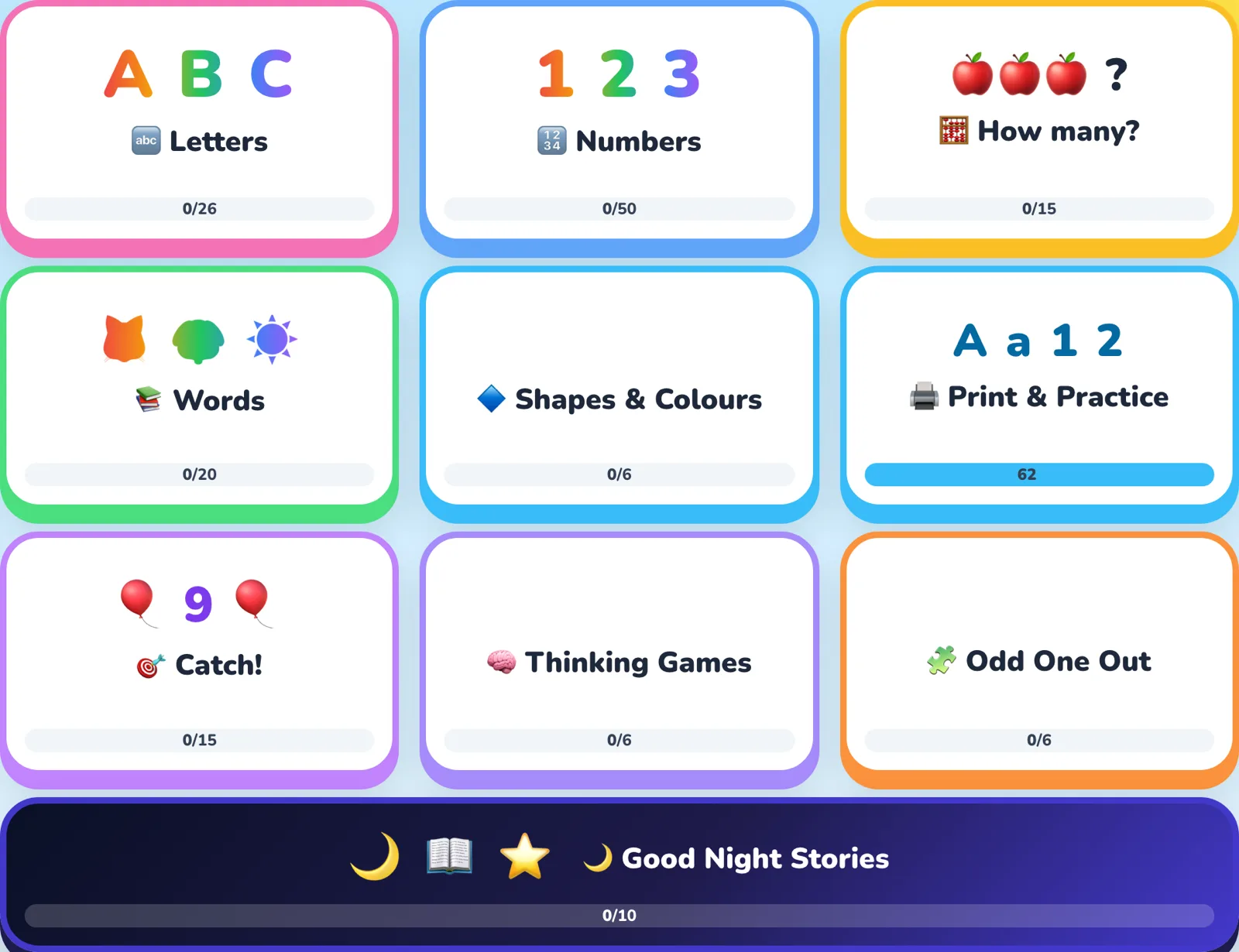 Kindergarten at Home: A Realistic Week for a Two to Six-Year-OldNot a curriculum. A week of ten-minute sessions that covers letters, numbers, shapes and thinking, designed around the attention span a small child actually has.Read the article →