
Why Credits and Games Keep a Homeschooled Child Coming Back
A homeschooled child has no classmates to keep up with and no bell to answer. The thing that brings them back to the desk tomorrow has to be built in. Here is what is built in, and the research behind it.

The short version
- A school child has classmates and a bell; a homeschooled child has neither, so the reason to sit down tomorrow has to be built into the work itself.
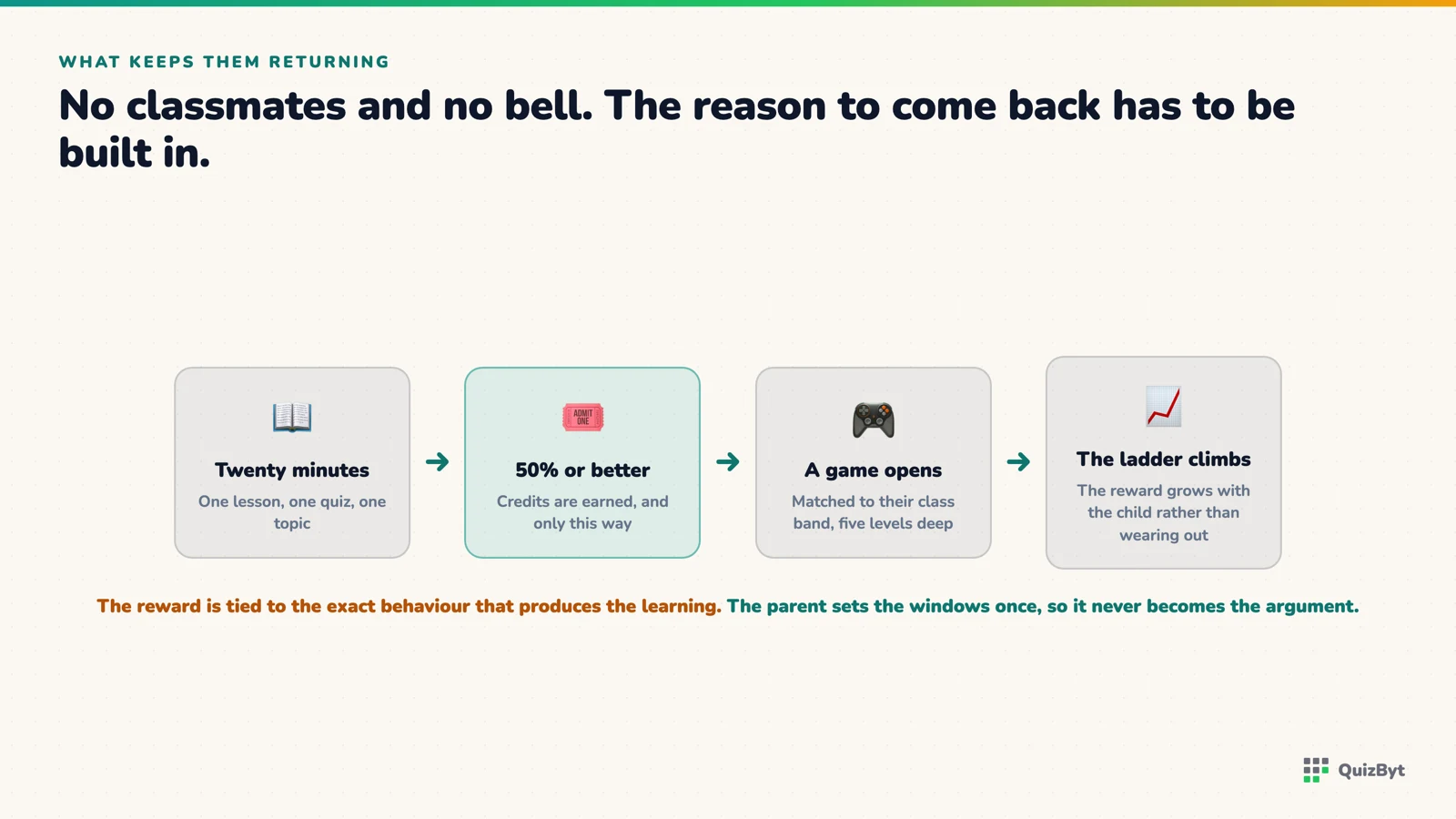
- Credits are earned only by passing quizzes, which ties the reward to the exact behaviour that produces learning.
- The games are matched to the child's class band and climb five levels each, so the reward grows with the child rather than wearing out.
- The parent sets the windows and the cap once, so the reward stays a reward and never becomes the day's argument.
A child in a school has thirty reasons to be at their desk that have nothing to do with the work: classmates, a bell, a teacher who notices, the plain social fact that everyone else is doing it. A homeschooled child has none of those. What brings them back to the desk tomorrow has to be built into the work itself, or it has to come from the parent, and the parent is already the timetable, the marker and the cook.
The reward is tied to the thing that works
Credits on QuizByt come from one place: scoring 50% or more on a quiz. Not from logging in, not from time spent, not from a purchase. That matters more for a homeschooled child than for anyone, because it makes the reward a measure of the one behaviour that produces learning. The testing effect (that retrieving something from memory strengthens it more than re-reading it) is among the most replicated findings in learning research, and the credit system is, underneath, a reason to take one more quiz. Practice testing goes through the evidence.
The reward grows with the child
A sticker chart wears out. The games do not, for two reasons.
First, the games a child sees are matched to their class (one band for Kindergarten and Class 1 to 5, one for Class 6 to 8, one for Class 9 upward) and the band changes as the child does. The games for a Class 3 child are word building and shape sorting with spoken instructions; the games for a Class 9 child are equation solving and logic grids. How the bands work is its own article.
Second, each game climbs five levels, opened one at a time by beating the one below, with the first two levels gentle enough to teach the rules. A game a child has "finished" has four more rungs, and beating the top one pays a bonus. Why Class 2 and O Level play the same game differently explains the design.
The unlock ladder is visible
A child can see exactly what they need: one to ten credits opens the first game in each section, eleven opens the second, twenty-six the third, fifty-one everything. A locked game says "Reach 11 credits to unlock". For a child working alone, a visible goal is worth more than a surprise. It turns "do your quiz" into "two more passes and Box Push opens". The unlock ladder explained has the numbers.
The parent sets the terms once
None of this works if games become the day's argument. So the parent sets, once and behind a PIN, whether games are on at all, a weekly schedule of windows and a daily cap in minutes, measured in the child's own timezone, so a cap set at home still holds on holiday in another time zone. The child knows the window; the parent is not the referee. Games on a schedule covers the setup.
And some of it is free, always
Each band has games that never need credits, and three daily games (two for the morning, one to settle down in the evening) are open to everyone. A child on a bad week with no credits is not looking at padlocks. They are looking at something to play and a clear reason to earn the rest.
What this replaces
Not the parent's interest, and not the conversation about why the answer was wrong. It replaces the bell. A homeschooled child needs a reason to sit down that is not their mother asking for the fourth time, and a reward that is tied to passing quizzes, grows with them, and runs on a schedule they can see is that reason. The whole day it sits inside is in a day that runs itself.
Questions parents ask
Why do homeschooled children lose motivation?
Often because the external structure of school (classmates, a timetable, a teacher noticing) is gone, and nothing was put in its place. The fix is structure built into the work, not more pressure from a parent.
Are the games educational or a distraction?
They are built on the same material (times tables, vocabulary, sequence, spatial reasoning, deduction) and matched to the child's class. They are the reward for quizzes, not a substitute for them.
Can a child play without doing quizzes?
A few games are free in every band and three daily games are open to everyone. Everything else needs credits, and credits come only from passing quizzes.
What stops games taking over the day?
The parent. Games run only in the weekly windows and daily cap set on the parental controls page, behind a PIN.
Responses
Sign in to join the conversation. Responses are open to people with a QuizByt account, which is how we keep this a place you would let your child read.
Loading responses…
Lessons that talk, quizzes that mark themselves, games that make kids think
QuizByt is matched to your child's class. Classes 1–10 and Cambridge O Level. Every subject opens with a free lesson, quiz and worksheet, no account needed.
 Homeschooling With QuizByt: A Day That Runs ItselfThe hardest part of homeschooling is not the teaching, it is being the timetable, the marker and the motivator at once. Here is a day where the lesson advances itself, the quiz marks itself and the reward is already agreed.Read the article →
 One Account, Three Children: Homeschooling Siblings at Different StagesA Kindergartener, a Class 4 child and a Class 9 student in one house need three completely different mornings. How one yearly plan carries all three, each with their own class, dashboard and PIN, and siblings at half price.Read the article →
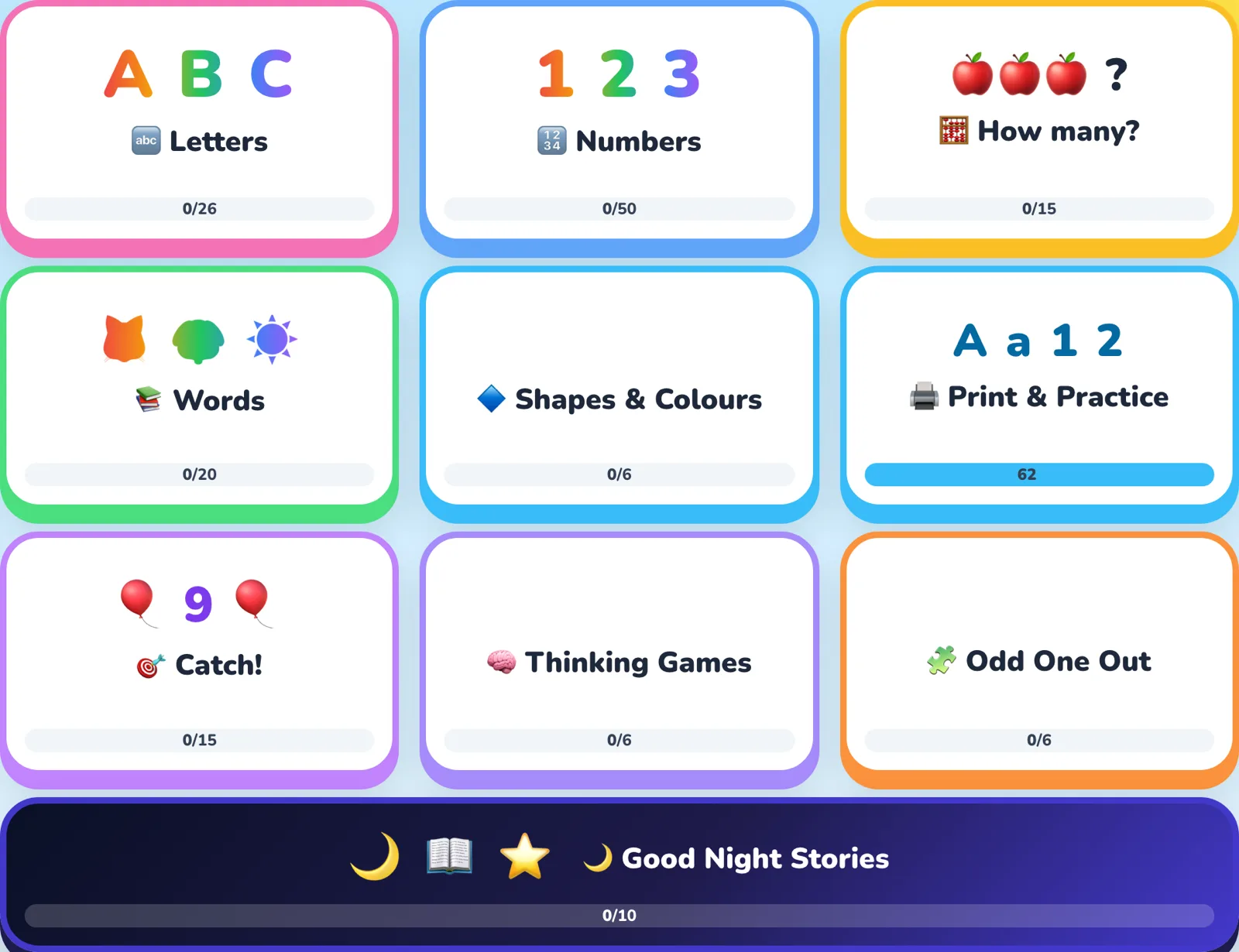 Kindergarten at Home: A Realistic Week for a Two to Six-Year-OldNot a curriculum. A week of ten-minute sessions that covers letters, numbers, shapes and thinking, designed around the attention span a small child actually has.Read the article →