
One Account, Three Children: Homeschooling Siblings at Different Stages
A Kindergartener, a Class 4 child and a Class 9 student in one house need three completely different mornings. How one yearly plan carries all three, each with their own class, dashboard and PIN, and siblings at half price.
The short version
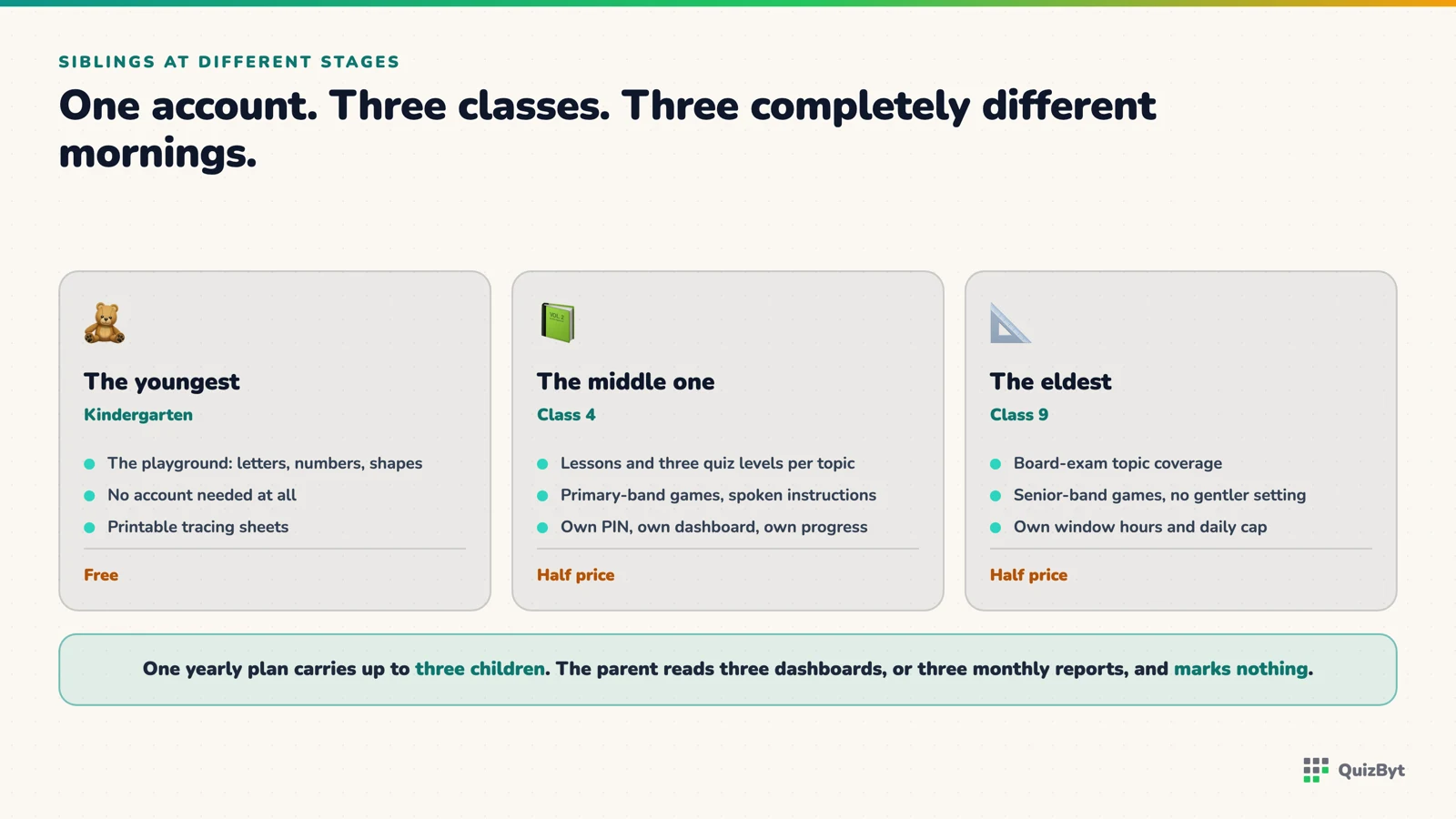
- A yearly plan carries up to three children, each with their own class, dashboard, progress and PIN; the second and third are half price.
- The youngest gets the Kindergarten playground, free and without an account, while the older two get lessons and quizzes for their own class.
- Each child's games are matched to their own class band and each has their own parental-control windows and cap.
- The parent reads three dashboards, or three monthly reports, and marks nothing.
Three children homeschooled in one house are three different mornings. A five-year-old is learning to trace the letter a. A nine-year-old is learning what a fraction is. A fourteen-year-old is six months from a board exam. One curriculum does not fit them, one timetable does not fit them, and one parent has to run all three. Here is how one account does.
Three children, three classes, one plan
A yearly plan carries up to three children. Each is added with their own name, their own class and their own PIN, and each gets their own dashboard: their own lessons, their own quizzes, their own progress, their own credit balance. The second and third children are half price. Nothing is shared between them except the parent's login, and the parent is the only one who sees all three. The pricing is on the yearly plan page.
The five-year-old
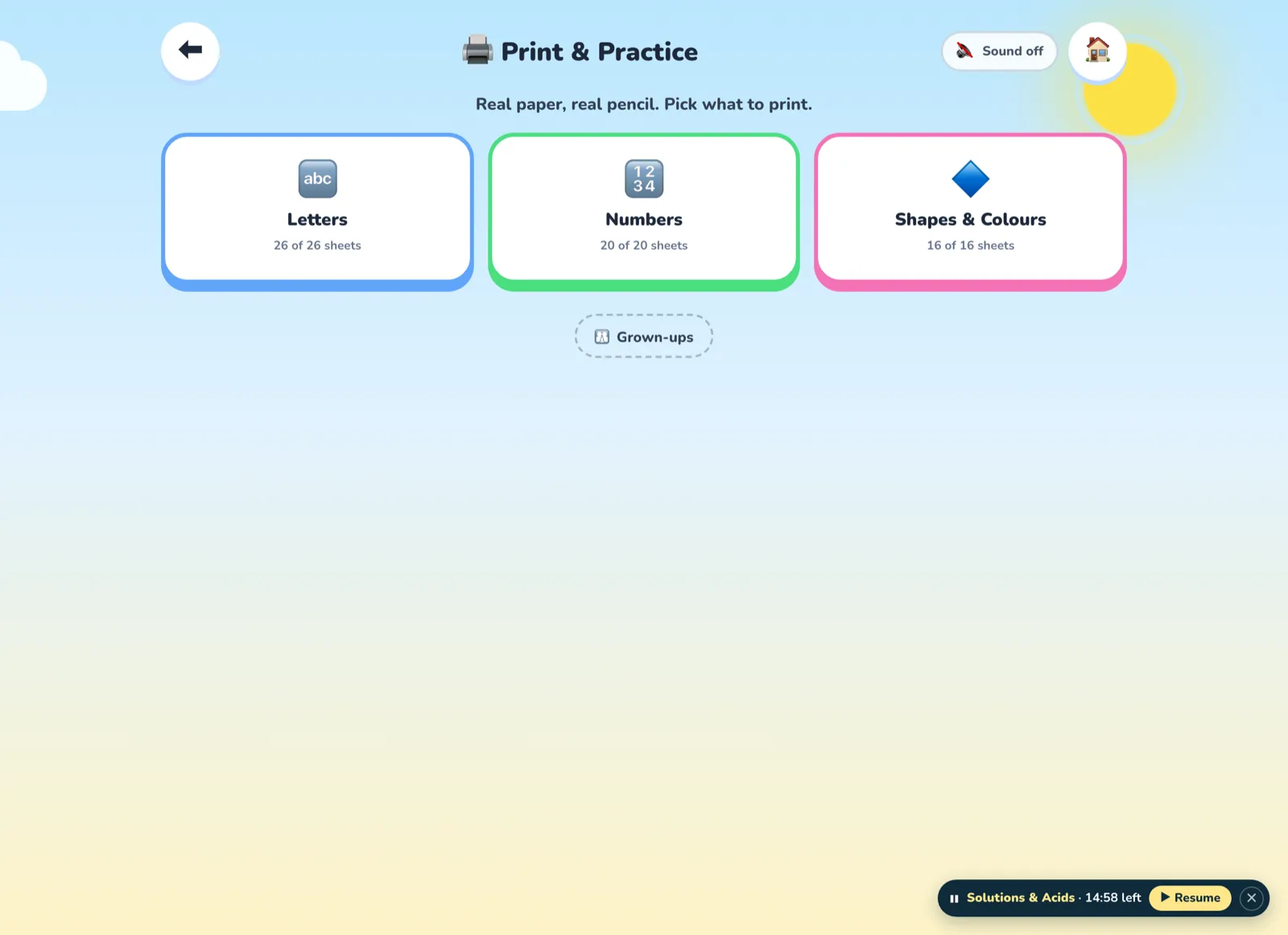
Does not need an account yet. The Kindergarten playground is free and works signed out: letter and number tracing drawn from the stroke forms schools teach, counting, first words, shapes and colours, and two logic games. The voice is off until a grown-up turns it on. Kindergarten at home, week by week is the plan for this child, and they join the family account when they move to Class 1.
The nine-year-old
Class 4. Their morning is a lesson that advances one idea at a time and ends on a quiz, marked instantly, with credits at 50% and a retry below 80%. Their games are the primary band (word building, memory, block building, mazes) with spoken instructions and gentle first levels. Their dashboard shows which of their subjects is behind. Classes 4 to 8, when marks start to mean something is the article for this stage.
The fourteen-year-old
Class 9. Same engine, harder use: quizzes at three levels with the skilled level on a seven-minute timer, an answer review with the reason behind every correct answer, and a games band of equation solvers and logic grids. Their retry rule comes from the plan (two attempts on yearly) and their dashboard is the one to watch for the weak topic hiding inside a good average.
Three sets of rules, one PIN
Parental controls are per child. The nine-year-old's games might run four to five on weekdays with a forty-five-minute cap; the fourteen-year-old's might run after seven with an hour. Both are set once, behind the parent's PIN, and measured in the child's own timezone. Neither child can change the other's. Games on a schedule covers the setup, and why credits and games keep a homeschooled child coming back covers why the setup is worth doing.
What the parent does
Reads. Three dashboards in the evening, or (for the parent who would rather not log in daily) three opt-in monthly reports by email. Marks nothing, because the quizzes marked themselves. Teaches the parts that need teaching, which the dashboards point at: the Class 4 child's fractions, the Class 9 child's one weak topic. Prints a worksheet for the kitchen table when the screen has had its twenty minutes.
The shape of each child's day is in a day that runs itself; the whole road they are on, from the first letter to the first exam, is the student journey.
Questions parents ask
How many children can be on one plan?
Up to three on the yearly plan. Each has their own class, dashboard and PIN. The second and third children are half price.
Can children be in different classes?
Yes. That is what it is for. A Kindergartener, a Class 4 child and a Class 9 student each pick their own class, see their own lessons and quizzes, and their own games band.
Does a Kindergartener need a paid account?
No. The Kindergarten playground is free and works without an account. A child that age can be added to the family plan later when they move to Class 1.
Can a parent set different game limits for each child?
Yes. Parental controls (games on or off, weekly windows, daily cap) are per child, behind the parent's PIN.
Responses
Sign in to join the conversation. Responses are open to people with a QuizByt account, which is how we keep this a place you would let your child read.
Loading responses…
Lessons that talk, quizzes that mark themselves, games that make kids think
QuizByt is matched to your child's class. Classes 1–10 and Cambridge O Level. Every subject opens with a free lesson, quiz and worksheet, no account needed.
 Why Credits and Games Keep a Homeschooled Child Coming BackA homeschooled child has no classmates to keep up with and no bell to answer. The thing that brings them back to the desk tomorrow has to be built in. Here is what is built in, and the research behind it.Read the article →
 What to Look For in a Learning App for a Five-Year-OldMost apps for this age are built to be opened again, not to teach. The difference is visible in about two minutes if you know where to look. Seven things to check, and the reason behind each one.Read the article →
 Printable Tracing Worksheets: How to Use Them So They Actually WorkA worksheet is a tool, not a lesson. Handed over with a pencil it teaches very little; used for four minutes in the right way it is the most valuable part of the day.Read the article →