
Printable Tracing Worksheets: How to Use Them So They Actually Work
A worksheet is a tool, not a lesson. Handed over with a pencil it teaches very little; used for four minutes in the right way it is the most valuable part of the day.
The short version
- Four or five attempts at one letter beats a full page, a tired hand practises the wrong shape.
- Show the stroke order before the child starts; a worksheet shows the destination, not the journey.
- Mark the best attempt, not the mistakes: circle one good letter and stop.
- If a child cannot hold a pencil yet, build hand strength first, dough, tongs, tearing, threading.
A printable tracing sheet is genuinely one of the most useful things you can put in front of a four-year-old. It is also routinely wasted, because the default way to use one is to hand it over with a pencil and go and do something else.
Here is how to get the value out of four minutes of it.
Show the stroke order before they start
This is the step almost everyone skips, and it is the most important one.
A worksheet shows a child what the letter looks like. It does not show what their hand has to do. Left alone, a large proportion of children will draw a perfectly acceptable-looking "a" by starting at the bottom and going up, or draw an "o" clockwise. It looks right on the page and it is a habit that becomes painful to correct at seven.
So: write it once yourself, slowly, while they watch, and say the movement out loud. "Round… and down." Then let them go. Ten seconds of demonstration changes what the next four minutes teaches.
This is also why the arrows matter. Our own printable sheets are generated from the same stroke data as the on-screen tracing, so the start point and direction are marked on paper too, and the letter shapes are the ones schools teach, not the font forms most worksheets inherit. There is more on that in why the "a" in most apps is the wrong shape.
Four attempts, not forty
Resist the full page. Genuinely.
Fine motor control at four is fragile and tires fast. The first four letters on a page are usually the child's best work; by the twentieth the hand is tired, the grip has collapsed and they are practising a worse version of the letter than they started with. Practice makes permanent, not perfect, and a tired hand is rehearsing the wrong movement.
Four or five good attempts, then stop, even if there is space left. The blank space is not waste.
Mark the best one, not the mistakes
When they finish, circle one attempt (the best one) and say exactly what is good about it. "This one. Look how straight that line is."
Two reasons. First, a child cannot act on "some of these are wrong" but can absolutely act on "make it like that one." Second, at four, criticism of your own handwriting is criticism of you. A page returned with three crossings-out teaches a child that writing is where they fail.
If something genuinely needs fixing, fix one thing, and only after the praise.
Tracing is not the same as writing
Worth being clear about, because it changes how you use the sheet.
Following a dotted line is a guided motor task. Producing the letter from memory on blank paper is a generative one, and they are not interchangeable, research on early letter learning has generally treated tracing, free writing and typing as distinct activities rather than as one skill, and the strongest findings tend to be about production rather than tracing.
The practical consequence: every sheet should end with at least one letter written without a guide. Most good worksheets are built this way, a row to trace, then a row of empty boxes. The empty boxes are the point of the sheet, not the leftover space.
If the pencil itself is the problem
If your child cannot yet grip a pencil comfortably, worksheets are the wrong tool this month. Build the hand first:
- Play dough: squeezing, rolling, pinching, hiding beads in it to dig out.
- Tearing paper into strips.
- Threading beads or pasta.
- Tongs or tweezers to move pompoms between bowls.
- Spray bottles: excellent for the precise muscles a pencil grip uses.
- Drawing with one finger in a tray of flour, salt or sand.
Meanwhile the letter knowledge can carry on happily on a screen, where the grip problem does not exist. Finger tracing teaches direction and order perfectly well; the pencil comes later. That division of labour is covered in screen tracing versus pencil on paper.
What a good sheet contains
- The letter in the form the child's school teaches. Check the "a" and "g".
- A visible start point and direction arrow for each stroke.
- A few guided repetitions, not a wall of them.
- At least one unguided attempt.
- Something that is not tracing (a find-and-circle strip, or a picture that starts with the letter) so the sheet is not four minutes of one motor task.
- Lines the right size. Small children need big.
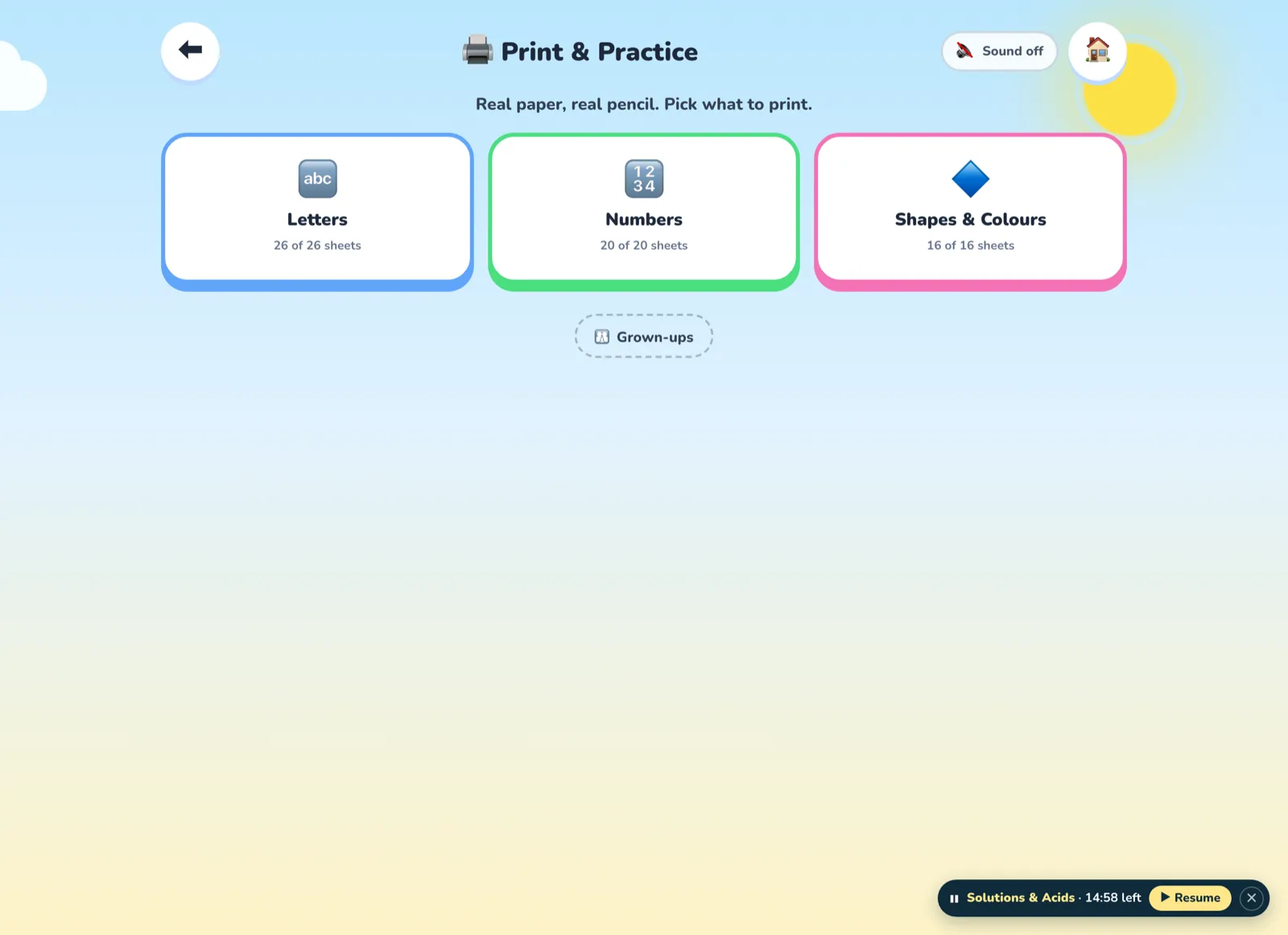
QuizByt's sheets follow that shape for all 26 letters, the numbers 1–20, and eight shapes and eight colours, organised at letters, numbers and shapes and colours. A few of each are free to download without an account.
Questions parents ask
How many times should a child trace a letter?
Four or five good attempts at one letter, then stop. A full page of forty tends to end with the last thirty being worse than the first ten.
Should I correct my child's letters?
Correct one thing at a time, and always after praising a specific good attempt. "This one is lovely, the line is nice and straight" achieves more than pointing at four wrong ones.
At what age can a child start tracing worksheets?
Usually around three and a half to four, but grip readiness varies a lot. If holding the pencil is the hard part, work on hand strength first and trace with a finger in sand or on a screen.
Are tracing worksheets enough to teach handwriting?
They are one part. Children also need to form letters freely without a guide, because tracing and writing are not the same motor task.
Responses
Sign in to join the conversation. Responses are open to people with a QuizByt account, which is how we keep this a place you would let your child read.
Loading responses…
Lessons that talk, quizzes that mark themselves, games that make kids think
QuizByt is matched to your child's class. Classes 1–10 and Cambridge O Level. Every subject opens with a free lesson, quiz and worksheet, no account needed.
 Kindergarten at Home: A Realistic Week for a Two to Six-Year-OldNot a curriculum. A week of ten-minute sessions that covers letters, numbers, shapes and thinking, designed around the attention span a small child actually has.Read the article →
 Letter Names or Letter Sounds: Which Should a Child Learn First?A child who knows that letter is called "em" still cannot read "mat". A child who knows it says /m/ can. The distinction sounds academic until you watch a five-year-old get stuck on it.Read the article →
 One Account, Three Children: Homeschooling Siblings at Different StagesA Kindergartener, a Class 4 child and a Class 9 student in one house need three completely different mornings. How one yearly plan carries all three, each with their own class, dashboard and PIN, and siblings at half price.Read the article →