
Online Schooling Is More Than Online Classes
A Zoom call moves the classroom online. It does not move the practice, the checking or the homework. Here is what the research says children need between live classes, and how lessons, quick quizzes, printable worksheets and games fill that gap.
The short version
- A live class is the explaining part of school. Most learning happens afterwards, when a child tries to use what was explained.
- Active learning and practice testing are among the best-supported findings in education research; watching and re-reading are among the weakest.
- Long video calls are tiring in ways a classroom is not, so the screen time is better spent on short, active work between calls.
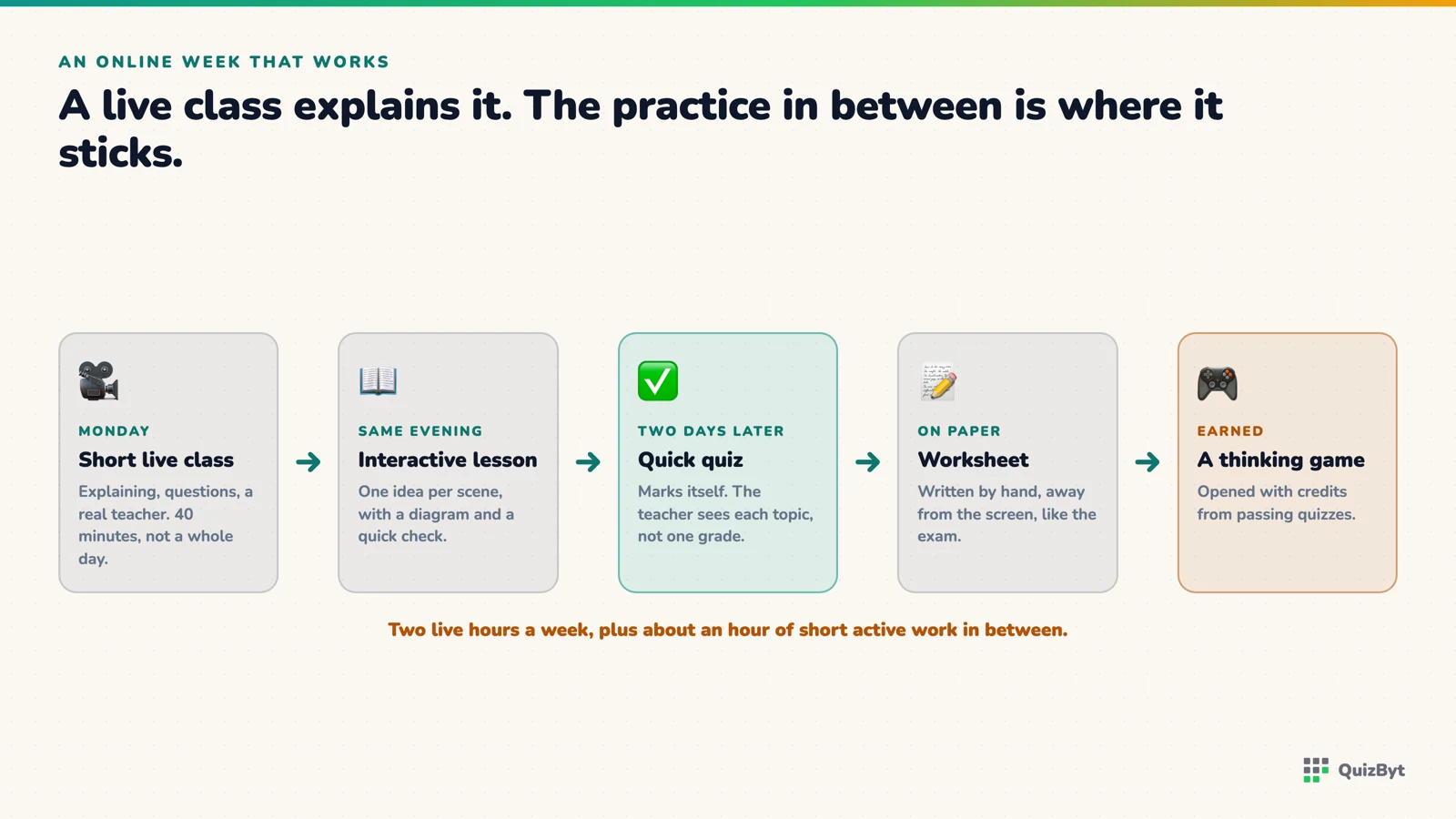
- A working online week mixes four things: a short live class, an interactive lesson to revisit, a quick quiz that marks itself, and a worksheet on paper.
When schools closed in 2020, most of the world did the obvious thing: it put the timetable on a video call. Teachers taught to a grid of faces, children watched from kitchen tables, and for a few weeks it felt like school had been saved. Then the results came in. The World Bank and UNESCO estimate that the share of ten-year-olds in low- and middle-income countries who cannot read and understand a simple text rose from 57% before the pandemic to about 70% afterwards (State of Global Learning Poverty, 2022).
There were many causes, from no internet at all to no device at home. But even where the video call worked perfectly, something was missing. This article is about that missing part, and why we built QuizByt around it.
What a live class does, and what it cannot do
A live class is very good at explaining. A teacher can show a method, take a question, notice a confused face and try again. Nothing on a screen replaces that, and we are not arguing that it should.
What a live class cannot do is the learning that comes after the explaining. A child understands long division while the teacher does it on the board. Whether they can do it alone, two days later, with nobody watching, is a different question, and it is the one the exam asks. In a physical school that gap is filled by classwork, homework, a quick test on Friday and a teacher walking between desks. Put only the explaining online and all of that disappears.
What the research says actually works
Two findings come up again and again in learning research, and both are about what the child does, not what the teacher shows.
- Active learning beats listening. A large review of 225 studies by Freeman and colleagues found that students in courses with active learning scored higher on exams, and students in lecture-only courses were 1.5 times more likely to fail (PNAS, 2014). That study was about university science, but the direction of the finding matches decades of school research.
- Testing yourself beats reading again. In Roediger and Karpicke's well-known experiment, students who re-read a passage did better on a test five minutes later, but students who were tested on it remembered much more after two days and after a week (Psychological Science, 2006). A major review of study techniques rated practice testing and spacing it out over time as the two most useful, and re-reading and highlighting near the bottom (Dunlosky et al., 2013).
The Learning Scientists, a group of cognitive psychologists who write for teachers, sum this up as six strategies for effective learning, with retrieval practice and spacing at the top. As retrievalpractice.org puts it, retrieval practice is a learning strategy, not an assessment strategy. A quiz tells you what a child knows, and taking it is also one of the ways they come to know it.
Why more video is not the answer
If the gap is practice, it is tempting to fill it with more live time. The trouble is that video calls are tiring in their own way. Stanford's Jeremy Bailenson proposed four reasons people find long calls draining: constant close-up eye contact, the extra effort of reading people through a screen, seeing your own face all day, and sitting still in one spot (Technology, Mind, and Behavior, 2021; Stanford News summary). He is careful to say these are explanations still being tested, but any parent who watched a nine-year-old through a full day of calls will recognise them.
So the better plan is shorter calls, and short, active work in between that a child can do at their own pace.
The four things an online week needs
1. A short live class
For explaining, questions and contact with a real teacher. On QuizByt a school or tutor schedules these from the class page: pick the subject, the time, and whether it is for the whole class or a few students. QuizByt creates the Zoom meeting, emails the students, and shows the class on the student's dashboard with a "Join now" button that opens fifteen minutes before. It also keeps a ten-minute break between back-to-back classes for the same class or teacher, because nobody learns well in the third hour without a pause.
2. An interactive lesson to come back to
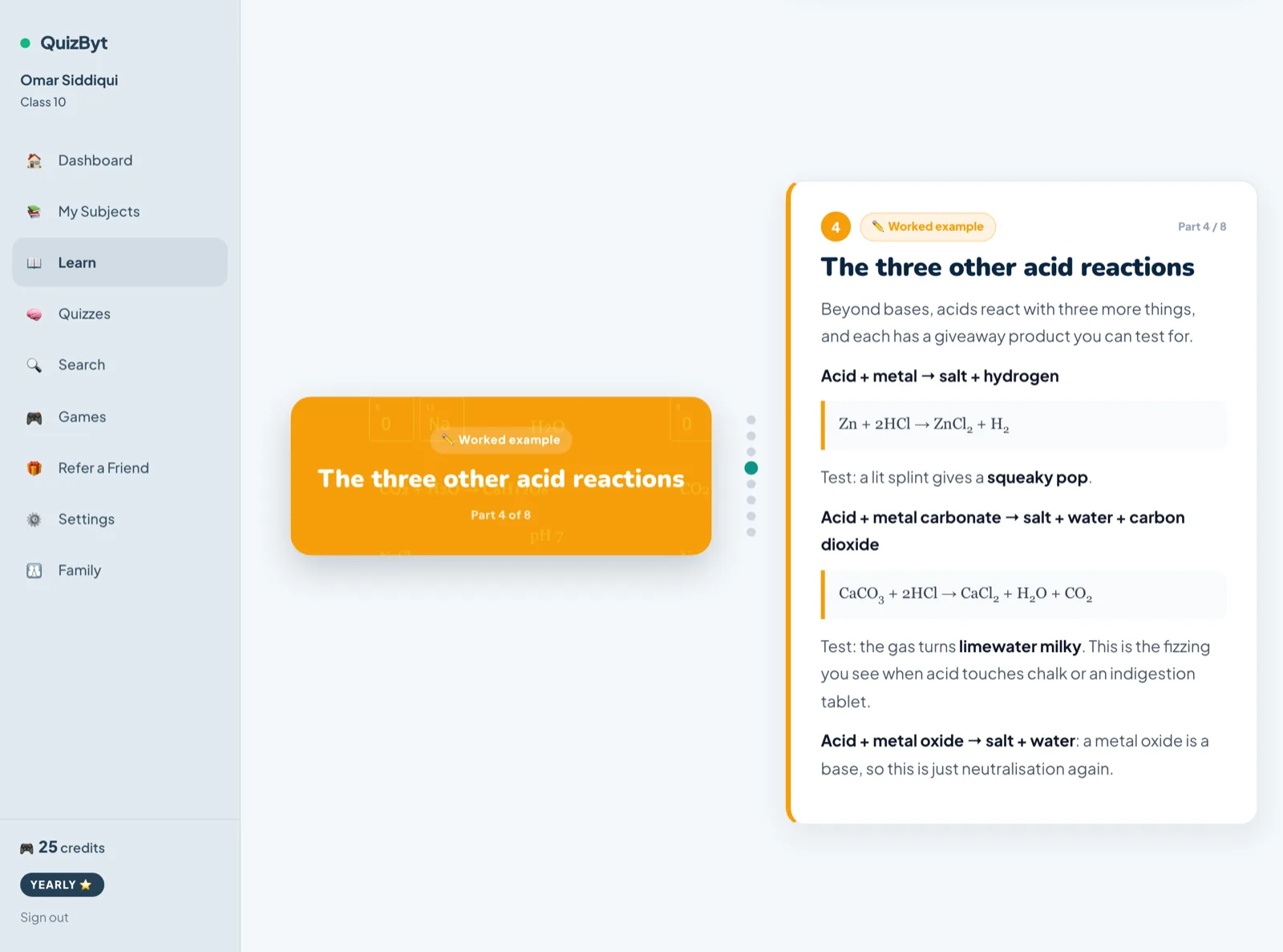
A recording of a call is a poor thing to revise from. Nobody re-watches forty minutes to find the two that mattered. A QuizByt lesson is a set of short scenes, one idea each, with a drawn diagram and, in many of them, a quick tap-to-answer check before the next scene. It is the explanation again, in a form a child can move through at their own speed the night before a test. Research on multimedia learning explains why the size of each step matters: working memory is small, and words with a well-chosen picture, one idea at a time, ask less of it (Mayer and Moreno, 2003). We wrote more about the format in scrolling lessons instead of slide decks.
3. A quick quiz that marks itself
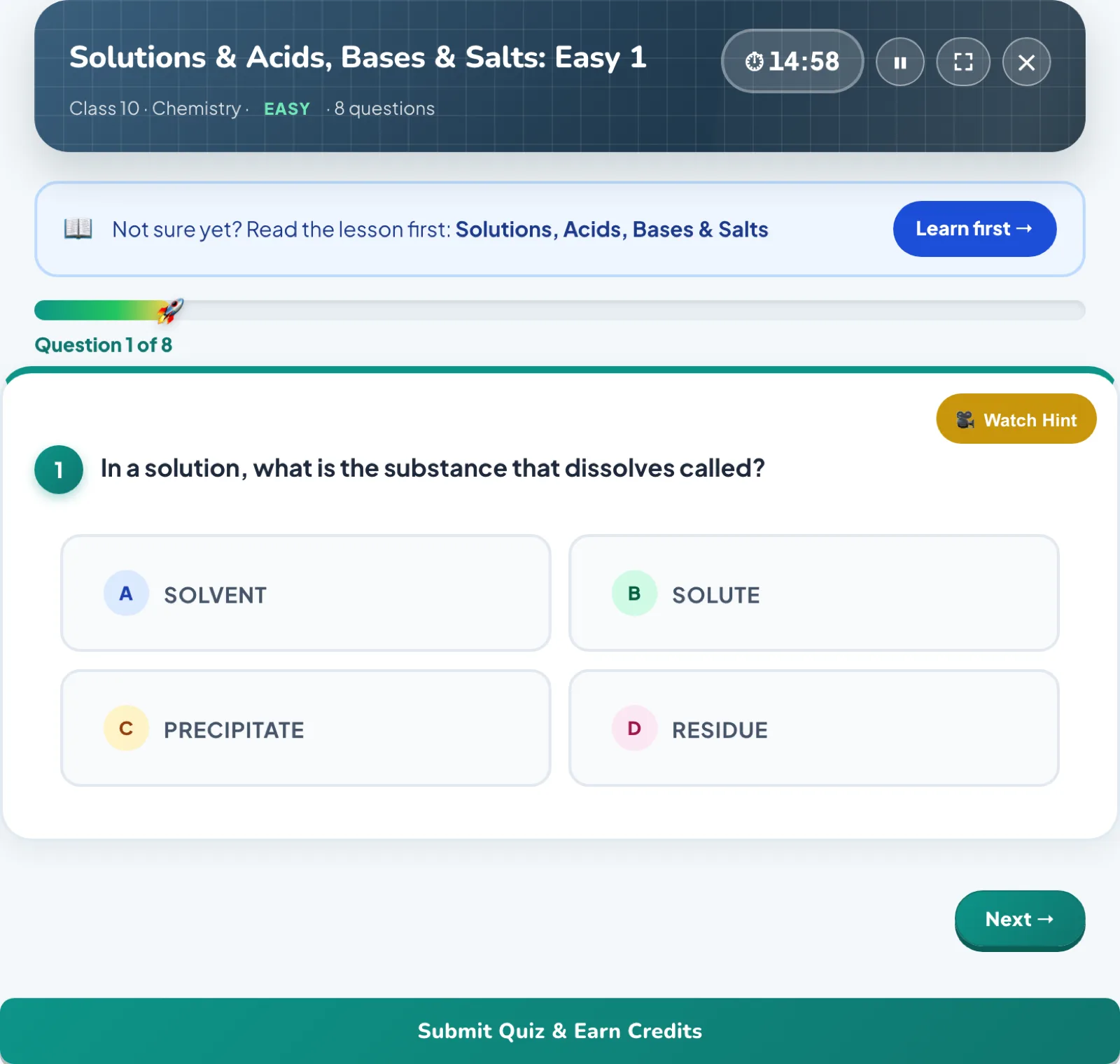
This is the retrieval practice. Every topic has quizzes at three levels (easy, medium and skilled), and they are not all four-option questions. Children put tiles in order, fill several blanks in a sentence, sort items into groups, match pairs, pick every right answer, or listen to a question read aloud. The quiz marks itself when the child finishes, so the teacher sees the result the same day instead of a pile of homework on Monday. The evidence behind this is in why a quiz beats reading the chapter again.
4. A worksheet on paper
Exams are still written by hand, and writing an answer is a different skill from tapping one. Each topic has a printable PDF worksheet, so some of the practice happens away from the screen altogether. It is also the easiest thing for a parent to check at the kitchen table.
Where games fit
Games are the part people are most suspicious of, and fairly so. The research is encouraging but modest. A review of digital games for learning found they beat non-game teaching on average, and that good design mattered more than simply being a game (Clark, Tanner-Smith and Killingsworth, 2016). A review of gamification found small positive effects on learning and motivation (Sailer and Homner, 2020). Edutopia teachers report the same in their classrooms: game-based review gets children processing material they would otherwise skim.
On QuizByt the games are thinking games (logic, number, word and memory puzzles) chosen by age, and most of them are opened by credits. A child earns credits by scoring 50% or more on a quiz, so the way to more games is always another quiz. So the game becomes a reason to practise, and never a way to avoid it. Parents can switch games off, cap play time and set hours behind a PIN. The details are in how credits decide which game opens next.
What a week can look like
For a Class 5 child learning fractions at home:
- Monday: a 40-minute live class on equivalent fractions. That evening, the lesson on the same topic, ten minutes.
- Tuesday: the easy quiz, then the worksheet on paper.
- Wednesday: a live class on adding fractions. The medium quiz on Monday's topic, two days later, because spacing is what makes it stick.
- Thursday: the lesson on adding fractions, its easy quiz, and a game earned with the credits.
- Friday: the skilled quiz on equivalent fractions. The teacher sees who is still stuck before next week's class.
Two live hours, and around an hour of short active work in between. That is less screen time than a timetable of calls, and far more practice.
References
- World Bank, UNESCO, UNICEF and partners (2022). The State of Global Learning Poverty: 2022 Update.
- Freeman, S. et al. (2014). Active learning increases student performance in science, engineering, and mathematics. PNAS.
- Roediger, H. L. and Karpicke, J. D. (2006). Test-enhanced learning. Psychological Science.
- Dunlosky, J. et al. (2013). Improving students' learning with effective learning techniques. Psychological Science in the Public Interest.
- The Learning Scientists (2016). Six strategies for effective learning.
- Agarwal, P. K. Why retrieval practice works. retrievalpractice.org.
- Bailenson, J. N. (2021). Nonverbal overload: a theoretical argument for the causes of Zoom fatigue. Technology, Mind, and Behavior.
- Mayer, R. E. and Moreno, R. (2003). Nine ways to reduce cognitive load in multimedia learning. Educational Psychologist.
- Clark, D. B., Tanner-Smith, E. E. and Killingsworth, S. S. (2016). Digital games, design, and learning. Review of Educational Research.
- Sailer, M. and Homner, L. (2020). The gamification of learning: a meta-analysis. Educational Psychology Review.
- Kuykendall, M. (2023). Game-based review sessions are fun and effective. Edutopia.
Questions parents ask
Are live online classes a bad idea?
No. A teacher explaining, answering questions and reading the room is valuable and hard to replace. The problem is a timetable that is only live classes, with nothing active in between.
How long should an online class be for a primary child?
Shorter than a school period. Many online schools run lessons of around 40 minutes, and younger children do better with less. The rest of the learning time works better as short practice.
Why print worksheets when everything is online?
Writing by hand is a different skill from tapping an answer, exams are still on paper, and a child working on paper is not looking at a screen. A good online week includes some of it.
Do learning games actually help?
Reviews of the research find a modest positive effect, and design matters more than the fact it is a game. Games work best as practice and as a reward for doing the real work, not as a replacement for it.
Responses
Sign in to join the conversation. Responses are open to people with a QuizByt account, which is how we keep this a place you would let your child read.
Loading responses…
Lessons that talk, quizzes that mark themselves, games that make kids think
QuizByt is matched to your child's class. Classes 1–10 and Cambridge O Level. Every subject opens with a free lesson, quiz and worksheet, no account needed.
 Agentic AI and the Syllabus Problem: Comparing Cambridge, Edexcel, Oxford AQA and a National BoardFour boards teach the same mathematics in four different orders, under four different names, split across four different years. Mapping that by hand takes weeks. Here is what an agent does well, where it quietly invents things, and how we kept it honest.Read the article →
 Top 5 Online Schools With Live Zoom Classes, and How QuizByt Is DifferentOutschool, K12, Connections Academy, King's InterHigh and Vedantu all teach children live over video. We read what each one offers, compared them with the quiz tools teachers use alongside, and set out plainly where QuizByt fits and where it does not.Read the article →
 Build Your Own Question Bank, Import Ours, or Draft With AIThree routes to a school question bank, and they are not alternatives. Most schools end up using all three, for different parts of the syllabus.Read the article →